The Resume-LinkedIn Disconnect: Why They Shouldn't Be Identical
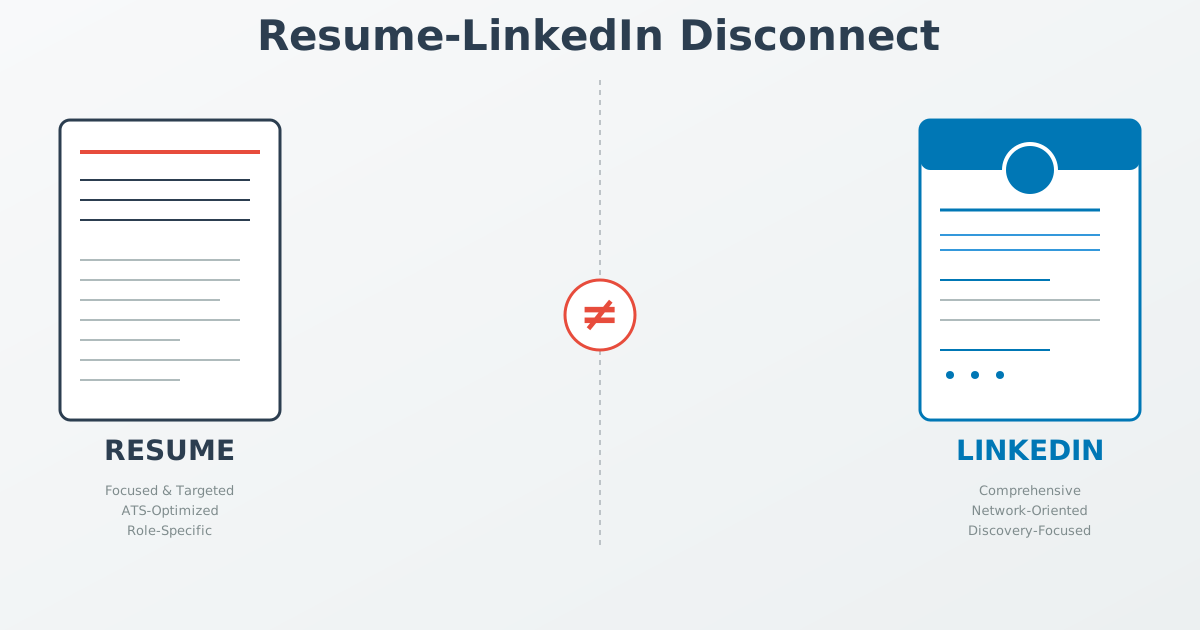
Stop treating your resume and LinkedIn profile like mirror images. They serve entirely different purposes, optimize for different audiences, and get evaluated by fundamentally different systems. Copying content verbatim from one to the other is a strategic mistake that costs you opportunities.
This disconnect isn't a problem to solve by harmonizing both platforms. It's an advantage to leverage.
The Two Audiences Problem
Your resume and LinkedIn profile reach different people through different gates. Understanding these gates is the foundation of strategic differentiation.
When a hiring manager opens your resume, they're asking: "Can this person do the job I need filled, right now?" They scan for proof of direct experience, specific technical skills, and measurable impact. They spend 6-7 seconds on an initial pass [1]. Their context is narrow and action-oriented.
LinkedIn serves a completely different funnel. Recruiters use it to prospect. Peers use it to evaluate your expertise. Potential collaborators decide if you're someone worth knowing. You're being assessed not just on current fit, but on growth potential, visibility, and professional network quality [2]. Someone might follow you today and contact you in 18 months when a role aligns perfectly.
Your resume optimizes for relevance to a specific job opening. LinkedIn optimizes for discoverability, trust-building, and long-term positioning. These aren't compatible goals when expressed through identical language and emphasis.
 Resume and LinkedIn serve different goals and should not be treated as mirrored documents.
The ATS Filter vs. The Algorithm
Resumes enter a different technical gauntlet than LinkedIn profiles. Most corporate hiring funnels still route resumes through Applicant Tracking Systems (ATS) before any human sees them [3]. These systems parse documents to extract keywords, detect required skills, and calculate relevance scores.
ATS systems are notoriously literal. They struggle with:
- Unconventional formatting (tables, graphics, unusual fonts)
- Synonyms and industry jargon variation
- Role titles that don't match job description language
- Soft skills expressed in abstract ways
If your resume says you're experienced with "cloud infrastructure automation" but the job description specifically requires "Infrastructure as Code (IaC) tools," you may be filtered out before a human reads your application.
LinkedIn, by contrast, uses recommendation algorithms and search indexing designed for discoverability, not elimination. LinkedIn's algorithm cares about keyword density, but it's far more forgiving of variation [4]. You can talk about "infrastructure automation," "cloud DevOps," and "infrastructure code" across your LinkedIn experience sections, and LinkedIn's semantic understanding will surface your profile for searches related to all three.
 Resume formatting is constrained by ATS parsing, while LinkedIn format is optimized for platform readability and discovery.
The Depth vs. Breadth Trade-off
A resume is constrained. Best practice keeps it to one page for early career, two pages maximum for experienced professionals. You have roughly 250-400 words of space to tell your story.
That constraint forces prioritization. Every word must serve the specific role you're applying for. You emphasize the most relevant projects. You highlight the technical stack the job needs. You suppress accomplishments that don't connect to the opening.
LinkedIn has no enforced constraint. Your experience section can detail every role, project, and achievement. You can include a comprehensive skills endorsement section. You can showcase your full publication history, speaking engagements, and certifications [5]. You can maintain a detailed "About" section that explains your philosophy, interests, and long-term vision.
This isn't a disadvantage. It's a feature. On LinkedIn, breadth of accomplishment signals authority and growth. Someone with seven internships, two startup exits, open-source contributions, and a published research paper looks more impressive on LinkedIn than someone whose resume lists only the three most relevant positions.
Trying to fit your entire LinkedIn profile into a resume defeats both documents. Trying to keep your resume's narrow focus on LinkedIn makes you look less accomplished than you are.
The Keyword Density Paradox
Keyword optimization is essential for both platforms, but the tactics diverge sharply.
Resumes need keyword density to survive ATS screening. Research suggests that matching 50-75% of job description keywords significantly improves ATS match scores [6]. A job description that lists "React, TypeScript, AWS, Docker, CI/CD pipelines" should appear in your resume in similar form. If the job says "containerization" and you say "Docker," that's still a win. But if the job says "API design" and you say "REST service development," the system might not connect them.
This drives some resume content toward literal keyword matching, sometimes at the expense of natural language. You want high keyword density without looking like keyword stuffing.
LinkedIn operates differently. Keyword optimization still matters for search and discoverability, but there's a higher tolerance for variation and narrative flow. Your LinkedIn headline might say "Full-Stack Engineer | React & AWS Specialist | Cloud Architecture." But in your experience section, you can write more natural descriptions: "Architected real-time systems using React for the frontend and deployed serverless functions on AWS Lambda." The semantic understanding is strong enough that this reads naturally and still ranks well for searches on "React," "AWS," and "cloud architecture."
 Resumes reward tighter keyword density for ATS matching, while LinkedIn rewards broader semantic coverage.
The Personality Question
Resumes are documents. They should be professional, consistent, and achievement-focused. But they're not supposed to convey personality. Hiring managers expect to see structured information: dates, job titles, responsibilities, metrics. Personality enters through the words you choose and the stories you tell about accomplishments, but the tone is formal.
LinkedIn is a social platform. Your personality, philosophy, and presence on the platform all factor into how you're perceived. A LinkedIn About section that reads "Passionate about clean code and building teams" is appropriate and common. The same phrasing on a resume feels out of place.
Research from the Harvard Business Review and LinkedIn's own studies show that people with established professional brand presences on LinkedIn see 3x more inbound recruiter interest [7]. This brand presence includes not just accomplishments but perspective, values, and tone.
If you try to keep your LinkedIn profile as formal and minimal as your resume, you're leaving this opportunity on the table. Conversely, if you bring the casual, personality-forward voice of social media to your resume, you undermine its effectiveness as a formal document.
The Recency Problem
Resumes should emphasize recent experience, especially when applying to new roles. A job description requiring 3 years of Kubernetes experience? Lead with your recent Kubernetes project. Push that 2014 LAMP stack project to one line at the bottom. Your resume changes with every application.
LinkedIn should be a comprehensive, un-biased history of your professional journey. It shouldn't downplay old achievements just because they're not the current hot skill. Someone visiting your profile in 2027 should be able to see the full arc of your career and understand how you evolved from junior engineer to principal architect.
A stagnant LinkedIn profile that only highlights your last role is less useful than one that shows progression and breadth. A resume that tries to be equally comprehensive sacrifices focus and impact.
 The strongest signals differ by platform: resumes prioritize role-fit precision; LinkedIn prioritizes long-term professional visibility.
Practical Implications: Role-Specific Optimization
Let's say you're a full-stack engineer applying for a backend infrastructure role. Your background includes React frontend work, Node.js backend experience, AWS deployment, and Docker containerization.
Resume for this role: Opens with infrastructure and backend architecture. Mentions React only in context of supporting full-stack projects. Emphasizes Docker, Kubernetes, AWS Lambda. Highlights CI/CD pipeline work. Downplays frontend-specific accomplishments.
LinkedIn profile: Maintains the complete story. Shows React expertise. Shows backend and infrastructure equally. Includes frontend and backend skills sections. Lists all technologies. Someone searching for "React engineer" and someone searching for "DevOps engineer" should both find you credible.
Later, you apply for a React-focused role. Your resume reorganizes entirely. Frontend skills move to the top. React gets featured in your headline. The same Docker and Kubernetes accomplishments now appear only if they supported frontend infrastructure goals.
Your LinkedIn profile doesn't change. It remains your comprehensive career narrative.
 Tailor resumes to each role through structured keyword extraction and relevance prioritization.
Building a Differentiation Strategy
Here's how to use the Resume-LinkedIn disconnect to your advantage:
For Your Resume:
- Tailor ruthlessly to the specific job description
- Prioritize keywords from the job posting (this helps
ATSsystems) - Lead with the most relevant experience and skills
- Keep it tight: one page for under 5 years experience, two pages maximum for senior roles
- Use clean, simple formatting that
ATSsystems can parse - Quantify results wherever possible [8]
For Your LinkedIn:
- Build a complete professional narrative that shows growth and breadth
- Showcase all skills, tools, and technologies you know well (not just current priorities)
- Write detailed, achievement-focused descriptions that tell the story of each role
- Include volunteer work, side projects, speaking, and certifications
- Develop a compelling About section that explains your philosophy and interests
- Encourage recommendations and endorsements from peers [9]
- Maintain a recent profile photo and complete all sections
- Engage with industry content to boost your visibility
The goal isn't to make them identical. It's to make them complementary. Your resume is your opening argument for a specific role. Your LinkedIn is your sustained case for why you're a valuable professional to follow, network with, and remember for future opportunities.
Why This Matters More Than Ever
The hiring landscape has fragmented. Recruiting is now multi-channel: ATS systems, LinkedIn recruiter outreach, GitHub profiles for developers, portfolio websites, referrals. Your resume alone is insufficient, but your LinkedIn alone might not get you past ATS screening. Both matter, but they matter differently.
Professionals who treat their resume and LinkedIn as a unified document are at a disadvantage. Those who optimize each for its actual purpose, audience, and technical constraints are more likely to be discovered, screened positively, and remembered for the right reasons.
Your disconnect isn't a weakness. It's your strategy.
Sources
- 1. Muse. "How Long Do Hiring Managers Actually Look at Your Resume?" https://www.themuse.com/advice/how-long-do-hiring-managers-actually-look-at-your-resume
- 2. LinkedIn Learning. "The Power of Professional Branding." https://www.linkedin.com/learning/
- 3. SHRM Research. "Talent Acquisition Study." https://www.shrm.org/
- 4. Forrester Research. "The Reinvention of Recruiting." https://www.forrester.com/
- 5. LinkedIn Official Blog. "How to Complete Your LinkedIn Profile to Get Noticed." https://blog.linkedin.com/
- 6. Jobscan. "The 2024 State of ATS." https://www.jobscan.co/
- 7. Harvard Business Review. "The Strength of Weak Ties." https://hbr.org/
- 8. O'Reilly Media. "Quantify Your Resume Impact." https://www.oreilly.com/
- 9. LinkedIn. "What Recruiters Look for on LinkedIn." https://business.linkedin.com/talent-solutions/recruiter