Resume Red Flags Tech Hiring Managers Notice Immediately
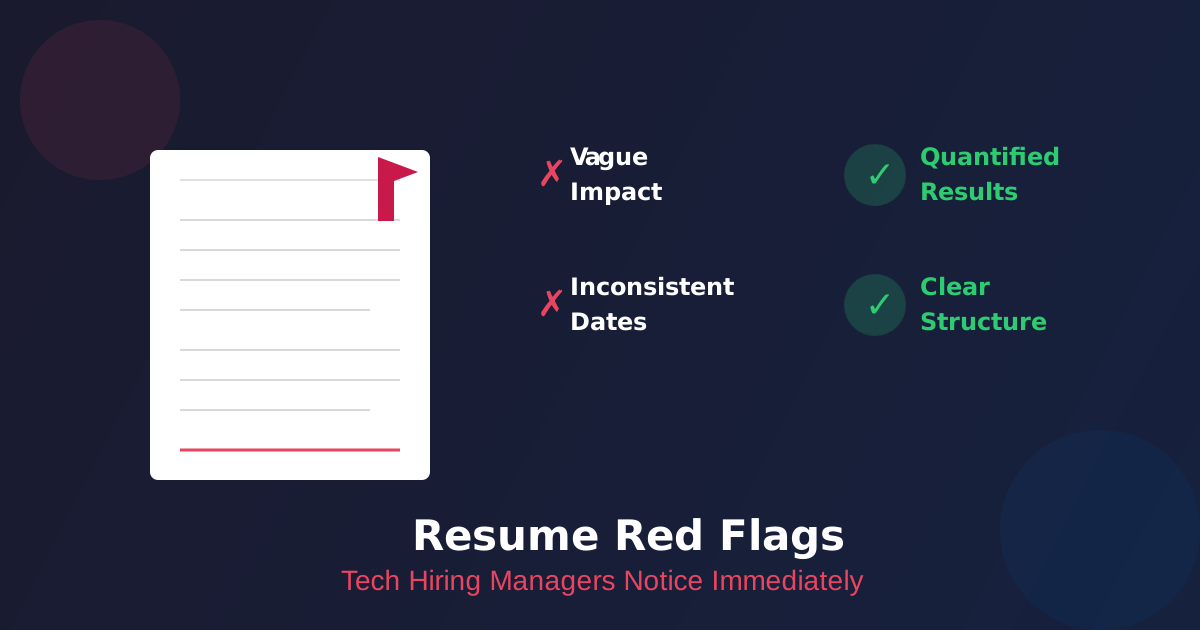
Hiring managers spend seconds scanning your resume. Not minutes. Seconds. Research shows recruiters take an average of 6-7 seconds on an initial pass, and they're looking for reasons to eliminate you, not reasons to move forward.[1] Every red flag in those first few seconds increases the odds your resume gets rejected before anyone reads the second bullet point.
The problem is most candidates don't know what those red flags look like until it's too late.
 Hiring managers make elimination decisions within seconds. One red flag early = rejection.
The Vagueness Trap: "Responsible For" vs. "Accomplished"
The single most common mistake engineers make is describing what they were responsible for instead of what they actually accomplished.
Bad: "Responsible for building backend services and maintaining infrastructure."
Good: "Architected microservices handling 2M daily requests, reducing latency by 40% and cutting infrastructure costs by $150K annually."
Vagueness kills resumes because it forces hiring managers to imagine your impact. They won't. They'll just move to the next candidate who showed concrete results.
Here's why this matters: hiring managers need to understand, in seconds, whether you can do the job they're hiring for. "Responsible for building services" could mean you wrote hello-world-level code or architected distributed systems. They can't assume. So they assume you're underwhelming and keep moving.
Every bullet point should answer this: What did you do, what was the measurable outcome, and why does it matter to someone hiring for a similar role?
This also applies to soft skills. "Good communicator" tells you nothing. "Led architectural design reviews with 12 engineers, aligned teams on a three-phase deployment strategy, and documented decisions for future reference" shows communication through action.[2]
 The formula that turns vague responsibilities into compelling accomplishments.
Inconsistency: Dates, Titles, and Timeline Gaps
Hiring managers cross-check facts. When they see inconsistencies, they immediately suspect dishonesty or carelessness - both disqualifying.
Red flags in this category:
- Job dates that don't add up (ending one job on the 31st and starting another on the 1st of the same month across different companies is unlikely)
- Title mismatches (you list yourself as "Senior Engineer" at one company and "Junior Developer" at another, but all timelines suggest similar levels of responsibility)
- Employment gaps that don't match up with your stated availability (you say you left Company A in June but list Company B starting in May)
- Skills that appear and disappear (you were "expert in Kubernetes" for three years, then it vanishes from your recent roles, which looks suspicious)
- Company name inconsistencies (ABC Corp vs. ABC Corp Inc vs. ABC Corporation)
These inconsistencies create cognitive friction. Hiring managers are trained to spot candidates with padded experience or timeline manipulation. Even if the inconsistency is innocent (a company rebrand you didn't update), it looks sloppy.[3]
Check your resume against LinkedIn. Check it against previous job applications. Check it against what you remember. Any discrepancy will eventually surface during a background check or conversation with a hiring manager, and it costs you credibility even if it's explainable.
Keyword Stuffing Without Context
Yes, resume keyword matching matters for Applicant Tracking Systems. No, you shouldn't cram every technology under the sun into your bullets.
Bad: "Experienced in React, Vue, Angular, Node.js, Express, Django, Flask, Python, Java, C++, Go, Rust, AWS, Azure, GCP, Docker, Kubernetes, PostgreSQL, MongoDB, Redis, GraphQL, REST APIs, CI/CD, DevOps, Agile, Scrum..."
This reads like a desperate grab at keywords. It also signals that you've dabbled in many things without depth, which makes hiring managers question whether you actually know any of them well.
Good: "Built scalable React applications with TypeScript, deployed on AWS using Docker and Kubernetes, implemented GraphQL APIs for reduced payload size, and set up CI/CD pipelines that reduced deployment time from 45 minutes to 8 minutes."
This version includes keywords naturally, shows you know them through context, and demonstrates impact. A hiring manager reading this believes you actually know React and AWS. They might even skim it thinking, "This person has done real work."
The rule: mention a technology only if you have a concrete accomplishment tied to it. Don't list every tool in your toolkit. List the ones that matter for the role and prove you've used them meaningfully.
Poor Structure and Readability
Resume scanners spend those 6-7 seconds taking in visual patterns. If your resume is hard to scan, it fails immediately.
Red flags:
- Long paragraphs (bullets should be 1-2 lines, not 3-4)
- Inconsistent formatting (some bullets have colons, others don't; some are full sentences, others are fragments)
- Unclear role/company relationships (it's not immediately obvious what you did at which company)
- Tiny fonts or cramped spacing (shows you're trying to hide information or can't prioritize)
- Excessive visual design (tables, charts, colored blocks that break ATS parsing)
Your resume competes for attention against 50-200 other candidates in an applicant pool. Bad formatting isn't just unprofessional - it's a cognitive burden that makes hiring managers reach for the well-formatted resume next to yours.[4]
Keep your structure consistent: Company Name, Job Title, Dates. Then 3-5 achievement-focused bullets. Repeat. Use a clean font, adequate margins, and clear hierarchy. Your resume should be scannable in seconds without design flourishes that distract from content.
Lack of Quantifiable Impact
Hiring managers want proof. Proof that you've built things that mattered. Proof that your work had measurable consequences.
Vague impact phrases kill credibility:
- "Improved performance" (improved by how much?)
- "Enhanced user experience" (how do you measure enhancement?)
- "Optimized database queries" (what was the result?)
- "Built internal tools" (who used them? how much time did they save?)
Specific metrics are memorable:
- "Improved API response time by 65%, from 800ms to 280ms"
- "Reduced cloud infrastructure costs by $200K annually through query optimization"
- "Built CLI tool used by 150+ engineers, saving 10 hours per week in manual deployments"
- "Increased test coverage from 42% to 87%, catching bugs before production"
You don't need to be perfectly precise. "Reduced latency by roughly 40%" is better than "improved performance." Approximate numbers with context are credible. False specificity ("improved by 37.2%") looks suspicious if you're not citing a source.
If you can't quantify something, describe the scope: How many users? How many teams? How critical was the system? "Architected core authentication system serving 5M monthly users" tells a hiring manager this was real, significant work.
Overselling vs. Underselling: Finding the Honest Middle
Some candidates overstate their contributions. Others downplay work that was genuinely important.
Overstating (red flag): "Led development of company's microservices architecture" when you were actually one engineer on a team of five who built it together. Hiring managers will ask about this in an interview and immediately know you're misrepresenting your role.
Understating (missed opportunity): "Contributed to infrastructure improvements" when you actually designed and implemented the entire CI/CD pipeline that the team now relies on daily. This undersells your capability and makes you look less impressive than you are.
The honest middle: describe your actual contribution. If you led something, say you led it. If you collaborated with others, you can frame it as "Partnered with two senior architects to design..." or "Worked with ops team to implement..." This shows collaboration without inflating your role.
Hiring managers respect accuracy more than bravado. Overselling gets caught in interviews. Underselling loses you opportunities.[5]
Employment Gaps and Timeline Questions
Unexplained gaps raise questions. Hiring managers immediately wonder: Were you fired? Prison? Just lazy? Usually it's none of the above, but silence creates suspicion.
If you have a gap:
- Explain it briefly in a cover letter or be ready for the question in an interview
- Use the gap time strategically: "Took three months for professional development, completed advanced Kubernetes certification, and built a production-ready distributed tracing system"
- Don't hide it or pretend the timeline was continuous
Short gaps (a month or two) don't need explanation. Longer gaps should have a narrative. If you were unemployed, say that. If you took time for personal reasons, that's fine. Just be honest. Hiring managers understand life happens.
A timeline that doesn't add up is far more suspicious than a transparent explanation.[3]
Lack of Relevant Keywords
This is the inverse problem: your resume has great accomplishments but uses different language than the job description.
Job posting says: "Experience with Infrastructure as Code (IaC)"
Your resume says: "Infrastructure automation using Terraform"
These are the same skill, but ATS systems often don't make the semantic connection. Your resume might get filtered out of a pool it should have advanced through.
The fix: read the job description carefully. Identify the exact language they use for required skills. Mirror that language in your resume where it's accurate. If they say "API design" and you have "REST architecture," reframe yours as "REST API design." If they want "cloud infrastructure" and you list "AWS," mention "AWS cloud infrastructure."
You're not dishonest. You're translating your accomplishments into their vocabulary.
Typos, Grammar, and Formatting Errors
Every typo screams carelessness. Every grammar mistake signals you didn't care enough to review.
Hiring managers assume your resume is your best work. If your best work has three typos, what does your code look like? What does your documentation look like?
Proofread multiple times. Use a spell-checker. Have someone else read it. Read it backwards to catch typos. Spend 30 minutes on this - it's worth it.
Small errors kill momentum. A hiring manager is skimming, feeling good about you, and then sees "responsibile" instead of "responsible." Their confidence dips. You're now in the "needs closer inspection" pile instead of the "move forward" pile.[4]
Misleading or Outdated Technology Claims
Don't list technologies you haven't touched in five years or used minimally.
Red flag: A resume lists "Expert in Java" as the top skill, but the candidate hasn't written production Java in seven years. The interviewer asks a basic Java question, and the candidate struggles. You lose trust immediately.
If you have solid Java knowledge, list it. If you've forgotten most of it, don't. Outdated or exaggerated tech claims set expectations you can't meet.
The same applies to certifications and degrees. If you completed a certification five years ago and never used that skill, mentioning it now is misleading. If you're actively using it, absolutely include it.
Accuracy matters. Hiring managers will test you on your claimed expertise, especially during technical interviews. If your resume doesn't match your actual capability, you'll look dishonest or incompetent either way.
The Untraceable Accomplishment
Some candidates claim accomplishments that can't be verified.
Example: "Led development of product that generated $10M in revenue"
At interview, the hiring manager asks: "Which product? Can I see it?" You hesitate. They already assume you're exaggerating or lying.
If you built something internally, that's still a real accomplishment you can describe. "Built internal tool that automated contract processing, saving the legal team 400 hours annually" is verifiable through reference checks. "Led product generating millions in revenue" without clarity is suspicious.
Make sure your accomplishments are either:
- Publicly verifiable (GitHub repo, published tool, production system you can reference)
- Verifiable through background checks or reference calls (projects at previous companies with public records)
- Describable with enough specificity that you can answer follow-up questions clearly
Vague, massive claims trigger skepticism.
Using Dated Technology or Language
Your resume is a snapshot of your current capability. If it looks like it hasn't been updated since 2018, hiring managers wonder: Are your skills outdated? Do you not care about staying current?
Red flags:
- Listing only technologies that are now considered legacy or outdated without mentioning current tools
- Using old resume formatting conventions or templates that feel ancient
- Including references to older certification formats or degrees without mentioning recent achievements
- No mention of modern development practices (cloud, containerization, CI/CD) if you're applying to a company that uses them
This doesn't mean you need to chase every trend. But your resume should reflect the technology landscape of the job you're applying for.
If you haven't updated your resume in two years and you're applying for a role requiring modern cloud infrastructure, that gap is a red flag.
Applying for the Wrong Job
This is subtle but critical. You submit a generalist resume to a specialized role or vice versa.
A hiring manager for a frontend React role sees a resume emphasizing backend infrastructure and database optimization. They wonder: Do you actually want this job? Are you desperate? Do you understand what the role requires?
Your resume should match the job posting enough that a hiring manager believes you're genuinely interested and genuinely qualified. This doesn't mean overstating your interest - it means tailoring your accomplishments to highlight relevant experience.
If you're applying to multiple different types of roles (frontend, backend, DevOps), maintain versions of your resume emphasizing different skills. Don't submit the same generic resume everywhere.
 Not all red flags are equal. Focus on critical issues first.
The Fix: Structure Beats Perfection
You don't need a fancy resume. You need a clear one that makes a hiring manager's job easier, not harder.
- Clear dates and company names (scannable in seconds)
- Accomplishment-focused bullets with measurable outcomes
- Relevant technologies mentioned in context
- Consistent formatting
- Honest claims that can survive an interview
- Accurate timeline with no red flags
- Language that matches the job description where legitimate
Structured, honest, clear resumes pass the 6-7 second scan and make it to the next stage. Everything else is noise.
If you're maintaining a master resume as your source of truth (like a living document), you can easily tailor versions for different roles while keeping your facts consistent and accurate. Tools like CoreCV.ai treat your accomplishments as structured data, making it simple to maintain consistency across versions while emphasizing different aspects for different roles - without rewriting the core story.
Sources
- 1. Muse. "How Long Do Hiring Managers Actually Look at Your Resume?" https://www.themuse.com/advice/how-long-do-hiring-managers-actually-look-at-your-resume
- 2. CareerOneStop (U.S. Department of Labor). "Showcasing Skills on Your Resume." https://www.careeronestop.org/
- 3. SHRM. "Background Checking: An Employer's Guide." https://www.shrm.org/
- 4. Jobscan. "The 2024 State of ATS: How Applicant Tracking Systems Evaluate Resumes." https://www.jobscan.co/
- 5. LinkedIn Learning. "How Hiring Managers Evaluate Resumes." https://www.linkedin.com/learning/
- 6. TheLadders. "Eye Tracking Study of Resume Evaluation." https://www.theladders.com/