The Resume Stack: How to Organize Multiple Versions
Most engineers don't fail because they're unqualified. They fail because the resume they sent didn't match the role that was hiring.
That mismatch is rarely dramatic. It's usually small, avoidable drift.
You apply to a backend role, but the resume you used last week leans full-stack. You swap a couple bullets, forget to update a date, and now you have two "truths" floating around. Two weeks later a recruiter replies and asks for the same resume again. You can't remember which file you sent.
Recruiters and hiring managers scan fast. If the first screen doesn't make the match obvious, you lose the opportunity before anyone gets to the interesting parts. Multiple sources put that first pass in seconds, not minutes [1], [2].
The fix isn't "write one perfect resume." The fix is to build a small system: a resume stack.
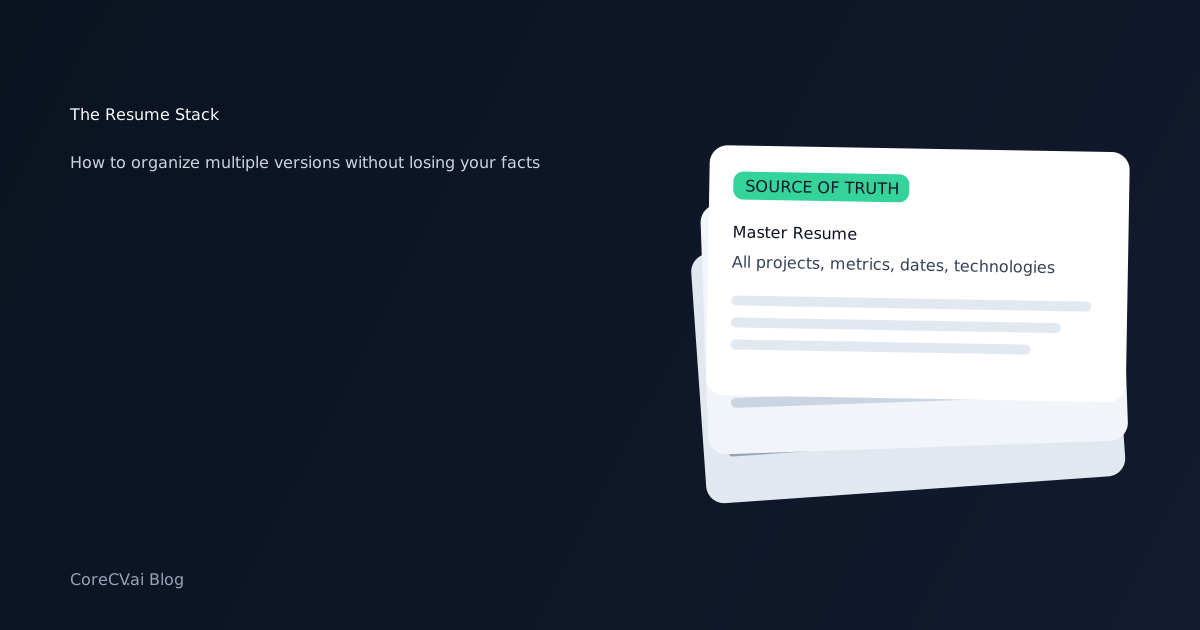
 Think in layers: one source of truth, then increasingly specific views.
The CoreCV way to think about versions
CoreCV is built around a simple idea: your resume should behave like structured data.
Facts live in one place. You generate different views of those facts depending on the role.
That philosophy is the opposite of the usual "copy a doc, tweak it, hope nothing breaks" workflow. It also lines up with how engineers already manage changing information: one source of truth, multiple outputs.
If you remember one rule, make it this:
Tailor emphasis aggressively, but change facts in only one place.
In practice, that means splitting your resume work into two parts:
- Facts: dates, titles, technologies used, project scope, metrics
- Framing: which facts you foreground, the vocabulary you use, and the order you present sections
When facts and framing live in the same file, you get drift. When they are separated, versioning becomes easy.
Define the four layers (and what they look like in CoreCV)
Here's a model that works for most tech job searches.
Layer 1: Source of truth (your canonical resume data)
This is not a PDF. It's not even "a resume" in the traditional sense.
It's your complete, accurate set of resume facts:
- Every role, project, and meaningful achievement
- Full metrics (including the ones you won't always include)
- Correct dates and titles
- A clean list of technologies, tools, and domains
In CoreCV, this layer is exactly what the product is designed for: a structured (JSON-based) resume you can keep consistent and update once.
If you only keep one thing current, keep this current.
Layer 2: Role baselines (reusable role-specific views)
A role baseline is a reusable version per role type. It is not company-specific. It's the default shape of proof for a kind of job.
Examples:
- Backend Engineer
- Platform / SRE
- Data Engineer
- Full-stack (startup)
In CoreCV terms, think of these as role-focused variants. You're not duplicating your life story. You're choosing the emphasis and ordering that makes sense for that role.
This layer saves you from rebuilding the same resume every time a job description uses slightly different wording.
Layer 3: Job mapping (a light, honest tailor pass)
This is where you align language and ordering to the job description:
- Use the same terms they use, when accurate
- Put the most relevant proof first
- Swap in or out one or two bullets (more on bullet modules below)
ATS and recruiter workflows often rely on language matching between the job description and your resume [2], [4]. That doesn't mean keyword stuffing. It means being readable to the systems that sit between you and the hiring manager.
CoreCV helps here because tailoring is easier when you are working from structured sections and consistent content, rather than reformatting every time.
Layer 4: Delivery artifact (what you submit or share)
This is the PDF/DOCX you upload, or the link you share.
Treat it like an artifact, not a living document. You don't edit the artifact directly. If you need a change, you edit upstream (source of truth or baseline) and regenerate.
This is also where CoreCV's philosophy matters: shipping the resume should not require breaking your data. Export a clean artifact or share it securely, but keep the source of truth intact.
Build a bullet library (so tailoring becomes selection)
Most people think tailoring means rewriting. Rewriting is the expensive path.
A better model is modular:
Bullets are modules. You select modules. Selection is how you tailor.
 A small library of proof can generate multiple strong resumes.
What a good module looks like
A module is one claim with enough proof that it survives a skeptical reader.
A structure that holds up:
- Action: what you built or changed
- Scope: system size, users, teams, data volume, constraints
- Result: measurable outcome
- Tools: only the relevant ones
Example:
"Reduced payments API p95 latency from 820ms to 290ms by adding read-through caching and rewriting high-cost queries, improving checkout completion by 4.1%."
It reads like real work because it has scope and consequence.
Tag your modules (lightweight, not fancy)
You don't need a complex tool. You need consistency.
Give every module a few tags you can sort by:
- Domain: backend, frontend, data, platform
- Skill: performance, reliability, security, cost
- Tech: postgres, kubernetes, aws, kafka
- Impact: revenue, retention, risk, time-saved
Then tailoring becomes selection.
If the job cares about reliability and on-call, you select the incident response and observability modules. If it cares about performance and APIs, you select the latency and scalability modules.
You are not inventing new stories. You're choosing the right evidence.
Create 2-3 baselines, not 12
Baselines are expensive to maintain.
If you create ten baselines, you will not keep them consistent. A better approach is one baseline per role type you are realistically applying to this month.
If you're applying to backend and platform roles right now, create:
- Baseline: Backend
- Baseline: Platform
A third baseline is only worth it when constraints change. For example, a seed-stage full-stack baseline often needs to be one page and emphasize breadth and speed of impact.
CoreCV's structured approach makes adding a baseline cheaper, but it's still work. Keep it tight.
How to tailor to a job description (without breaking your truth)
You want to align to the job description without turning your resume into a fiction project.
A simple process that stays honest:
1) Extract evaluation categories
Skim the job description and pull out categories, not individual words.
Examples:
- Distributed systems and scalability
- Observability and incident response
- Data pipelines and quality
- Security and least privilege
This gives you a map.
2) Match categories to proof modules
For each category, pick one or two modules that prove it.
If you can't find a module, you have three options:
- Admit it's not your strength and don't force it
- Use a related module and be precise about the overlap
- Decide not to apply
That last one saves time and protects credibility.
3) Align vocabulary, not reality
If the job description says "observability" and your bullet says "monitoring," align the term if it's accurate.
If the job description says "event-driven" and you used "pub/sub," add the mapping.
Don't rename your work into something it wasn't. Translation is fine. Inflation is obvious.
4) Reorder for the first 6-10 seconds
The top third of your resume should make the match obvious.
Career centers routinely call out fast scan behavior and ATS filtering as the reality you need to design for [2], [4].
If this job is platform-heavy, your first few bullets should read like platform proof. If it's backend-heavy, they should read like backend proof.
Version tracking without busywork
A resume stack works only if you can answer one question quickly: which version did I send?
You can do this in a simple way:
- Keep a clear naming convention for exported artifacts
- Keep a lightweight change log of what you changed vs baseline
If you use CoreCV, keep the "truth" stable and generate role-specific exports. When you generate a resume, rename it so the context is obvious later (role + company + date).
A naming convention that actually helps
Use a filename convention that answers five questions:
- who
- which role type
- which company
- which job
- which date
Example:
FirstnameLastname_BackendEngineer_CompanyName_Req1234_2026-02-16.pdf
If there is no req ID, use job title and location:
FirstnameLastname_PlatformSRE_Acme_SRE-Remote_2026-02-16.pdf
The point is determinism, not aesthetics.
A tiny change log
For each submission, keep a few lines:
- what you changed vs baseline
- why you changed it
- which modules you swapped in/out
Example:
Moved incident-response module to top job because the role emphasizes on-call. Replaced the "reduced infra costs" module with a "reduced MTTR" module. Updated wording to use "observability" to match the job description.
This makes follow-ups painless.
Update flow: keep everything consistent
When you remember a better metric, it's tempting to edit whatever file you have open.
Don't.
 Update facts once, then regenerate versions.
A consistent flow:
Facts change in the source of truth. Baselines pull from the source of truth. Job-specific variants pull from baselines.
That is the CoreCV philosophy in a sentence: structured data first, tailored views second.
Common failure modes
Each version becomes a fork
If you see different dates, titles, or tech stacks depending on which file you open, your versions have become forks.
Fix: move facts into the source of truth and treat everything else as a view.
Tailoring turns into rewriting
If you spend 60-90 minutes rewriting bullets per application, you're paying the worst possible cost.
Fix: build modules and swap them.
ATS formatting breaks your content
Even strong content can get mangled if formatting is hard to parse. Multiple career resources recommend avoiding tables, text boxes, and heavy layout elements for ATS submissions because systems can distort or ignore content [4], [6].
Fix: keep the ATS path boring. Single column. Normal headings. Readable fonts.
The takeaway
If your job search involves more than one role type, you need a resume stack.
It doesn't need complicated tools. It needs discipline:
- One source of truth that stays consistent
- A small library of bullet modules with evidence
- Two or three baselines you actually reuse
- Job-specific mapping that translates, not inflates
- Clean artifacts you can trace later
CoreCV is designed to support that exact workflow: structured resume data, easy tailoring, and clean exports or secure sharing when it is time to deliver.
Sources
- 1. TheLadders (hosted by Boston University), "TheLadders Eye-Tracking Study" (PDF): https://www.bu.edu/com/files/2018/10/TheLadders-EyeTracking-StudyC2.pdf
- 2. University of Arizona Career Services, "Tailoring Your Resume": https://career.arizona.edu/resources/tailoring-your-resume/
- 3. ONET Resource Center, "ONET-SOC Taxonomy": https://www.onetcenter.org/taxonomy.html
- 4. MIT CAPD, "Make your resume ATS-friendly": https://capd.mit.edu/resources/make-your-resume-ats-friendly/
- 5. U.S. Bureau of Labor Statistics, "Skills Data": https://www.bls.gov/emp/data/skills-data.htm
- 6. University of Minnesota Duluth Career Center, "Applicant Tracking System (ATS) Tips": https://career.d.umn.edu/students/resume-cover-letter/applicant-tracking-system-ats-tips