Updating Your Tech Skills: Learning the Right Tools for 2026
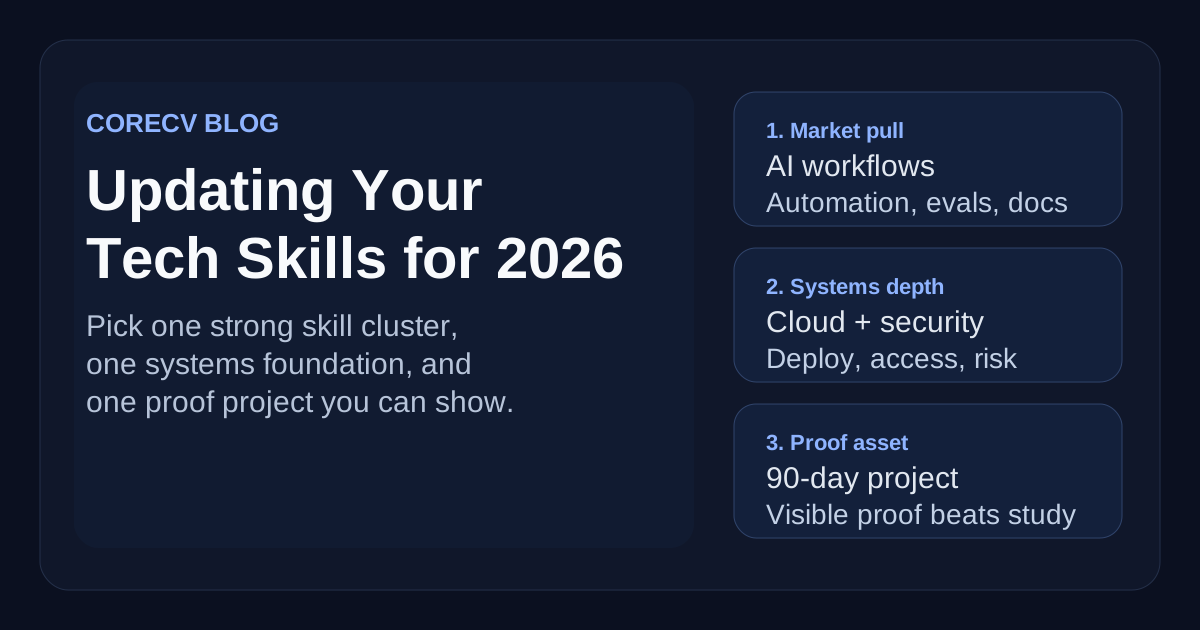
The hard part about keeping your skills current is not finding courses, repos, or newsletters. It is deciding what deserves real time when the market keeps throwing new tools at you. For most software engineers in many hiring markets, a better 2026 plan is narrower: build one marketable skill cluster, one systems-level foundation, and one project that proves you can use both.
That focus matters because the signal is changing faster than the job titles. The World Economic Forum says AI and big data, networks and cybersecurity, and technological literacy are the three fastest-growing skill areas, and estimates that 39% of workers' existing skills will be transformed or outdated by 2030.[1] GitHub's 2024 Octoverse report points in the same direction from the tooling side: contributions to generative AI projects rose 59%, total AI projects rose 98%, Python overtook JavaScript, and Jupyter Notebook usage jumped 92%.[2]
Start with skill clusters, not individual tools
It is more useful to think in clusters that employers can actually recognize.
The first cluster is AI-assisted product and engineering work. You do not need to become an ML researcher. You do need to learn how to use AI for drafting, testing, documentation, evaluation, and workflow automation without trusting it blindly. Stack Overflow's 2024 survey found that 76% of respondents are using or planning to use AI tools in development, and 62% are already using them today.[3]
The second cluster is cloud, infrastructure, and security depth. WEF's ranking of networks and cybersecurity as a fastest-growing skill area is a reminder that teams care about reliability and exposure, not just feature output.[1] You do not need every vendor service, but you do need a working mental model for deployment, identity, permissions, observability, and incident risk. In backend or platform roles, this pillar often carries more weight than the others.
The third cluster is data and systems fluency. In practice, that means writing SQL without flinching, tracing a request from UI to database, using containers locally, and turning a messy dataset into something another engineer can query or ship. GitHub's shift toward Python and Jupyter points to demand for engineers who can move between application code, analysis, and AI-adjacent work.[2] Stack Overflow also reports PostgreSQL as the most-used database at 49% and Docker at 59% among professional developers, which is a strong clue about the baseline tools worth knowing well.[4] Frontend, mobile, and data candidates may weight this second pillar differently, but most still benefit from being able to explain how data and services actually move.
 A strong 2026 plan usually combines one market pull area, one systems foundation, and one proof asset.
Pick skills by employer pull, not by novelty
The best learning plans begin with demand you can point to. The U.S. Bureau of Labor Statistics projects 15% employment growth for software developers, QA analysts, and testers from 2024 to 2034, with about 129,200 openings per year on average.[5] That is healthy demand, but it does not make every shiny tool worth your weekends.
Use a simple filter before you commit to anything:
- Market pull: Are employers actively asking for this in roles adjacent to yours?
- Reuse: Will this skill help in more than one project or team?
- Proof: Can you show evidence of it within 60 to 90 days?
- Compounding effect: Does it make your existing strength more valuable?
That last point is where many people go wrong. A backend engineer usually gets more upside from better system design, cloud cost awareness, and AI-assisted workflows than from starting unrelated beginner tracks. A frontend engineer may get more value from TypeScript depth, performance profiling, and API design literacy than from rushing into a generic "learn AI" playlist.
 If a skill has weak employer pull and no short path to proof, it probably belongs in the parking lot, not your main roadmap.
Build a 90-day plan that creates evidence
A useful skill plan should leave behind proof, not just notes. I would split the next 90 days into three passes.
Days 1-30: choose one cluster and rebuild your fundamentals. Read official docs, ship tiny exercises, and write down the recurring concepts rather than memorizing product screens.
Days 31-60: raise the stakes with one scoped project that forces practical decisions. If you are focusing on AI-assisted engineering, create a small tool with an evaluation loop and logging. If you are focusing on cloud and security, deploy a service with proper secrets handling, metrics, and alerts. If you are focusing on data fluency, build something that ingests, transforms, and exposes a dataset cleanly.
In the final stretch, stop adding surface area and start packaging what you learned.
Days 61-90: write a short project note, record architecture decisions, and turn outcomes into resume bullets with clear scope, tradeoffs, and results. Public project history, docs, and demos help because they give hiring teams visible evidence that the work happened and what you learned from it.[2]
 A 90-day cycle works best when learning ends in a public or portfolio-ready artifact.
What not to do in 2026
Do not optimize for the longest tool list. Do not confuse awareness with capability. And do not let AI tools flatten your own understanding. Stack Overflow found that 45% of professional developers think AI tools are bad or very bad at handling complex tasks, which is a useful reminder that judgment still matters.[3]
A better plan is to learn the tools that make your current specialty harder to replace and easier to trust. That usually means one AI workflow skill, one infrastructure or data skill, and one proof project you can discuss in detail. If you keep your resume in a structured workflow such as CoreCV, it is easier to turn real project work into credible bullets without rewriting the facts every time.
Sources
1. World Economic Forum, The Future of Jobs Report 2025: https://www.weforum.org/publications/the-future-of-jobs-report-2025/digest/
2. GitHub, Octoverse 2024: AI leads Python to top language as the number of global developers surges: https://github.blog/news-insights/octoverse/octoverse-2024/
3. Stack Overflow, 2024 Developer Survey - AI: https://survey.stackoverflow.co/2024/ai/
4. Stack Overflow, 2024 Developer Survey - Technology: https://survey.stackoverflow.co/2024/technology/
5. U.S. Bureau of Labor Statistics, Software Developers, Quality Assurance Analysts, and Testers: https://www.bls.gov/ooh/computer-and-information-technology/software-developers.htm