The Future of Tech Resumes: AI Personalization + Structured Data
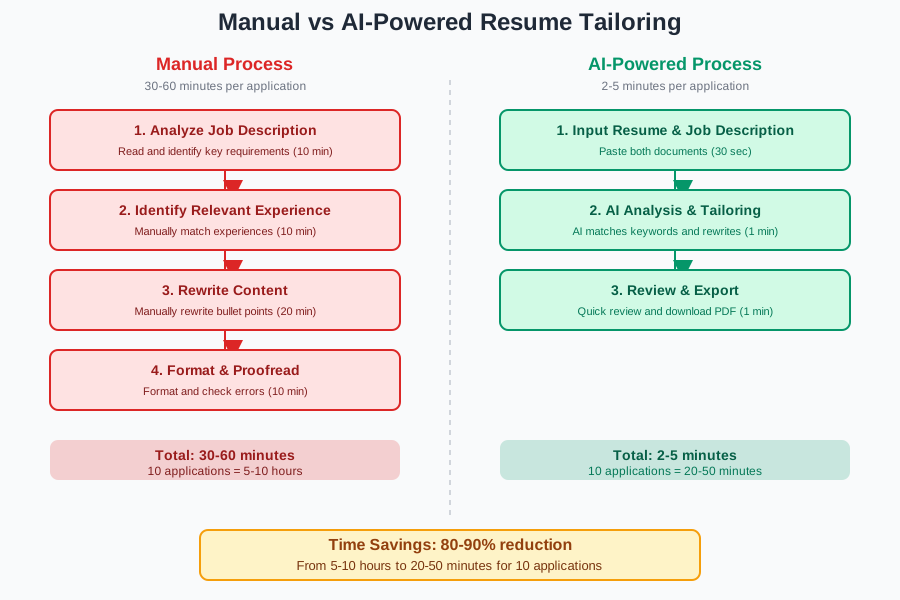
If you are an experienced engineer, you have probably revised your resume dozens of times. The familiar ritual of tweaking bullet points and selecting fonts is no longer enough. Currently, the first "reader" of your resume is often software. Applicant Tracking Systems (ATS) parse a document and extract structured fields such as job titles, dates, skills and education. Recruiters then search and filter based on those fields to manage hundreds of applicants. Meanwhile, job-seekers are using AI to generate generic resumes and cover letters, so the competition for attention is fierce. This post argues that the static, one-size-fits-all resume is dying. Instead, modern hiring pipelines reward resumes that are both role-specific and machine-readable.
Why Static Resumes Fail
Traditional resume formats present a fundamental challenge. PDFs look polished but are difficult for ATS to parse accurately. Word documents are editable but inconsistent across platforms, and plain text is machine-readable yet lacks visual appeal. The result is that strong candidates can get lost when the parsing fails; the ATS might misinterpret dates or miss relevant experience entirely. Recruiters confirm that automation alone is not effective: job seekers often stuff keywords into AI-generated documents, and when the actual substance does not match, the resume fails in interviews. A static resume also assumes that the same narrative works for every role, an assumption that hiring data disproves. Learn more about creating ATS-friendly resumes that parse correctly. According to a 2024 Enhancv survey of 31,000 resumes, 83% of recruiters prefer resumes tailored to the specific job description and 61% of hiring managers say a tailored resume is the best way for candidates to improve their chances. Static resumes ignore this expectation and thus underperform.
AI-Driven Personalization
AI resume builders have emerged to address these pain points. These tools interpret your career history and automatically generate role-specific content. Instead of manually rewriting bullet points, the system analyzes job postings to extract required skills and phrasing patterns and adjusts your resume accordingly. This process goes beyond keyword stuffing; it translates responsibilities, outcomes and scope into language aligned with how recruiters evaluate seniority and impact. It also allows you to produce multiple versions of your resume for different roles, making targeted applications scalable. The point is not to generate hype about AI but to recognize that AI can handle the mechanical aspects of tailoring content while you focus on strategic storytelling. For a comprehensive guide, see our article on how to tailor your tech resume with AI.
AI Limitations: AI-powered resume tools are highly effective for optimization and tailoring, but they work best when combined with human judgment. AI may occasionally suggest inappropriate phrasing or fail to capture unique aspects of your experience. Always review and refine AI-generated content for accuracy, tone, and authenticity.
Role-Specific Tailoring Is No Longer Optional
ATS and recruiters increasingly rely on matching the language of the job description. According to industry guidance, a modern resume must "match the language of the job description" and tell a clear, human story of your strengths and achievements. This involves aligning terminology (for example, using "customer service support" if that phrase appears in the posting) and integrating keywords naturally. Research shows that 63% of employers prefer customized resumes and cover letters. Role-specific tailoring therefore improves both automated ranking and human perception.
Continuous Feedback and Version Control
AI resume builders provide ongoing feedback on wording strength, clarity and relevance. They highlight weak verbs or vague statements and encourage quantifiable achievements. This is consistent with recruiter preferences: industry research suggests that approximately 75% of hiring managers want to see quantifiable achievements, and including metrics can significantly boost interview chances. An AI-assisted resume can quickly adjust phrasing, emphasize different skills and maintain multiple versions over time. In practice, this turns your resume into a living career asset rather than a static document.
Machine-Readable Structures: Beyond PDF
Even a well-tailored resume must be machine-readable. Traditional PDFs or Word documents depend on parsers that can misinterpret layout and formatting, especially when design elements like tables and images are used. For an engineer, the natural solution is to make the resume itself structured data.
Structured Resume Data Formats
Modern resume platforms are adopting structured data formats like JSON internally to store professional history in a machine-readable way. These schemas define standardized fields such as work, education, skills and projects. The key advantage is that platforms like CoreCV store your resume as structured data behind the scenes, then generate perfectly formatted and ATS-optimized PDFs or other output formats. This ensures your resume is both visually polished for human readers and structured in a way that maximizes ATS parsing accuracy. The platform handles the complexity of maintaining structured data while you benefit from superior outputs. For a detailed guide to JSON-based resumes, see our article on building your resume as code.
The Complexity of Manual Structured Resumes
Building resume infrastructure with structured data is not trivial. It requires understanding schema parameters, field relationships and data types. Small formatting choices can affect how automated systems evaluate your qualifications. Writing and maintaining valid JSON across dozens of nested fields is error-prone - even small syntax errors invalidate the entire file. This complexity explains why platforms are essential: they handle the structured data management behind the scenes, while you focus on content. Modern resume platforms use AI to generate and validate structured data automatically, then produce ATS-optimized outputs without requiring you to touch code or JSON files.
How AI Personalization and Structured Data Intersect
AI personalization and structured resume data are complementary rather than competing trends. When a platform stores your resume as structured data internally, AI can operate on that data with precision, enabling more accurate tailoring and analysis. For example, platforms like CoreCV maintain structured data behind the scenes, allowing AI to automatically map your experiences to job requirements and generate customized resume versions. The output you receive is a polished, ATS-optimized PDF or document - not a JSON file. This approach combines the best of both worlds: structured data for precision and traditional formats for submission.
From a candidate's perspective, structured data plus AI personalization means less time spent on reformatting and more time on strategic narrative. You work through an intuitive interface while the platform maintains structured data behind the scenes. This enables generating different resume versions for different roles - each as a professional PDF optimized for both ATS parsing and human readers. Learn more about what CoreCV.ai offers for structured resume management.
Remaining Human: The Role of Narrative
While AI and structured data improve efficiency, they cannot replace your professional story. Once you pass the ATS, your resume must "tell a clear, human story of your strengths and achievements." Research indicates that 91% of recruiters seek qualities like leadership and analytical skills. A structured resume should therefore include narrative elements - concise summaries, project descriptions and impact statements - to make your technical experience relatable. AI can propose these narratives, but you are ultimately responsible for ensuring they reflect reality and integrity. Over-reliance on generative AI can lead to inflated or irrelevant claims, which become apparent during interviews.
Conclusion
The future of tech resumes is not about flashy templates or one-click conversions. It is about reasoning through what information recruiters and machines need and structuring that information for different audiences. Static resumes fail because they cannot adapt to specific roles and often confuse ATS systems. AI personalization tools are valuable when they provide role-aware translation of experience, multi-version management and continuous feedback. Modern platforms like CoreCV combine these approaches: they store data as structured information internally, apply AI-powered personalization, and generate beautiful, ATS-optimized output formats for submission. You don't need to learn JSON or code - the platform handles the technical complexity while you focus on your career narrative. Think of it as treating your resume data like a software artifact behind the scenes, while receiving polished documents ready for any application.
Disclosure: This article is authored by the CoreCV team. While we mention CoreCV.ai, the strategies and advice presented apply broadly to modern resume approaches. We've included alternative perspectives and objective information where applicable.