How Far Back Should a Resume Go for Tech Jobs?
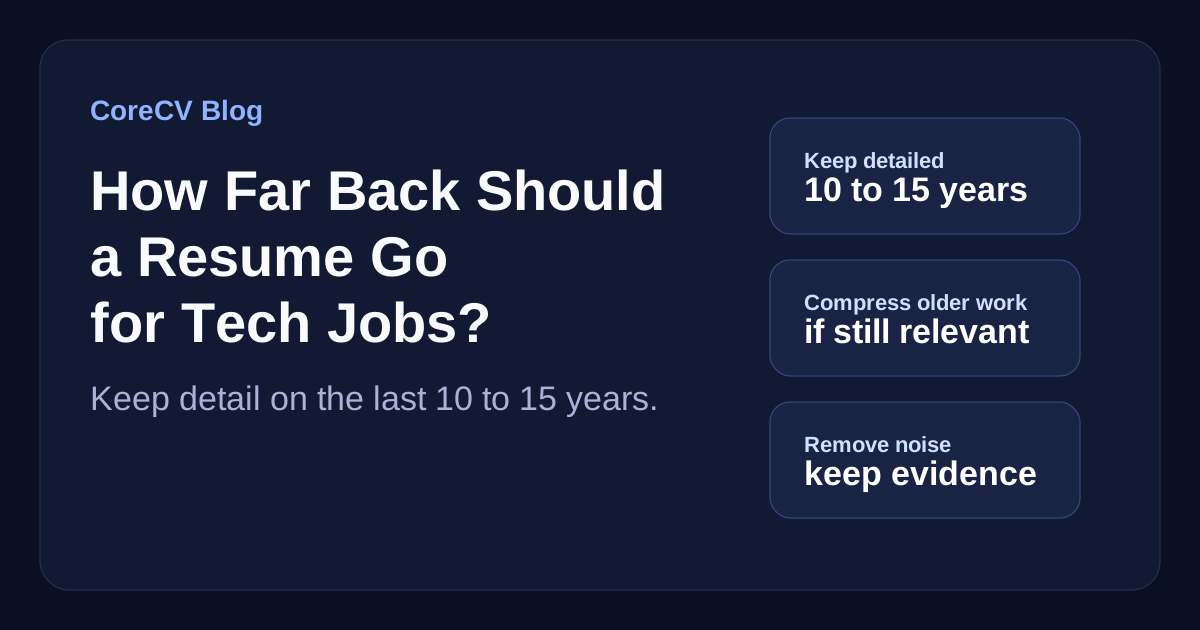
There is no magic year cutoff that works for every tech resume. The useful question is simpler: how far back do you need to go before older experience stops changing how a hiring team reads your fit for this role? Once a role stops adding evidence, it starts taking space from stronger, newer proof.
For most software engineers, I would start by showing the last 10 to 15 years in meaningful detail, then only keep older experience if it still strengthens the case. That is not a law. It is a practical default.
That matters more in tech than in slower-moving fields. The World Economic Forum says workers' core skills are expected to change by 2030, not stay fixed.[1] Stack Overflow's 2024 survey shows how quickly the working stack keeps shifting: Docker was used by 59% of professional developers, PostgreSQL by 49%, Azure by 28%, and Google Cloud by 25%.[2] When tools and expectations move that fast, a resume should not act like an archive.
MIT's career guidance recommends keeping a master resume with everything, then building a targeted version for each application.[3] Harvard makes the same broader point in a different way: resumes should be tailored to the role and ordered by importance, with experience listed in reverse chronological order.[4] Put those together and the answer becomes clearer. You do not need to print your whole working life every time. You need the version that makes the strongest argument now.
What should stay in full detail
That usually means recent roles get the most space because they are the easiest evidence for current tools, recent scope, and present-day judgment. If you are applying for backend or platform jobs in 2026, a hiring manager will care more about your recent production work, system ownership, migrations, incident response, and architecture decisions than about a ten-year-old role maintaining a stack nobody uses anymore.
 Recent capability gets the most space. Older experience has to earn it.
When older experience should stay
Older work still deserves room when it changes your credibility in a way recent experience alone cannot.
For example, if you are a senior engineer and an older role is where you first led a migration, managed a distributed system at meaningful scale, shipped developer tooling across teams, or built domain knowledge that still matters in fintech, healthtech, infra, or security, that history may still help. The mistake is not keeping it. The mistake is keeping it at full bullet-level detail when a shorter treatment would do the job.
The labor market also gives senior candidates a reason not to over-trim. The Bureau of Labor Statistics projects about 129,200 openings per year on average for software developers, QA analysts, and testers from 2024 to 2034, and notes that many openings come from people moving to other occupations or leaving the labor force.[5] That supports keeping older work when it helps explain durable experience, judgment, or domain context that newer bullets alone do not show.
A good compromise is to compress older but relevant roles. Keep the company, title, and dates. Reduce the bullets to one line, or move very old history into an "Additional Experience" section. That preserves trajectory without letting the past dominate the page.
 You can preserve career trajectory without giving every old role equal weight.
When older experience should go
Older experience should usually go when it creates noise, not signal.
That includes roles built around obsolete tools that no longer support your target direction, very junior work that is now fully superseded, and long bullet lists that repeat patterns your newer jobs already prove better. LinkedIn's 2025 recruiting report found that 93% of talent acquisition professionals say accurately assessing candidate skills is crucial for quality of hire, and companies using the most skills-based searches are 12% more likely to make a quality hire.[6] That does not set a strict chronology rule. It does support the idea that clearer evidence of relevant skills matters.
If your old experience is not helping a reader evaluate current skill, current level, or a domain that still matters, it is probably filler. Delete it, compress it, or strip it back to titles only.
Be especially careful with old tools sections. A long list of outdated frameworks can make your resume look frozen in time. Keep legacy technologies only when they still explain something useful about your background, such as operating in regulated environments, managing migrations, or maintaining systems with long support horizons.
How to trim without losing the story
The cleanest method is to keep a fuller master record somewhere else, then export a sharper resume for each target role. That is why MIT's master-resume advice is still useful for experienced candidates.[3] Your public resume should be selective. Your private record should not be.
A simple test helps: if I removed this role, would the reader understand me less accurately? If the answer is yes, keep it. If the answer is no, trim it. If the answer is "only a little," compress it.
For tech candidates, I would make the decision in this order:
- keep recent roles that prove current capability
- keep older roles that explain seniority, domain depth, or unusual credibility
- compress the rest
- remove anything that only adds age, not evidence
 If removing a role does not change the reader's understanding, it probably does not belong in the main version.
If you already keep a structured master resume, including in a tool like CoreCV, this gets easier. You can keep the full factual history as source material, then create tighter role-based versions without rewriting your career from scratch.
The goal is not to hide your age or erase your history. It is to make the most relevant evidence easy to read. A good tech resume should feel current, not incomplete.
Sources
1. World Economic Forum. "The Future of Jobs Report 2025." https://www.weforum.org/publications/the-future-of-jobs-report-2025/digest/
2. Stack Overflow. "2024 Developer Survey - Technology." https://survey.stackoverflow.co/2024/technology/
3. MIT Career Advising & Professional Development. "Resumes." https://capd.mit.edu/resources/resumes/
4. Harvard FAS Mignone Center for Career Success. "Create a Strong Resume." https://careerservices.fas.harvard.edu/resources/create-a-strong-resume/
5. U.S. Bureau of Labor Statistics. "Software Developers, Quality Assurance Analysts, and Testers." https://www.bls.gov/ooh/computer-and-information-technology/software-developers.htm
6. LinkedIn. "LinkedIn Report: How AI Will Redefine Recruiting in 2025." https://www.linkedin.com/business/talent/blog/talent-acquisition/future-of-recruiting-2025