Inside a Tech Recruiter's Mind: What They Really Look For
Note: The insights in this article are based on observed patterns in tech recruiting workflows, industry best practices, and documented recruiter behavior rather than a specific research study.
The tech job market in 2025 is not short on candidates. It is short on attention.
Recruiters and hiring managers operate under severe time constraints, supported by ATS filters and internal heuristics designed to reduce volume quickly. The result is a screening process optimized for signal extraction, not holistic storytelling. Understanding this constraint explains nearly every resume decision that actually matters.
This post distills recurring patterns observed across tech recruiting workflows - without anecdotes, quotes, or folklore. Just what consistently survives review.
The First Pass Is About Elimination, Not Selection
Most resumes are rejected, not ranked.
Early screening is designed to answer a single question:
"Is there enough relevant signal here to justify spending more time?"
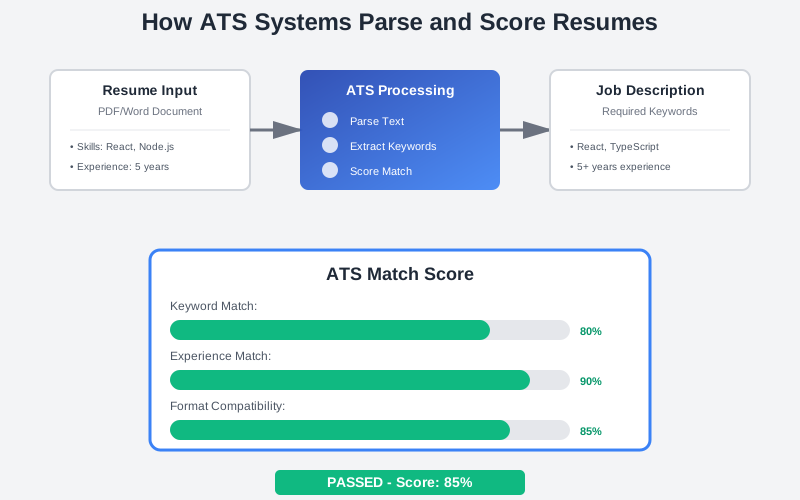
 How ATS systems and recruiters filter resumes in the initial screening phase
Research on recruiter behavior and ATS system telemetry data suggests that resume review times are often measured in seconds, not minutes. That forces reviewers to rely on:
- Section ordering
- Keyword density
- Role alignment
- Outcome clarity
Anything that obscures those signals increases rejection risk. To ensure your resume passes automated filters, learn about creating ATS-friendly resumes.
Signal vs. Noise: How Recruiters Actually Interpret a Resume
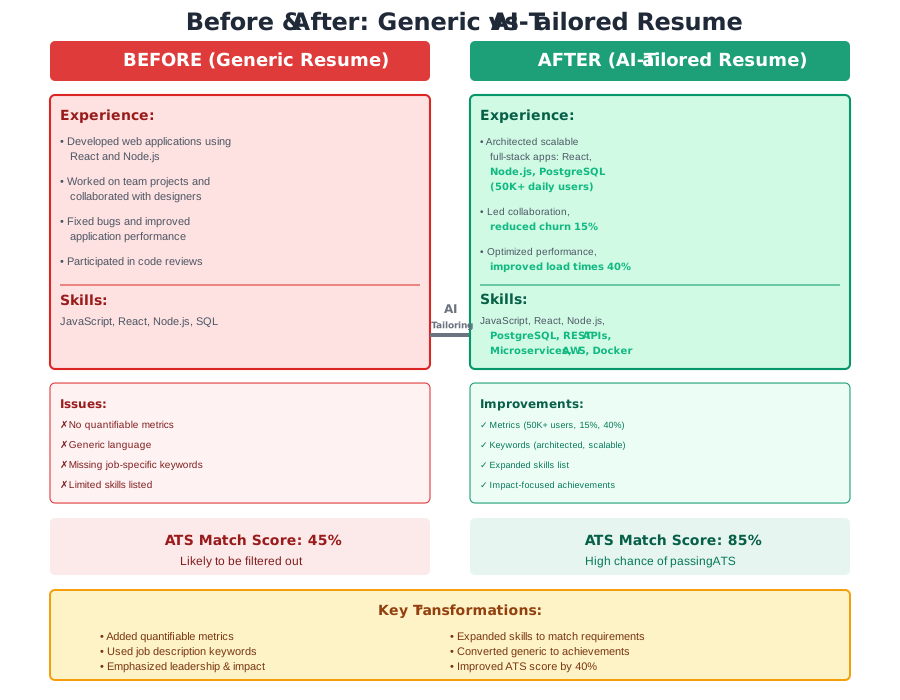 The difference between high-signal and low-signal resume elements
What Counts as Signal
Signal is information that reduces uncertainty about whether you can perform this role.
High-signal elements include:
-
Clear role titles and scope
Ambiguous titles force interpretation. Interpretation costs time. -
Concrete outcomes
"Built," "led," or "contributed" matters far less than what changed as a result. -
Relevant technical depth
Tools, systems, and domains that map directly to the job description. -
Recent, applicable experience
Recency beats breadth. A narrower but aligned background outperforms a long, unfocused one. -
Consistent narrative progression
Lateral moves are fine. Random jumps without explanation are costly.
What Is Commonly Treated as Noise
Noise is anything that consumes attention without improving decision confidence:
- Exhaustive skill lists with no context
- Generic summaries that could fit any engineer
- Irrelevant past roles included "for completeness"
- Visual embellishments that interfere with parsing
- Repetition of the job description without evidence
Noise doesn't just fail to help - it actively reduces perceived signal density. For a detailed breakdown of what reduces signal, see our guide on common resume mistakes tech professionals make.
Clarity Beats Cleverness Every Time
Recruiters are not looking to be impressed by prose. They are trying to reduce ambiguity.
Patterns that consistently perform better:
- Plain section headers
- Direct language
- Short, scannable bullet points
- One idea per line
Resumes that require interpretation are treated as higher risk. This is not a judgment of ability - it’s a consequence of scale.
Relevance Is Role-Specific, Not Career-Wide
A common mistake among experienced engineers is optimizing for career completeness instead of role relevance.
Recruiters do not ask:
"Is this an impressive career?"
They ask:
"Does this background map cleanly to this role?"
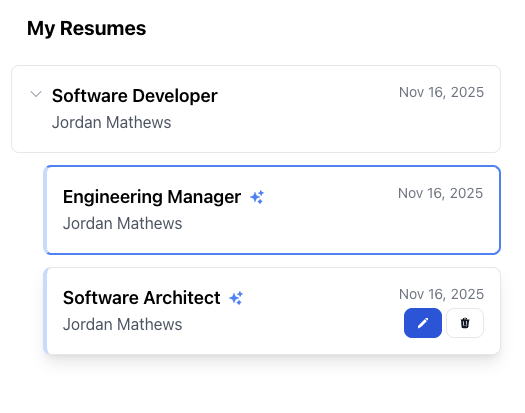 Tailoring resumes for different roles - emphasizing relevant experience for each position
That means:
- The same resume is not optimal for multiple roles
- Projects and accomplishments should be selectively emphasized
- Older experience may need to be compressed or omitted
Tailoring is not embellishment. It is prioritization.
Impact Is the Fastest Way to Establish Credibility
When time is limited, outcomes carry disproportionate weight.
High-impact bullets tend to answer at least one of the following:
- What changed?
- By how much?
- Why did it matter?
- Who or what did it affect?
This does not require exaggerated metrics. It requires directional clarity. Even approximate impact communicates more than responsibility descriptions.
Why Structure Matters More Than Formatting
Most resumes today are parsed multiple times - by ATS systems, internal tools, and humans.
Machine-readable structure improves consistency across those passes.
 How structured data ensures your resume is parsed correctly by ATS systems
This is why:
- Predictable section order matters
- Consistent labeling reduces misclassification
- Structured data formats (internally or externally) make role-specific tailoring feasible at scale
Treating a resume as a static document increases friction in every downstream step. For guidance on structuring your resume with the right level of detail, see our article on choosing the right resume length.
The Resume Is a Filter, Not a Biography
Recruiters are not trying to understand everything you’ve done. They are trying to decide whether to invest more time.
A resume that succeeds at that task:
- Surfaces relevant signal immediately
- Minimizes interpretation cost
- Aligns clearly with a specific role
- Makes impact legible under time pressure
Anything that does not serve those goals is unlikely to help.
Closing Thought
A resume is not evaluated in isolation. It is evaluated under constraint.
Once you accept that reality, most "resume advice" debates disappear. What remains is a simpler question:
Does this document make it easy to see why I'm a fit for this role - right now?
Design for that, and you are aligned with how tech recruiting actually works. For a UX-first framework for applying this in practice, read design your resume like a product.
Disclosure: This article is authored by the CoreCV team. While we mention CoreCV.ai, the strategies and advice presented apply to any ATS-friendly resume approach. We've included alternative tools and objective information where applicable.