One Page or Two? The Real Answer for Tech Professionals

"Keep it to one page." It's the advice every job seeker has heard, repeated so often it's become gospel. But for tech professionals with complex project histories, diverse tech stacks, and years of experience, this rule can feel like trying to compress a production codebase into a single file. At some point, enforced brevity becomes a liability, not an asset.
The truth? Resume length isn't a binary choice. The real answer depends on relevance, structure, and what the role actually demands. Let's break down when one page works, when two pages are justified, and how to make the decision based on data rather than outdated conventions.
The Origins of the One-Page Rule
The one-page resume standard emerged from a different era - when resumes were physically handed to hiring managers, desk space was limited, and scanning meant literal paper shuffling. In that context, brevity made practical sense.
But modern hiring operates differently. Resumes are digitally stored, parsed by ATS systems, and reviewed on screens where scrolling is effortless. The original constraint (physical paper) no longer exists, yet the rule persists, often to the detriment of experienced candidates who have legitimately more to show.
Here's the shift: hiring managers now care less about page count and more about signal-to-noise ratio. A two-page resume packed with relevant, quantified achievements beats a one-page resume padded with filler or missing critical context.
What the Data Actually Says
Let's look at what research tells us about resume length preferences. Understanding how tech recruiters actually evaluate resumes provides crucial context for these decisions.
Hiring Manager Preferences
A study by ResumeGo analyzed how hiring managers respond to resumes of different lengths. The findings challenge the conventional wisdom: hiring managers were 2.3 times more likely to prefer two-page resumes over one-page resumes, particularly for candidates with substantial experience. [1]
The reason? Two pages allowed candidates to provide context, demonstrate impact with metrics, and show career progression - all critical signals for evaluating fit.
ATS Compatibility
One common concern is whether Applicant Tracking Systems can handle multi-page resumes. The answer: yes, modern ATS systems parse multi-page resumes without issue. [2] What matters for ATS compatibility isn't page count - it's format, structure, and keyword alignment.
Key insight: ATS systems care about parseable content, not arbitrary length limits. Clean formatting, standard headings, and relevant keywords matter far more than squeezing everything onto a single page.
Federal Hiring Standards
In a notable shift, the U.S. Office of Personnel Management (OPM) implemented a two-page resume standard for federal hiring in 2024, explicitly moving away from the one-page default. [3] The goal: encourage candidates to provide enough detail to properly evaluate qualifications without overwhelming reviewers.
This signals a broader recognition that rigid page limits can filter out qualified candidates who simply have more relevant experience to share.
 Hiring manager preferences: two-page resumes receive 2.3x more favorable responses for experienced candidates
When One Page Makes Sense
Let's be clear: one page isn't always wrong. For certain situations, it's actually the optimal choice.
Entry-Level Professionals (0-2 years of experience)
If you're fresh out of a bootcamp, early in your first role, or transitioning from a non-tech field, you likely don't have enough relevant experience to justify a second page. Focus on:
- Education and certifications (bootcamp completion, relevant coursework, AWS/GCP certs)
- Projects (personal, open-source, or academic projects that demonstrate skills)
- Internships or contract work (even short-term roles show practical application)
- Technical skills (languages, frameworks, tools you're proficient in)
For this stage, one page forces you to prioritize your strongest signals, which is valuable. Hiring managers evaluating junior roles expect conciseness.
Example structure for entry-level:
- Professional summary (2-3 sentences)
- Technical skills (languages, frameworks, tools)
- Projects (2-3 most relevant)
- Experience (internships, contract work, or first role)
- Education and certifications
Highly Focused Roles
If you're applying for a niche role where only a subset of your experience is relevant, you might intentionally trim your resume to one page to maintain focus.
For example, if you're a full-stack engineer with 7 years of experience but you're applying for a frontend-specific role, you might condense backend-heavy positions to emphasize your React, TypeScript, and UI/UX work. The goal: keep the reader focused on what matters for this specific job.
Startup and Early-Stage Companies
Some startups explicitly prefer one-page resumes, especially for smaller teams where hiring managers review applications personally. The culture leans toward brevity and quick decision-making. If you're targeting startups, check the application instructions - they'll often specify.
 Optimal one-page structure for entry-level tech professionals: prioritize projects and skills over limited work history
When Two Pages Are Justified
Here's where the rigid one-page rule breaks down: for mid-career and senior professionals, two pages are often not just acceptable but expected.
Mid-Career Professionals (5-10 years of experience)
By mid-career, you've held multiple roles, led projects, and accumulated technical depth that can't be fairly represented in a single page without losing critical context.
A two-page resume allows you to:
- Detail career progression across 3-5 roles
- Quantify impact with metrics (performance improvements, cost savings, user growth)
- Showcase technical breadth (multiple tech stacks, architectural decisions, cross-functional collaboration)
- Highlight leadership (mentoring, technical direction, team leadership)
Example: A backend engineer with 7 years of experience might have built APIs at three different companies, each with different scale challenges (startup, growth-stage, enterprise). Each role taught different lessons - microservices architecture, database optimization, distributed systems. Cramming this into one page means either leaving out critical projects or genericizing achievements to the point of meaninglessness.
Senior Professionals (10+ years of experience)
For senior engineers, engineering managers, architects, or technical leads, a two-page resume is standard. Anything less often signals a lack of experience rather than efficiency.
At this level, hiring managers expect to see:
- Leadership and influence (team building, technical roadmaps, cross-departmental impact)
- Strategic contributions (architectural decisions, platform migrations, scalability solutions)
- Mentorship and growth (developing junior engineers, establishing best practices)
- Business impact (revenue influence, cost optimization, product success metrics)
Key point: Senior roles are evaluated on impact at scale. A one-page resume can't credibly demonstrate 15 years of increasingly complex technical leadership.
Complex Project Histories
Tech roles often involve intricate, multi-phase projects that require context to understand. Consider:
- Platform migrations (moving from monolith to microservices over 18 months)
- Performance optimizations (reducing latency from 500ms to 50ms across distributed systems)
- Team scaling (growing engineering team from 5 to 30 while maintaining velocity)
These stories need space to breathe. Reducing them to single bullet points strips away the nuance that demonstrates your problem-solving approach and technical judgment.
Multiple Relevant Positions
If you've held 4-6 roles that all contribute meaningfully to your candidacy, you shouldn't be forced to omit them to meet an arbitrary page limit. Career progression is a signal - showing growth from junior engineer to senior engineer to tech lead tells a story that matters.
Bad approach: List only your last two roles and omit earlier experience.
Better approach: Use a two-page format to show trajectory, with more detail on recent roles and concise summaries of earlier positions.
 Comparing resume approaches: cramped one-page format versus well-structured two-page format for experienced professionals
The Framework: Relevance, Structure, Alignment
Instead of asking "How many pages should my resume be?", ask these three questions:
1. Is Every Detail Relevant?
Relevance is the ultimate filter. Each bullet point, skill, or project should answer: "Does this strengthen my case for this specific role?"
Relevant details:
- Technical skills that match the job description
- Projects that demonstrate required competencies
- Quantifiable achievements that show impact
- Leadership or collaboration that aligns with role expectations
Irrelevant details:
- Technologies you haven't used in 5+ years (unless explicitly required)
- Roles from 15 years ago that don't demonstrate progression
- Non-technical work unrelated to the position
- Generic responsibilities without demonstrated outcomes
Practical test: If you removed a bullet point, would your application be weaker? If not, cut it.
2. Is the Structure Clear and Scannable?
Length matters less than structure. A two-page resume with clear headings, bullet points, and logical flow is easier to read than a cramped one-page resume with dense paragraphs and tiny fonts.
Best practices for structure:
- Use consistent formatting (same font, size, and spacing throughout)
- Lead with impact (put the most important information first)
- Group related content (skills by category, experience in reverse chronological order)
- Use white space (don't sacrifice readability for space savings)
- Employ action verbs (built, optimized, led, architected, reduced)
Example of poor structure (one page, hard to read):
Software Engineer (2018-2020): Worked on various projects involving
React, Node.js, Python, AWS, Docker, Kubernetes, PostgreSQL, Redis,
GraphQL, REST APIs. Collaborated with teams. Improved performance.
Fixed bugs. Wrote tests. Participated in code reviews...
Example of clear structure (two pages, scannable):
Senior Software Engineer | Acme Corp | 2020 - Present

- Architected microservices platform serving 500K+ daily users, reducing
  API response times by 60% (from 200ms to 80ms average)

- Led migration from monolithic Rails app to containerized Node.js
  services, improving deployment frequency from weekly to daily

- Mentored 5 junior engineers through code reviews and pair programming,
  reducing production bugs by 35%

Technical Environment: Node.js, TypeScript, AWS (ECS, RDS, S3),
PostgreSQL, Redis, Docker, Kubernetes, GraphQL
The second example uses more space but communicates far more value.
3. Does It Align With the Role?
Tailoring isn't optional - it's essential. A generic two-page resume is worse than a focused one-page resume. The goal: customize your content to match what the role demands.
For a Senior Full-Stack Engineer role, emphasize:
- Full-stack project experience
- Scalability and performance work
- Leadership and mentorship
- Frontend and backend proficiencies
For a DevOps Engineer role, emphasize:
- CI/CD pipeline development
- Infrastructure automation
- Cloud architecture (AWS, GCP, Azure)
- Monitoring and reliability improvements
Tailoring allows you to adjust length dynamically. Some roles justify two pages; others might need only one. Let relevance guide the decision, not convention.
 Decision flowchart: use relevance, structure, and role alignment to determine optimal resume length
Common Myths About Resume Length
Let's address some persistent misconceptions:
Myth 1: "Recruiters only look at the first page anyway"
Reality: Recruiters spend an average of 6-7 seconds on an initial scan, but that doesn't mean they ignore page two. [4] What they're doing is quickly assessing whether to continue reading. If page one demonstrates relevance, they'll absolutely review page two.
Implication: Make page one strong, but don't sacrifice critical information to stay on one page.
Myth 2: "ATS systems penalize multi-page resumes"
Reality: Modern ATS systems parse multi-page resumes without issue. What causes ATS failures are poor formatting (graphics, tables, unusual fonts) and lack of keyword alignment - not page count. [2] Learn more about creating ATS-friendly resumes regardless of length.
Implication: Focus on ATS-friendly formatting and relevant keywords, not page limits.
Myth 3: "A two-page resume looks like you can't prioritize"
Reality: A two-page resume filled with relevant, quantified achievements demonstrates depth and impact. A one-page resume with filler or missing context suggests the opposite.
Implication: Quality of content matters far more than arbitrary length restrictions.
Myth 4: "One page shows you respect the recruiter's time"
Reality: Recruiters want signal, not brevity. A concise, relevant two-page resume respects their time more than a cramped one-page document missing critical information.
Implication: Optimize for clarity and relevance, not just brevity.
Practical Guidance: How to Decide
Here's a decision framework based on experience level and role type:
Decision Matrix
| Experience Level | Role Type | Recommended Length | Key Focus |
|---|---|---|---|
| 0-2 years | Junior, Entry-Level | 1 page | Education, projects, skills |
| 3-5 years | Mid-Level | 1-2 pages | Career progression, technical depth |
| 6-10 years | Senior | 2 pages | Leadership, impact, technical breadth |
| 10+ years | Staff/Principal/Manager | 2 pages | Strategic influence, team impact |
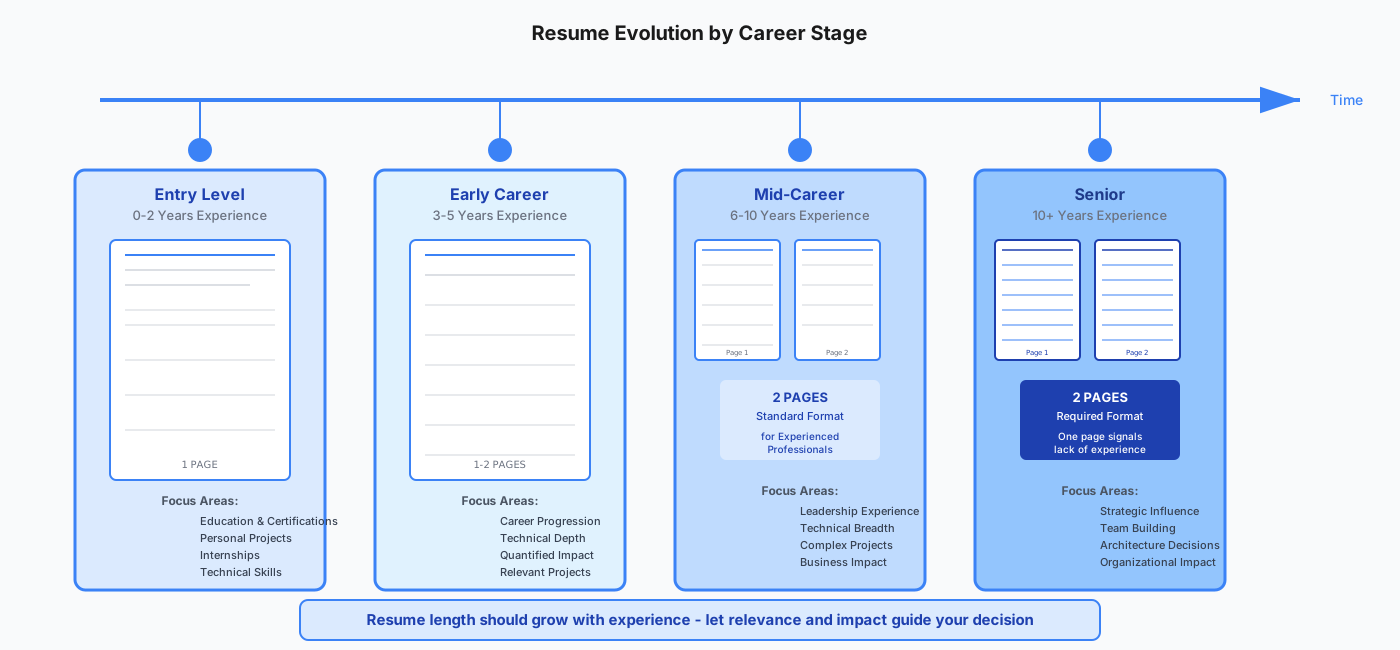 Resume length progression by career stage: from entry-level one-pagers to senior two-page formats
Red Flags to Avoid
When optimizing resume length, avoid these common resume mistakes that undermine your application:
On a one-page resume:
- Tiny fonts (below 10pt) to cram content
- Dense paragraphs that sacrifice readability
- Missing key achievements to save space
- Generic statements that lack impact
On a two-page resume:
- Irrelevant roles from 15+ years ago
- Repetitive descriptions across roles
- Unnecessary personal details
- Filler content just to reach two pages
The Content Test
Ask yourself:
- Does every section strengthen my case for this role? (If no, cut or condense)
- Can a hiring manager quickly identify my key qualifications? (If no, restructure)
- Am I providing enough context for my achievements? (If no, expand where needed)
- Would this resume work if it were one page shorter or longer? (If yes, optimize)
How to Structure a Two-Page Resume
If you've determined that two pages are justified, here's how to structure it effectively:
Page One: Lead with Your Strongest Signals
- Professional Summary (3-4 lines highlighting key qualifications)
- Technical Skills (organized by category: languages, frameworks, tools, cloud platforms)
- Most Recent Experience (1-2 most recent roles with detailed achievements)
Goal: By the end of page one, the reader should know:
- What you specialize in
- What technologies you use
- What impact you've delivered
Page Two: Depth and Supporting Evidence
- Additional Experience (earlier roles, with less detail)
- Education and Certifications (degrees, bootcamps, relevant certs)
- Notable Projects (open-source, side projects, or significant work)
- Additional Skills or Recognition (optional: publications, talks, awards)
Goal: Page two provides supporting context that reinforces your qualifications without overwhelming the reader.
Formatting Tips
- Use a clean, ATS-friendly template (avoid graphics, tables, or complex layouts)
- Maintain consistent spacing (same margins, line spacing, and section breaks)
- Use standard section headings (Experience, Education, Skills, Projects)
- Include a page number (optional but professional: "Page 1 of 2")
- Don't split a role across pages (keep each position on a single page)
When to Customize Length for Each Application
Ideally, you maintain a master resume with all your experiences, then tailor it for each application. This allows you to:
- Expand or condense based on role requirements (senior role = two pages; niche role = one page)
- Highlight relevant experiences (emphasize frontend for UI roles, backend for API roles)
- Adjust technical skills (prioritize skills mentioned in the job description)
Structured Resume Tip: Maintaining a structured resume format (for example, using a JSON-based system like CoreCV.ai) makes role-specific tailoring dramatically easier. You keep one comprehensive data source and generate tailored versions without manual reformatting.
This approach lets you optimize length dynamically rather than committing to a rigid format.
Real-World Examples
Let's look at how length decisions play out in practice:
Example 1: Junior Developer (1 page)
Profile: Bootcamp grad with 1 year of experience, applying for Junior Full-Stack Developer role
Why one page works:
- Limited work history (1 internship, 1 junior role)
- 3 strong personal projects demonstrate capability
- Technical skills clearly listed
- Education and certifications provide additional credibility
Structure:
- Summary (2 lines)
- Technical Skills
- Experience (2 roles, 4-5 bullets each)
- Projects (3 projects, 2-3 bullets each)
- Education (bootcamp + degree)
Result: Tight, focused, demonstrates potential without overstating experience.
Example 2: Senior Engineer (2 pages)
Profile: 8 years of experience across 4 companies, applying for Senior Backend Engineer role
Why two pages are necessary:
- 4 relevant roles with increasing responsibility
- Complex projects (platform migration, performance optimization, team leadership)
- Leadership and mentorship experience
- Technical breadth across multiple stacks
Structure (Page 1):
- Summary (3 lines emphasizing backend expertise)
- Technical Skills (categorized by backend, infrastructure, tools)
- Current Role (6-7 bullets showing impact)
- Previous Role (4-5 bullets)
Structure (Page 2):
- Earlier Roles (2-3 bullets each, less detail)
- Education
- Certifications (AWS Certified Solutions Architect, etc.)
- Notable Open-Source Contributions
Result: Comprehensive view of career progression, technical depth, and leadership - impossible to convey in one page without losing critical context.
Example 3: Staff Engineer (2 pages, highly focused)
Profile: 12 years of experience, applying for Staff Engineer (Infrastructure) role
Why two pages work (but tightly edited):
- Only includes infrastructure-related experience
- Earlier non-infrastructure roles condensed to single lines
- Focus on architectural decisions and platform impact
- Leadership influence at scale
Structure (Page 1):
- Summary (4 lines emphasizing infrastructure architecture)
- Technical Skills (focused on cloud, infrastructure, observability)
- Current Role (7-8 bullets, deep technical detail)
- Previous Role (5-6 bullets)
Structure (Page 2):
- Earlier Roles (1-2 bullets each, infrastructure focus only)
- Key Projects (2-3 major infrastructure initiatives)
- Education and Certifications
- Conference Talks or Publications (if relevant)
Result: Demonstrates staff-level impact and technical depth while staying relevant to infrastructure focus.
The CoreCV.ai Approach
At CoreCV.ai, we take a structured, data-driven approach to resume building that eliminates the artificial constraint of page count. Here's how:
JSON-Based Resume Structure
By storing your resume as structured data (JSON format), you maintain a single source of truth with all your experiences, then generate tailored versions for each role. This means:
- No manual reformatting when switching between one-page and two-page versions
- Dynamic tailoring that adjusts content based on role requirements
- Consistent formatting across all versions
- ATS-friendly output regardless of length
AI-Powered Tailoring
Our AI analyzes job descriptions and suggests which experiences to emphasize, helping you make length decisions based on relevance rather than guesswork.
Template Flexibility
With 9 ATS-optimized templates (3 free, 6 Pro), you can choose formats that handle one or two pages elegantly, maintaining readability and professional appearance at any length.
The goal: let the content and role requirements determine length, not arbitrary rules or formatting limitations.
Final Guidance: Focus on Value, Not Page Count
Here's the bottom line: the right resume length is the length that most effectively communicates your qualifications for the specific role you're targeting.
For Entry-Level Tech Professionals:
- Default to one page unless you have substantial relevant projects or internships
- Prioritize technical skills, education, and hands-on project work
- Focus on potential and learning velocity
For Mid-Career Tech Professionals:
- Use 1-2 pages based on role complexity and experience relevance
- Emphasize quantifiable impact and technical depth
- Show career progression and increasing responsibility
For Senior Tech Professionals:
- Default to two pages to adequately demonstrate leadership and impact
- Focus on strategic contributions, not just technical execution
- Highlight influence, mentorship, and business outcomes
For All Levels:
- Prioritize relevance over completeness (not everything belongs on every resume)
- Structure for scannability (clear headings, bullet points, logical flow)
- Tailor for each role (adjust length and focus based on job requirements)
- Test ATS compatibility (formatting matters more than page count)
The tech industry has moved beyond the one-page rule. It's time your resume strategy did too.
Ready to build a resume that adapts to any role? Try CoreCV.ai for structured, ATS-friendly resumes with flexible length and AI-powered tailoring.
Sources
-
1. CNBC: Hiring Managers Prefer Two-Page Resumes: https://www.cnbc.com/2018/12/19/resumego-hiring-managers-prefer-candidates-with-two-page-resumes.html
-
2. Adobe: How Long Should a Resume Be?: https://www.adobe.com/acrobat/resources/how-long-should-a-resume-be.html
-
3. U.S. Office of Personnel Management: Two-Page Resume Standard: https://www.opm.gov/news/opm-implements-two-page-resume-standard-to-streamline-federal-hiring/
-
4. GeeksforGeeks: When and How to Use Two-Page Resume Format: https://www.geeksforgeeks.org/2-page-resume-when-and-how-to-use-longer-format/Additional research sources:
Disclosure: This article is authored by the CoreCV team. While we mention CoreCV.ai, the strategies and advice presented apply to any modern job search approach. We've focused on providing actionable insights based on industry research and hiring trends.