Prepping for Tech Interviews: System Design vs. Coding Challenges
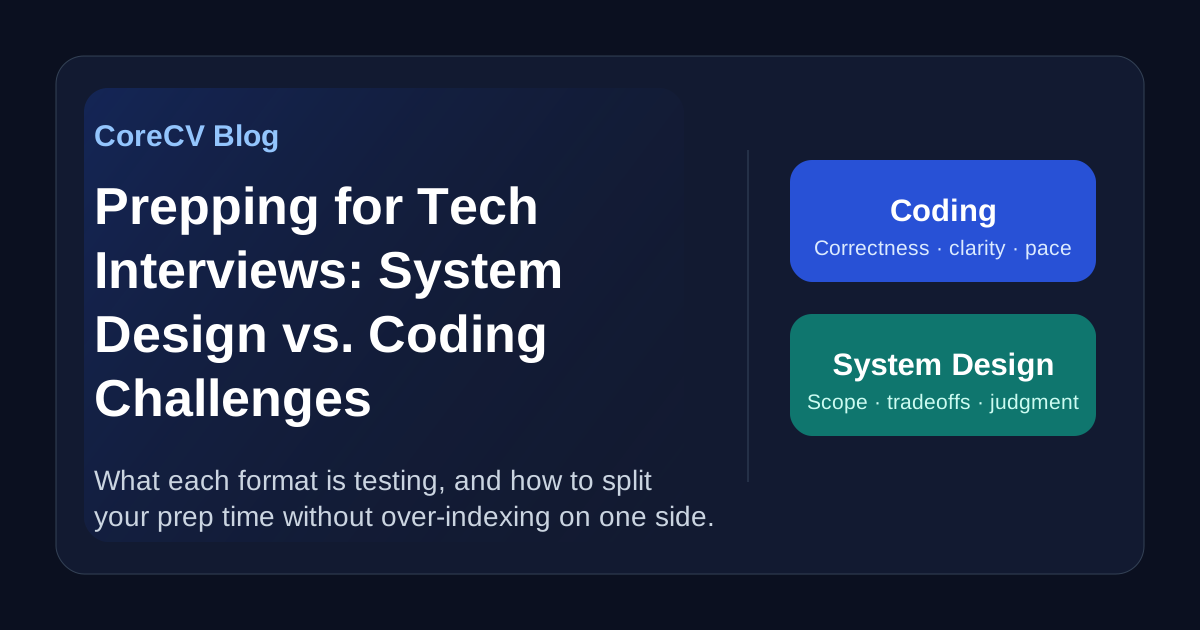
A lot of interview prep goes sideways for one simple reason: candidates often train for whatever feels familiar. Strong builders may over-focus on system design because it sounds like real work. LeetCode-heavy candidates may over-focus on coding rounds because they are easier to schedule and score. In many interview loops, those formats are separated because they are looking for different evidence, and your prep is usually stronger when it reflects that.
That split is getting sharper as employers push harder on skill validation. LinkedIn's 2025 Future of Recruiting report says 89% of talent acquisition professionals expect quality of hire to matter more, 93% say accurately assessing candidate skills is crucial, and companies using the most skills-based searches are 12% more likely to make a quality hire.[1] That does not prove, on its own, that every company now runs stricter technical loops. It does fit a broader trend toward clearer skill validation, which makes vague preparation riskier. You need to know which interview is trying to prove what.
What coding interviews are really testing
Coding rounds are usually the cleaner signal. The question may look like algorithms, data structures, debugging, or practical coding under time pressure, but the interviewer is usually checking a narrower set of things: can you reason clearly, write correct code, communicate tradeoffs, and recover when you hit friction.
Amazon's hiring guidance shows role-specific prep paths and distinct materials for software development roles and more senior variants.[2] That structure does not prove how every team weights each round, but it does reinforce that coding evaluation is treated as a distinct signal rather than a throwaway warm-up.
Good coding prep is therefore less about memorizing every hard pattern and more about building repeatable habits:
- restating the problem in precise terms
- choosing a workable approach before typing
- testing edge cases out loud
- writing readable code under a time limit
- explaining tradeoffs without rambling
If you freeze in coding rounds, the usual cause is not lack of intelligence. It is lack of rehearsal under interview conditions.
 Different interview formats are collecting different kinds of evidence.
What system design interviews are really testing
System design interviews are broader and messier on purpose. The interviewer is not asking whether you can draw a distributed system from memory. They are testing whether you can turn an ambiguous product need into a technical plan with sensible tradeoffs.
This is why system design rounds tend to matter more as scope increases. At mid-level, you may only need to show that you understand APIs, storage, caching, queues, and failure modes well enough to build a reasonable first version. At senior levels, the bar moves toward prioritization, scaling constraints, reliability, operational risk, and judgment under incomplete information.
System design answers get stronger when you make your assumptions explicit, explain tradeoffs in sequence, and tie choices back to the problem in front of you. A strong design answer sounds like an engineer making decisions, not a candidate reciting a textbook.
The easiest mistake is preparing system design as a vocabulary exercise. Knowing the words load balancer, sharding, or eventual consistency does not help much if you cannot explain why you would choose one tradeoff over another.
How to split your prep time
The right split depends more on the target role than on your preferences.
If you are applying for early-career or lower mid-level roles, I would usually bias toward coding because that is where more of the hard filter tends to sit. You still need enough design fluency to talk through APIs, data flow, and basic scaling, but you probably do not need to spend three weeks drawing globally distributed systems.
If you are applying for mid-level to senior backend, platform, infrastructure, or staff-track roles, the split should move closer to even. Once the job expects architecture judgment, coding alone is not enough. Interviewers want evidence that you can choose boundaries, identify bottlenecks, and reason about failure.
One practical way to calibrate is to read the job description like an interview map. If the role emphasizes execution in a familiar stack, coding deserves more time. If it emphasizes ownership, architecture, scale, reliability, or cross-team technical decisions, system design should get a larger share. The Stack Overflow 2024 survey is useful here for a narrower reason: it shows how wide the technology surface really is, with Docker used by 59% of professional developers, PostgreSQL by 49%, Azure by 28%, and Google Cloud by 25%.[3] You do not need to study every popular tool. You do need to practice design discussions in the kinds of systems your target roles actually use.
 Prep time should shift with the role, not just with what you enjoy practicing.
A weekly prep plan that holds up
A balanced plan is usually better than bingeing one format at a time.
Use two sessions each week for live coding under a timer. Use one or two sessions for system design, but keep them grounded: one product requirement, one architecture sketch, one bottleneck analysis, one discussion of tradeoffs and failure modes. Add a short review block after each session to write down where your explanation got fuzzy.
Then connect the prep back to your own experience. The best interview stories often come from shipped work: a migration, a painful incident, a redesign, a performance fix. If you are keeping role-specific resume variants, make sure the versions you send still line up with the stories you are rehearsing. A structured source of truth, including a tool like CoreCV, helps because you can tailor the presentation without drifting away from the underlying facts.
 A smaller, repeatable weekly loop usually works better than last-minute interview cramming.
The goal is not to become equally perfect at every interview format. It is to show the specific evidence the loop is designed to collect. Coding rounds ask whether you can solve and communicate under constraints. System design rounds ask whether you can make good technical decisions when the problem is underspecified. Prepare for those as different jobs, and your interview prep starts making a lot more sense.
Sources
1. LinkedIn. "LinkedIn Report: How AI Will Redefine Recruiting in 2025." https://www.linkedin.com/business/talent/blog/talent-acquisition/future-of-recruiting-2025
2. Amazon Jobs. "How We Hire." https://www.amazon.jobs/content/en/how-we-hire
3. Stack Overflow. "2024 Developer Survey - Technology." https://survey.stackoverflow.co/2024/technology/