Should You Put GitHub on Your Resume? Sometimes.
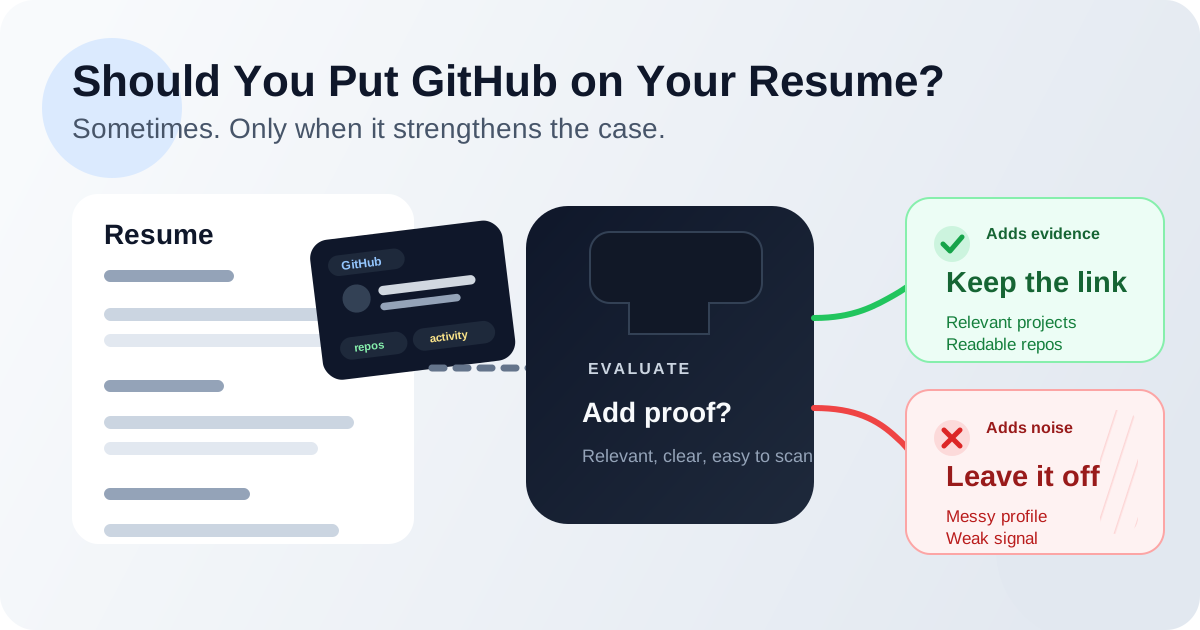
A GitHub link is not a default requirement on a software engineer resume. It helps when it gives a hiring team better evidence of how you work, what you build, or what kind of technical judgment you have. It hurts when it sends them to a messy profile, half-finished tutorials, or repositories that add less than the resume already shows.
That distinction matters because good resumes are built for fast scanning and clear relevance. MIT's career guidance recommends keeping a master resume but tailoring the version you send so the most relevant evidence is easy to see.[1] Harvard makes a similar point: write for people and systems that skim quickly, keep the document easy to scan, and order information by importance.[2] A GitHub link should meet that same standard. If it makes someone work harder to understand your fit, it is probably not helping.
When GitHub strengthens a resume
GitHub is most useful when your public work adds proof that is otherwise hard to show in a short resume.
That is often true for junior candidates, career switchers, and self-taught developers. If your professional experience is still thin, a clean profile can show that you ship projects, write documentation, work with current tools, and finish what you start. It can also help when you have meaningful open source contributions, a well-documented side project that matches the role, or technical writing that shows how you think.
GitHub itself gives you ways to shape that first impression. You can pin repositories, surface contribution activity, and add a profile README, which means a linked profile should look curated rather than accidental.[3]
A brief market reality is useful here, but only in a narrow sense: GitHub remains a mainstream place where developers publish and organize technical work, and the tools many employers care about are widely used across the industry.[4][5] That does not mean a GitHub link is automatically valuable. It means recruiters will recognize the environment. The value still comes from relevance and quality.
 A GitHub link helps only when the profile adds more evidence than it costs in attention.
When GitHub does not help
GitHub usually hurts for familiar reasons: the work is irrelevant to the job, the profile is noisy, or the link duplicates stronger evidence already on the resume. A senior backend engineer applying for platform roles does not gain much from sending someone to abandoned class exercises or unrelated frontend tutorials. A profile full of forks, vague repo names, and empty READMEs creates extra interpretation work. And if your resume already shows the exact systems, scope, and outcomes the role calls for, GitHub may not add anything unless it reveals something your job history cannot, such as open source leadership, public technical writing, or unusually relevant side work.
There is another important nuance: some strong candidates should not link GitHub at all because their best work is proprietary, private, or covered by NDA. That is normal. You do not need public code to be credible. If your strongest evidence lives in shipped products, internal systems, or confidential client work, your resume should carry that story on its own.
What makes a GitHub profile worth linking
A profile is worth linking when the first screen already tells a coherent story. Usually that means a recognizable name or handle, a short bio or profile README, a few pinned repositories chosen on purpose, clear repo names, usable READMEs, and activity recent enough to feel current. You are not trying to look prolific. You are trying to make your judgment visible.
A useful rule of thumb by career stage is simple. For junior candidates, GitHub is often worth linking if it contains your best proof of capability. For mid-career candidates, it should add something the resume cannot show well on its own, such as side projects, writing, demos, or visible contributions outside work. For senior candidates, the bar is higher: the profile should reinforce leadership, depth, specialization, or outside credibility, not just prove that an account exists.
A practical test works well: if a hiring manager clicked this link, would they understand your fit more clearly within a quick skim? If yes, keep it. If not, leave it off and use the space to strengthen the resume itself.
If you keep a structured master resume and maintain tailored versions for different roles, it gets easier to decide what belongs on the page and what belongs behind a link. Tools like CoreCV can help organize project and experience content inside that workflow, but the main decision stays the same: link GitHub only when it makes your case clearer.
Sources
1. MIT Career Advising & Professional Development, Resumes: https://capd.mit.edu/resources/resumes/
2. Harvard FAS Mignone Center for Career Success, Create a Strong Resume: https://careerservices.fas.harvard.edu/resources/create-a-strong-resume/
3. GitHub Docs, About your profile: https://docs.github.com/en/account-and-profile/concepts/personal-profile
4. GitHub, Octoverse 2024: https://github.blog/news-insights/octoverse/octoverse-2024/
5. Stack Overflow, 2024 Developer Survey - Technology: https://survey.stackoverflow.co/2024/technology/