Highlighting Soft Skills: Communication and Leadership on a Technical Resume
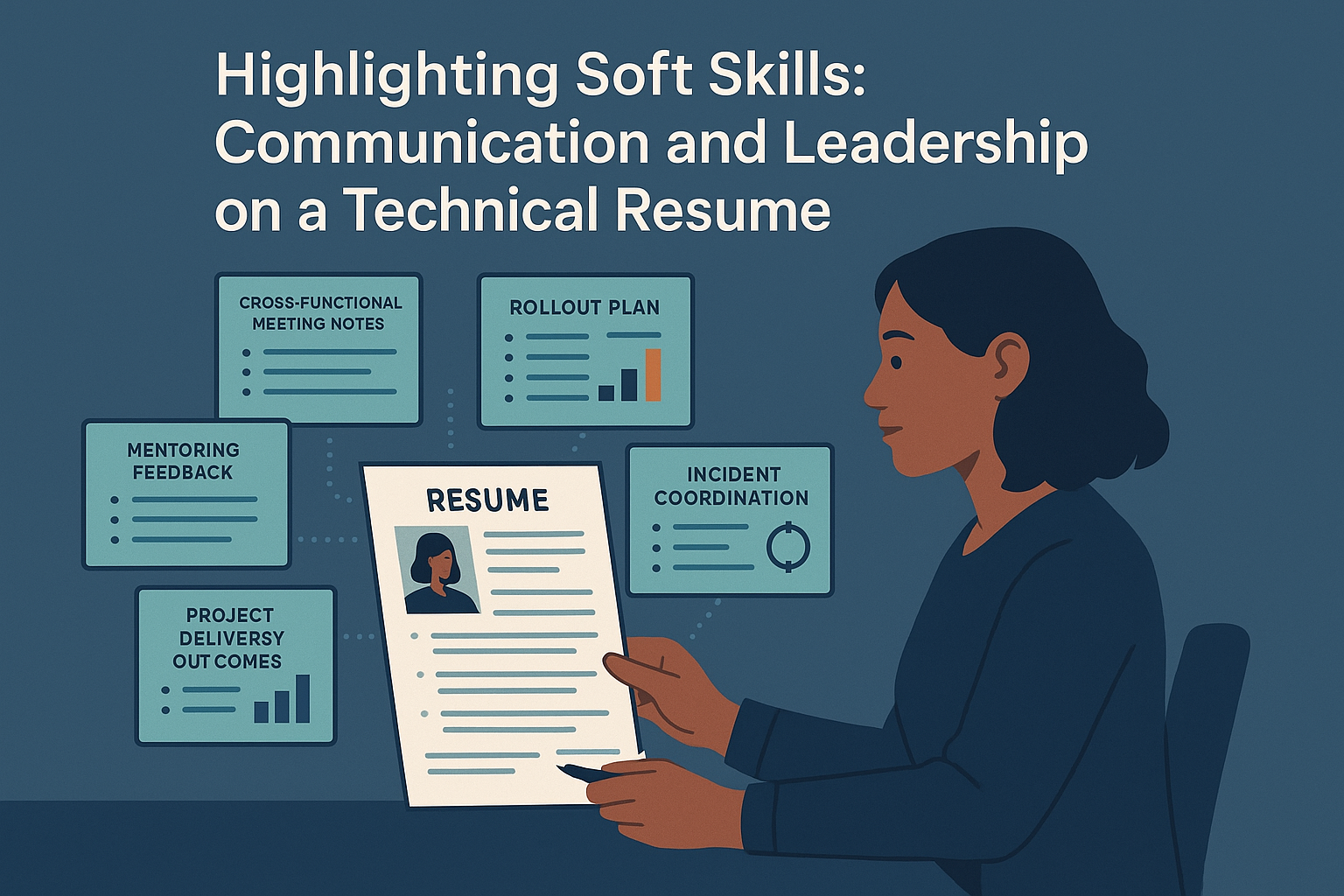
Soft skills do belong on a technical resume. The mistake is treating them like personality traits instead of job evidence. Hiring teams are not looking for "great communicator" or "strong leader" floating in a summary with nothing behind it. They are looking for proof that you can align people, explain complex work clearly, make decisions, mentor others, and move projects forward. That matters because resumes are scanned quickly, and vague claims disappear fast while specific, outcome-based evidence survives the skim.[1][2]
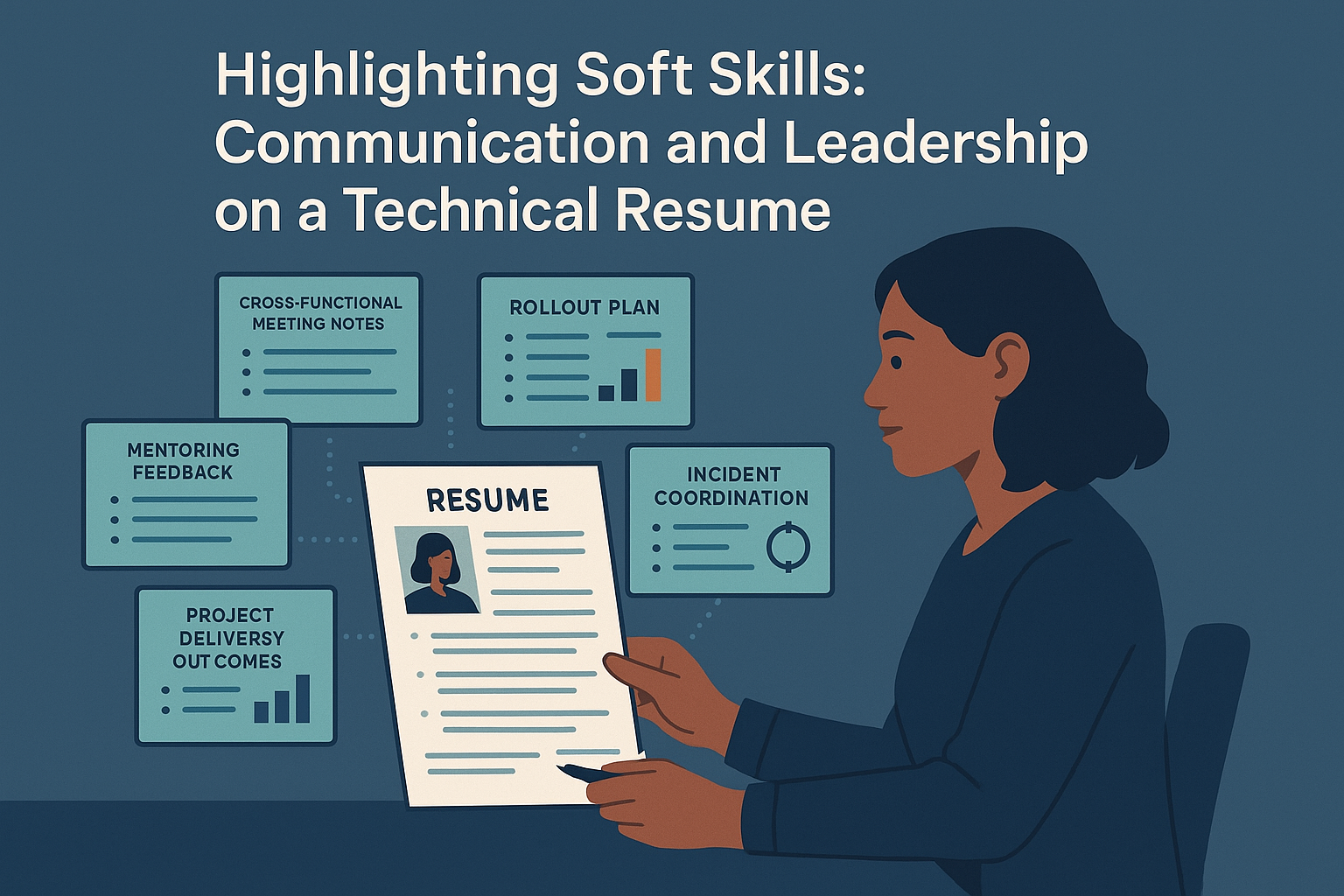
For technical roles, communication and leadership are usually visible in the work itself. Did you run a migration across teams, present tradeoffs to product and design, mentor a junior engineer, or unblock an incident by coordinating decisions under pressure? Those are soft skills. The goal is not to create a separate list of buzzwords. It is to make those capabilities legible in the places where employers already look.
Start with evidence, not adjectives
The fastest way to weaken a technical resume is to claim soft skills directly without showing them. "Excellent communicator." "Strong team player." "Proven leader." None of those phrases tells a hiring manager what you actually did.
Harvard's resume guidance is useful here: be specific, fact-based, and demonstrate results.[1] MIT makes a similar point, noting that experience descriptions should emphasize accomplishments and visible relevance, not generic responsibility statements.[2]
That means a better soft-skills bullet usually follows a simple pattern: what situation you handled, how you worked with others, and what changed because of it.
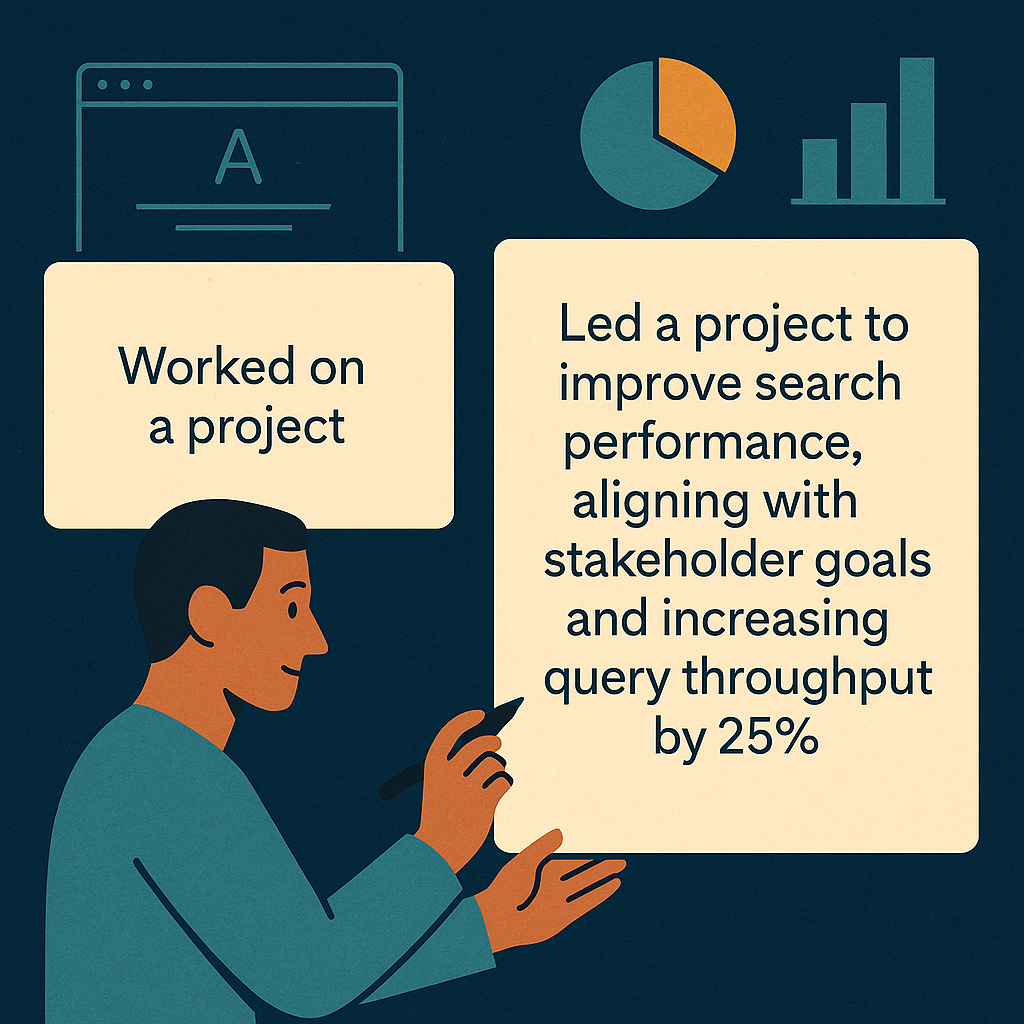
Instead of this:
- Strong communication skills across technical and business teams
Write something like this:
- Translated API reliability issues for product and support partners during a payments incident, helping the team prioritize fixes and reduce repeat escalations over the next release cycle
The second version still shows communication, but it does so through real work.
Communication is more than presenting clearly
On technical resumes, communication often gets reduced to public speaking. That is too narrow. Communication shows up in architecture proposals, design reviews, documentation, incident updates, stakeholder alignment, and handoffs between teams.
NACE includes communication, leadership, and teamwork among its core career readiness competencies, which is useful here mainly as a reminder that these are real workplace skills, not filler categories.[3] For an experienced technical resume, the stronger move is still to show how that communication showed up in the work itself.
In practice, strong communication bullets usually make one of three things easy to see: you made complexity understandable, you created alignment across different groups, or you reduced confusion that was slowing work down. That might mean writing rollout notes for an internal platform change so four engineering teams could adopt it with fewer support questions. It might mean walking product and engineering leads through system tradeoffs so the team chose a phased migration instead of a riskier full cutover. Or it might mean coordinating bug triage across support, QA, and backend engineering so high-priority defects moved faster. These are still technical bullets. They just make the communication part visible.

Leadership does not have to mean people management
Many technical candidates undersell leadership because they assume it only counts if they had direct reports. On resumes, leadership is often better understood as ownership, guidance, and influence.
You can show leadership by setting direction on a project, mentoring less experienced teammates, improving execution across a team, or making decisions that reduced risk. That applies to senior engineers, team leads, staff engineers, and often mid-career candidates too. Even junior candidates can show leadership through onboarding help, documentation ownership, or leading a small initiative.
The most convincing leadership examples usually sound like work, not self-description. Mentoring two junior engineers through code reviews and release work shows leadership because it helped them ramp faster. Leading the technical plan for a customer-facing dashboard rewrite shows leadership because it aligned backend and frontend work well enough to avoid a rollback. Introducing a clearer incident handoff across on-call rotations shows leadership because it improved response consistency when the stakes were real. In each case, the resume never has to announce "I am a leader." The reader can infer it from the result.

Put soft-skill evidence where it carries the most weight
Many candidates will be better served by putting soft-skill evidence directly into experience bullets, because that is where the reader can see context and outcomes together. A dedicated skills section can still help in some cases, especially when you want to mirror recurring job-description language or support ATS matching around collaboration, stakeholder communication, or mentoring. If you keep one, make it concise. The stronger proof should still live in the work history.
If you use a summary, keep it restrained. It can frame the kind of work you do, but it should not become a pile of personality claims. Experience is the main event. Projects can also help if they involved collaboration, mentoring, or cross-functional ownership.
Quantification helps when it is honest. You may not be able to put a number on "good communication," but you can often quantify the scope around it: number of teams aligned, size of the rollout, incident volume reduced, onboarding time improved, stakeholders supported, or releases coordinated.
If you keep a structured master resume in CoreCV, it becomes easier to save several strong examples of communication and leadership, then reuse the ones that fit the role you want.
The standard to aim for
A strong technical resume does not separate hard skills from soft skills as if one is real work and the other is decoration. Communication, leadership, and teamwork matter when they help technical work land: fewer misunderstandings, smoother releases, stronger mentoring, better decisions, and clearer execution.
If a hiring manager finishes your resume with a clear sense that you can build, explain, coordinate, and lead work responsibly, you have done enough. In a fast resume screen, that kind of concrete evidence travels farther than another line of adjectives because it helps someone picture how you would work with their team. You do not need more soft-skill language. You need better proof.
Sources
1. Harvard FAS Mignone Center for Career Success, Create a Strong Resume: https://careerservices.fas.harvard.edu/resources/create-a-strong-resume/
2. MIT Career Advising & Professional Development, Resumes: https://capd.mit.edu/resources/resumes/
3. National Association of Colleges and Employers, What is Career Readiness?: https://www.naceweb.org/career-readiness/competencies/career-readiness-defined