Career Pivot 101: Rebranding Yourself for a New Tech Path

A tech career pivot usually fails for a simple reason: the story looks wider than the evidence. Harvard and MIT both advise candidates to tailor resumes so relevant skills and accomplishments are visible immediately rather than buried in a generic work history.[1][2] If you want to move from developer to product manager, or from QA to DevOps, the goal is not to pretend you already held the new title. It is to make the overlap legible.
That starts by dropping the idea that you are starting over. Many pivots inside tech are adjacency moves, where you carry forward domain knowledge, communication, and technical judgment into a role that sits nearby. NACE frames career readiness as a mix of communication, critical thinking, teamwork, technology, and career self-development, which is a useful reminder that valuable experience is broader than a job title alone.[4]
Start with the overlap, not the dream title
A weak pivot resume opens with aspiration: "Engineer seeking to become a product manager." A stronger one opens with evidence: roadmap input, customer-facing decisions, launch coordination, experimentation, or cross-functional leadership. Harvard recommends fact-based writing and MIT emphasizes accomplishments over responsibilities.[1][2]
That means listing the work you already did that lives close to the target role. A developer moving toward product management can highlight prioritization, stakeholder communication, tradeoff decisions, and feature discovery. A QA engineer moving toward DevOps can highlight test automation, CI/CD exposure, release reliability, incident prevention, and collaboration across development and operations. AWS describes DevOps as a model built around removing barriers between development and operations, increasing efficiency, and sharing responsibility for reliability.[5]
Rewrite your resume around proof of direction
Do not rewrite your background into fantasy. Instead, reorder it around the evidence that already supports the move.
Use your headline, summary, and top bullets to point toward the next role. MIT advises using the position description to decide what to include.[2] If you are targeting product roles, push discovery work, metrics, and cross-team leadership higher. If you are targeting DevOps roles, bring automation, deployment, observability, and reliability evidence closer to the top.
This is also where transferable skills need specifics. "Strong communicator" is forgettable. "Worked with design, support, and engineering to narrow scope and ship a high-impact feature" is better. "Improved release confidence by expanding automated test coverage in CI" is better than "collaborative QA professional." Harvard explicitly recommends specific, active, quantified language written for people and systems that scan quickly.[1]
Your skills section should also tighten up. Remove tools that pull attention toward the wrong lane, keep the ones that support the new direction, and mirror the target role's language where it is honest to do so. Recruiters often search with filters and structured fields, so naming relevant skills clearly can matter long before anyone reaches the interview stage.[3]
 Reorder the resume around evidence that already supports the move.
Build evidence outside the resume when needed
Sometimes the pivot gap is not storytelling but proof.
If that is the case, do not wait for permission. Look for small but visible ways to accumulate evidence: write product briefs for an internal idea, shadow roadmap meetings, own release checklists, improve deployment docs, contribute to observability work, or ship a side project that reflects the target path. NACE's career readiness framework explicitly includes proactive learning, feedback, networking, and relationship-building as part of career self-development.[4]
The key is relevance over volume. One credible project tied closely to the target role beats a pile of random coursework.
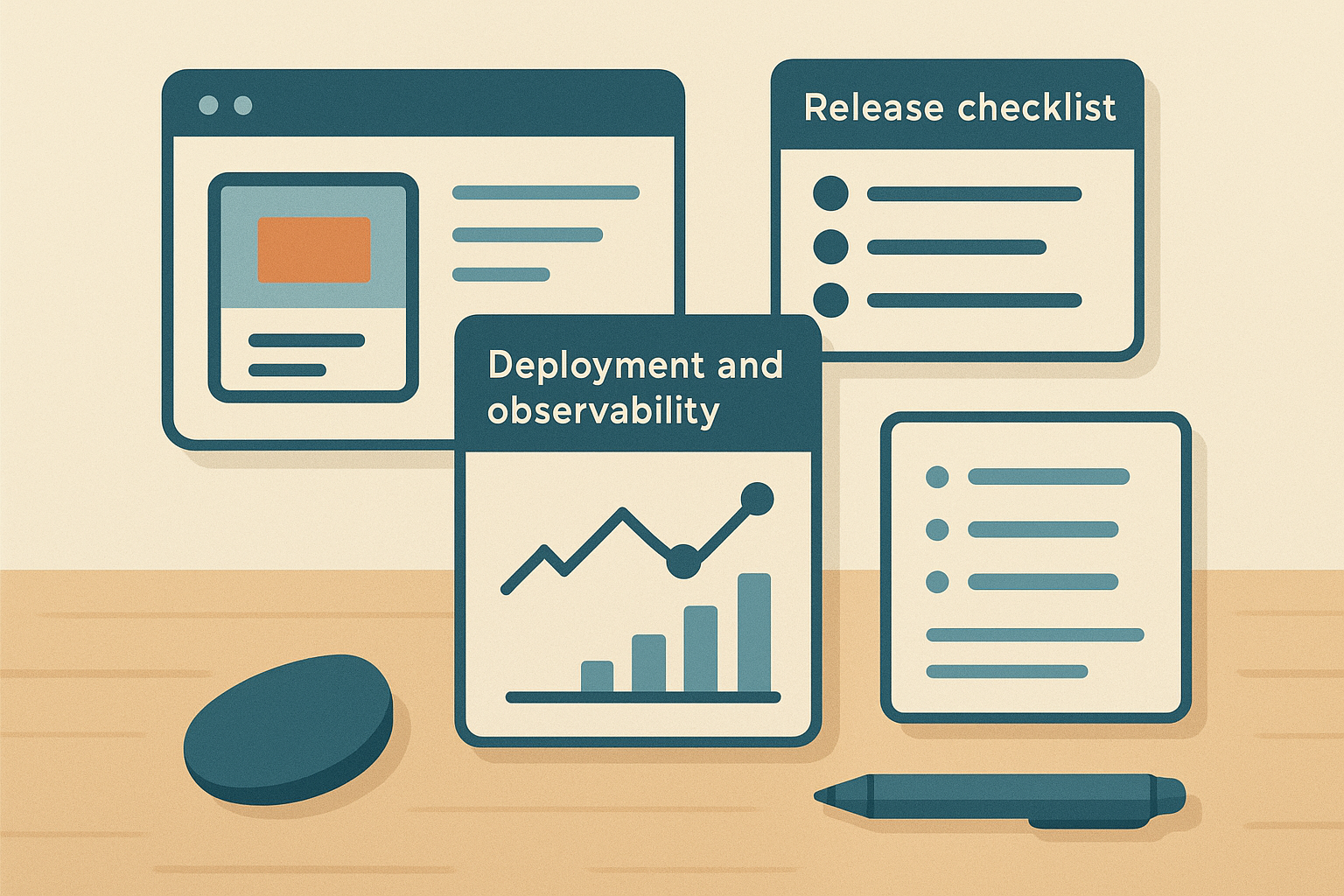 Small, relevant proof artifacts carry more weight than vague ambition.
Use networking to sharpen your language
Networking gets framed as visibility, but for a pivot it is also research. You need to know how people in the target role describe success, what problems they own, and what signals actually make them hireable.
Talk to people who already made the move you want. Ask which parts of your current background would carry the most weight and what examples they would expect in an interview. That gives you better bullets, better LinkedIn framing, and better answers when someone asks why this pivot makes sense. LinkedIn's recruiter tooling is built around structured search and filters, so clearer role language across your profile increases the odds that your pivot story gets surfaced.[3]
Keep the story consistent everywhere
A pivot feels convincing when your resume, LinkedIn, and interview answers all point in the same direction. If one says "senior backend engineer," another says "aspiring PM," and your examples wander across five different goals, you create doubt instead of momentum.
Pick a simple throughline and repeat it with evidence. Something like: "Software engineer moving toward product work through feature prioritization, customer-facing collaboration, and launch ownership." Or: "QA engineer growing into DevOps through automation, CI/CD, and release reliability work." Then make sure your bullets, featured projects, and conversations keep proving that sentence.
If you maintain multiple resume versions, a tool like CoreCV can help you keep one structured base resume and produce tighter variants for adjacent roles without losing the facts. That matters when you are testing a pivot and need consistency more than reinvention.
 The pivot feels credible when every surface tells the same story.
The takeaway
A good tech career pivot reads less like an identity swap and more like a credibility exercise.
Lead with overlap, tighten the language, collect evidence that fits the next role, and make the story consistent across every surface a recruiter sees. When the pivot looks adjacent and well-supported, it starts reading like the next logical step.
Sources
1. Harvard FAS Mignone Center for Career Success, Create a Strong Resume: https://careerservices.fas.harvard.edu/resources/create-a-strong-resume/
2. MIT Career Advising & Professional Development, Resumes: https://capd.mit.edu/resources/resumes/
3. LinkedIn, LinkedIn Recruiter: https://business.linkedin.com/hire/recruiter
4. NACE, What is Career Readiness?: https://www.naceweb.org/career-readiness/competencies/career-readiness-defined
5. AWS, What is DevOps?: https://aws.amazon.com/devops/what-is-devops/