How to Show Promotions on a Resume Without Losing the Story

Promotions are one of the strongest signals on a resume because they show that one employer kept increasing your scope and trust. The problem is that many resumes hide that signal under clutter. If the reader cannot quickly tell whether you moved from engineer to senior engineer to staff engineer, or whether those title changes actually came with broader ownership, the story gets lost. Harvard advises candidates to tailor resumes to the role they want and to write for readers and systems that scan quickly. MIT likewise recommends using the position description to decide what belongs on the page and making relevant information immediately visible.[1][2]
Start by making the progression obvious
A promotion should not require detective work.
If you spent several years at one company and advanced through multiple roles, the first job of the resume is to make that progression legible in a few seconds. That usually means showing one company heading with an overall date range, then listing the titles beneath it in reverse chronological order with their own dates. This preserves continuity while making the growth easy to see.
That structure works especially well when the roles are closely related, such as Software Engineer, Senior Software Engineer, and Staff Software Engineer. The employer sees one story: same company, increasing responsibility, deeper trust.
Berkeley's resume guidance emphasizes clear parallels between experience and employer needs, with attention on outcomes rather than generic description.[3] A clean progression helps because it gives context to those outcomes. A systems migration matters more when the reader can also see that you were promoted before leading it.
When to stack roles and when to split them
The right format depends on how different the roles really were.
If the work evolved naturally within the same function, stacking roles under one company is usually best. It keeps the resume compact and highlights continuity. This is the common case for engineering promotions where the domain, team, and technical surface stayed broadly related while your scope grew.
 Stack related roles when continuity is the main story.
If the role changed substantially, splitting can be better. For example, if you moved from software engineer into engineering manager, or from individual contributor work into product leadership, separate entries may help because the work itself changed enough to deserve distinct accomplishment sets.
Yale's career guidance emphasizes strong organization and accomplishment-focused writing.[4] That is the useful test here. If stacking makes the bullets confusing, split the roles. If splitting creates duplicate company context and wastes space, stack them.
You do not need a perfectly uniform rule for every employer in your history. You need a format that makes each story easier to scan.
Show increasing scope, not repeated job descriptions
The most common mistake is repeating the same bullets under every promoted title with only minor wording changes.
That wastes space and weakens the promotion story. If three roles all say you built APIs, fixed bugs, and collaborated cross-functionally, the reader sees motion without meaning.
Instead, make the bullets reflect what expanded.
For the earlier role, emphasize execution. For the later role, emphasize broader ownership, harder technical decisions, mentoring, architecture, cross-team coordination, or business impact. MIT advises candidates to prioritize what is most relevant to the target role.[2] That means older roles often need fewer bullets, while the most recent and most senior role deserves the clearest evidence.
A simple pattern works well:
- include one or two bullets that capture standout impact from the earlier role
- give more space to the later role where scope increased
- keep shared technologies or domain context concise instead of restating the same environment three times
 Bullets should show what expanded, not just that the title changed.
Berkeley's emphasis on outcomes is important here too.[3] "Promoted after leading migration of billing services to reduce incident volume by 35%" tells a stronger story than three nearly identical bullets about backend development.
Handle minor title changes honestly
Not every title change needs to be framed like a major promotion.
Some companies rename levels, standardize titles, or make administrative changes that do not reflect a meaningful jump in responsibility. If that happened, do not oversell it. The resume should communicate growth, not litigate internal HR structures.
In cases like that, you can often simplify. Keep the company together, show the highest or most relevant title clearly, and mention the progression only if it helps the reader understand your path. Harvard's guidance favors clarity and relevance over clutter.[1] That applies here. A smaller title adjustment that adds no real meaning may deserve less visual weight than a major expansion in scope.
The same applies to very short intermediate roles. If you held a title for six months before another promotion and there was no clear change in work, listing every stage separately can make the resume look noisier without making it more persuasive.
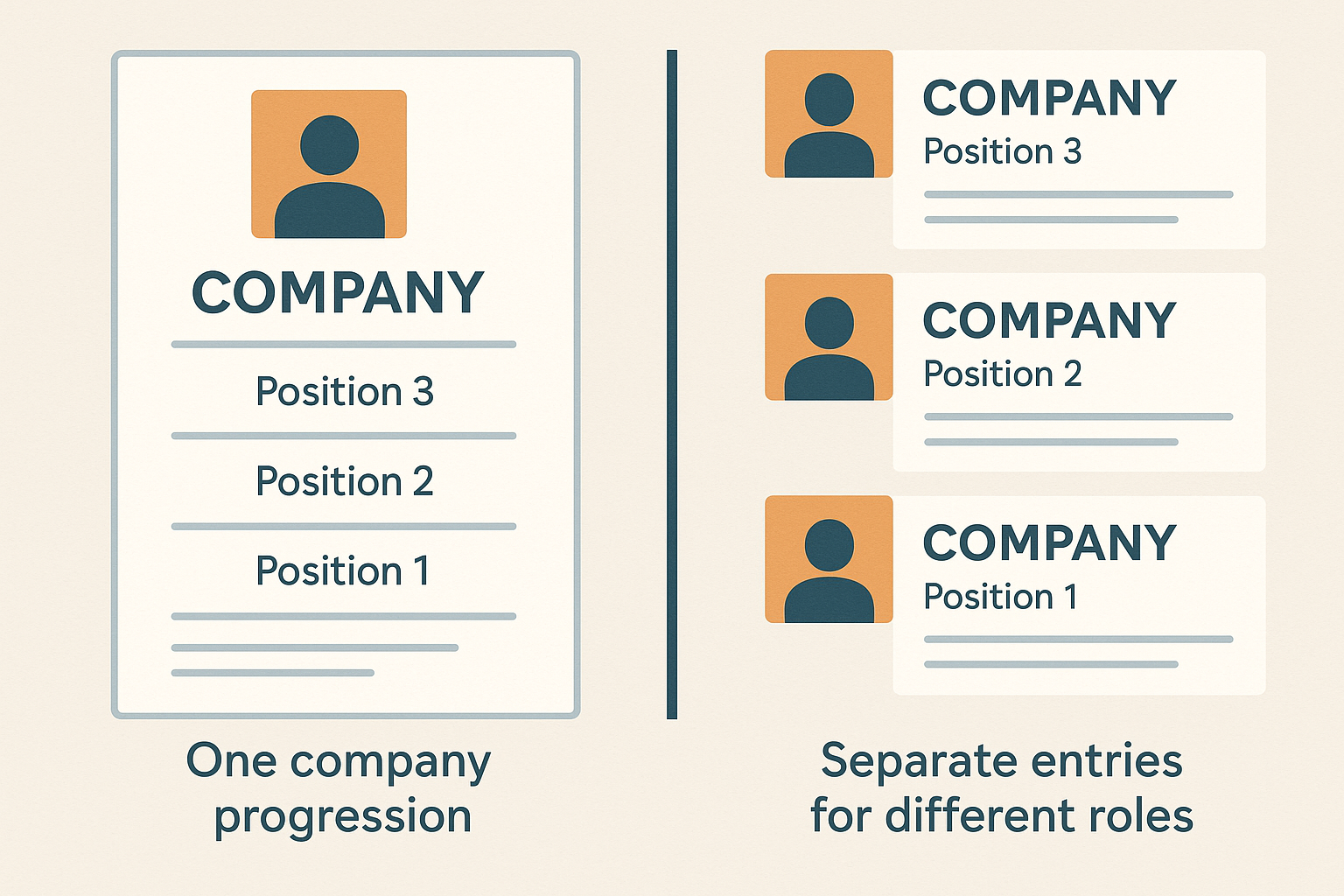 Split roles when the work changed enough to need separate evidence, not just because the title changed.
A practical rule for formatting promotions well
Use the format that makes two things obvious fast: you stayed, and you grew.
The reader should be able to tell, without slowing down, that one company kept trusting you with more. They should also be able to see what changed at each stage: bigger systems, broader ownership, stronger results, or leadership over work that mattered more. If you cannot point to a real change in scope, do not give the title change oversized treatment. Keep the visual emphasis proportional to what actually changed.
That is the whole goal. Promotions are not valuable because the arrows point upward. They are valuable because they prove progression in a way employers recognize quickly.
This is also where a structured master resume helps. If you use CoreCV.ai to manage multiple resume versions, you can keep shared accomplishments attached to the right role, reuse the strongest promotion evidence for different applications, and avoid rewriting the same company history from scratch every time.
The standard to use
Make the company history easy to scan. Stack related roles when continuity matters. Split roles when the work changed enough to justify distinct evidence. Give the most space to the role that best represents your current level. Trim repetitive bullets, and make each title earn its place by showing what actually grew.
A promotion already tells part of the story. Your formatting and bullets should make the rest of it obvious.
Sources
1. Harvard FAS Mignone Center for Career Success, Create a Strong Resume: https://careerservices.fas.harvard.edu/resources/create-a-strong-resume/
2. MIT Career Advising & Professional Development, Resumes: https://capd.mit.edu/resources/resumes/
3. UC Berkeley Career Engagement, Resumes: https://career.berkeley.edu/prepare-for-success/resumes/
4. Yale Office of Career Strategy, Resumes, CVs, Cover Letters, and Thank You Notes: https://ocs.yale.edu/channels/resumes-cover-letters-thank-you-notes/
5. Indeed Career Guide, How To Show a Promotion on a Resume: https://www.indeed.com/career-advice/resumes-cover-letters/show-promotion-on-resume
Disclosure: This article is authored by the CoreCV team. While we mention CoreCV.ai, the strategies and advice presented apply broadly to modern job searching and resume writing.