How to Spot a Bad Job Posting Before You Apply

A bad job posting rarely costs just ten minutes. For technical candidates, one vague listing can turn into hours of resume tailoring, recruiter screens, take-home work, and interview prep before you discover the company never defined the role well in the first place. Learning to screen postings early is one of the easiest ways to protect your time.
Not every weak posting points to a terrible job. Some teams move fast, some hiring managers are not strong writers, and some legitimate roles are posted with less detail than they should have. The real question is whether the listing still gives you enough signal to judge the work, the level, and the process before you invest real effort.
What a credible posting should tell you
A solid posting does not need polished marketing copy. It should, however, make the basics legible. You should be able to tell what kind of problems the team needs solved, whether the role is mostly hands-on delivery or something broader, what level they seem to be hiring for, and what constraints matter most. Employment type, location expectations, and at least some compensation context also help you decide whether the opportunity belongs in your funnel.
If one of those details is missing, that is not automatically a deal-breaker. If most of them are missing, it usually means the employer is still fuzzy about the role itself. That fuzziness often shows up later as a messy interview loop, shifting expectations, or a resume target that is too vague to tailor well.

Signs the company may not know what it wants
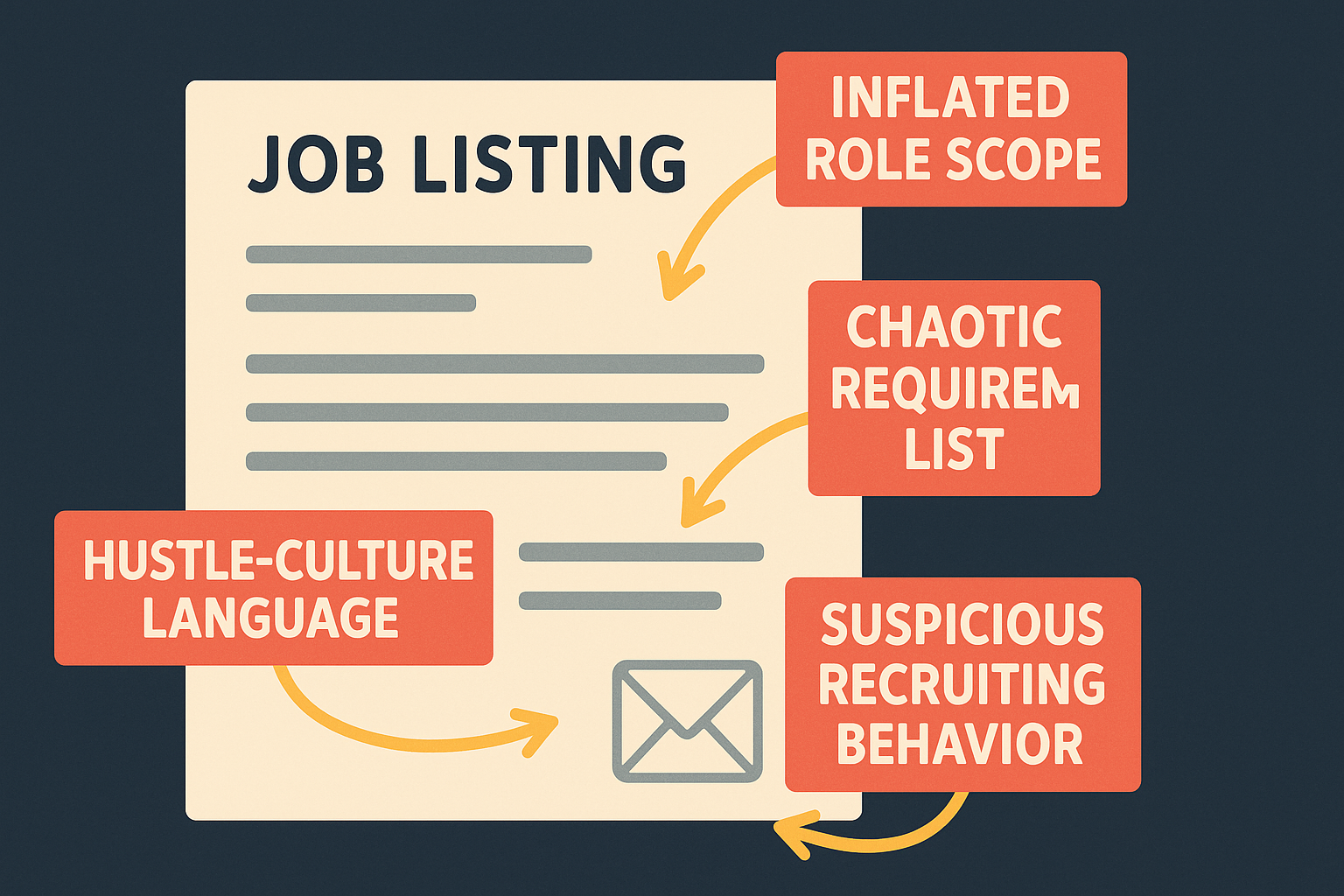
One common problem is vagueness disguised as ambition. A posting that asks one person to own architecture, feature delivery, hiring, support coverage, stakeholder management, and security can be describing several different jobs at once. Sometimes that reflects a startup reality. Sometimes it reflects a team that has not decided what success actually looks like.
Another warning sign is a requirement list with no hierarchy. Long tech stacks are normal. What matters is whether the posting helps you tell the difference between core requirements and nice-to-haves. If every framework, cloud tool, and soft skill is presented as equally mandatory, it becomes harder to tell what the team will value in practice.
Language can also reveal a lot, even when it is not proof of anything by itself. Terms like "rockstar," repeated references to wearing many hats, or heavy emphasis on pressure and hustle may simply reflect lazy writing. They can also hint at unclear boundaries, understaffing, or a culture that treats strain as normal. Treat wording like this as a clue to verify in screening calls, not as a verdict on its own.
Contradictions matter too. If the title says senior but the pay range, scope, or experience band reads junior, the company may be trying to hire above budget. If the role is labeled remote but quietly expects frequent office time, that mismatch will probably not get easier later.
When to worry about scams, not just sloppy hiring
Some postings are low quality. Others are designed to steal money or personal information. The FTC warns that scammers advertise jobs through the same channels legitimate employers use and often want your money or sensitive information, not your skills.[1]
That is why a few signals should make you slow down or walk away. Up-front requests to pay for training, equipment, certifications, or background checks are a major warning sign. So are offers promising unusually high pay for very little work. The FTC is explicit on that point: if someone promises a lot of money for little effort, it is almost certainly a scam.[1]
Other behaviors deserve extra caution, even when context matters. If a recruiter pushes you away from normal hiring channels immediately, asks for highly sensitive information before there is a legitimate need, or seems ready to make an offer without any meaningful evaluation of your fit, treat that as a reason to verify the company independently before continuing.
Do a five-minute screen before you tailor your resume
A quick screen can save you from optimizing for the wrong opportunity. Start by trying to describe the role in one sentence. If you cannot explain what the team probably needs, the posting is too muddy to support thoughtful tailoring.
Next, separate the true requirements from the noise. Harvard advises candidates to tailor a resume to the kind of position they are seeking and to write for people and systems that scan quickly.[2] MIT similarly recommends using the position description to decide what to include and making relevant information immediately visible.[3] That advice is useful only when the posting gives you a coherent target.
Then check for internal consistency. Title, scope, seniority, compensation, and location expectations should broadly line up. Finally, ask yourself whether the hiring process sounds grounded in a real role. A team does not need perfect wording, but it should sound like it knows why it is hiring.

A simple standard to use
The best postings are clear enough for you to make a rational decision. You can see the likely work, the likely level, and the likely tradeoffs without having to reverse-engineer the job from buzzwords. If all you see is inflated scope, generic culture language, and process friction, that is useful information too.
Once a posting passes that screen, tailoring becomes worth the effort. If you keep a structured master resume in CoreCV.ai, that step gets faster because you can adapt relevant experience to a real target instead of guessing at a vague one.
Sources
1. Federal Trade Commission, Job Scams: https://consumer.ftc.gov/articles/job-scams
2. Harvard FAS Mignone Center for Career Success, Create a Strong Resume: https://careerservices.fas.harvard.edu/resources/create-a-strong-resume/
3. MIT Career Advising & Professional Development, Resumes: https://capd.mit.edu/resources/resumes/
Disclosure: This article is authored by the CoreCV team. While we mention CoreCV.ai, the strategies and advice presented apply to any modern job search approach. We've focused on providing actionable insights based on industry research and hiring guidance.