How to Show AI-Native Work on a Resume Without Sounding Generic
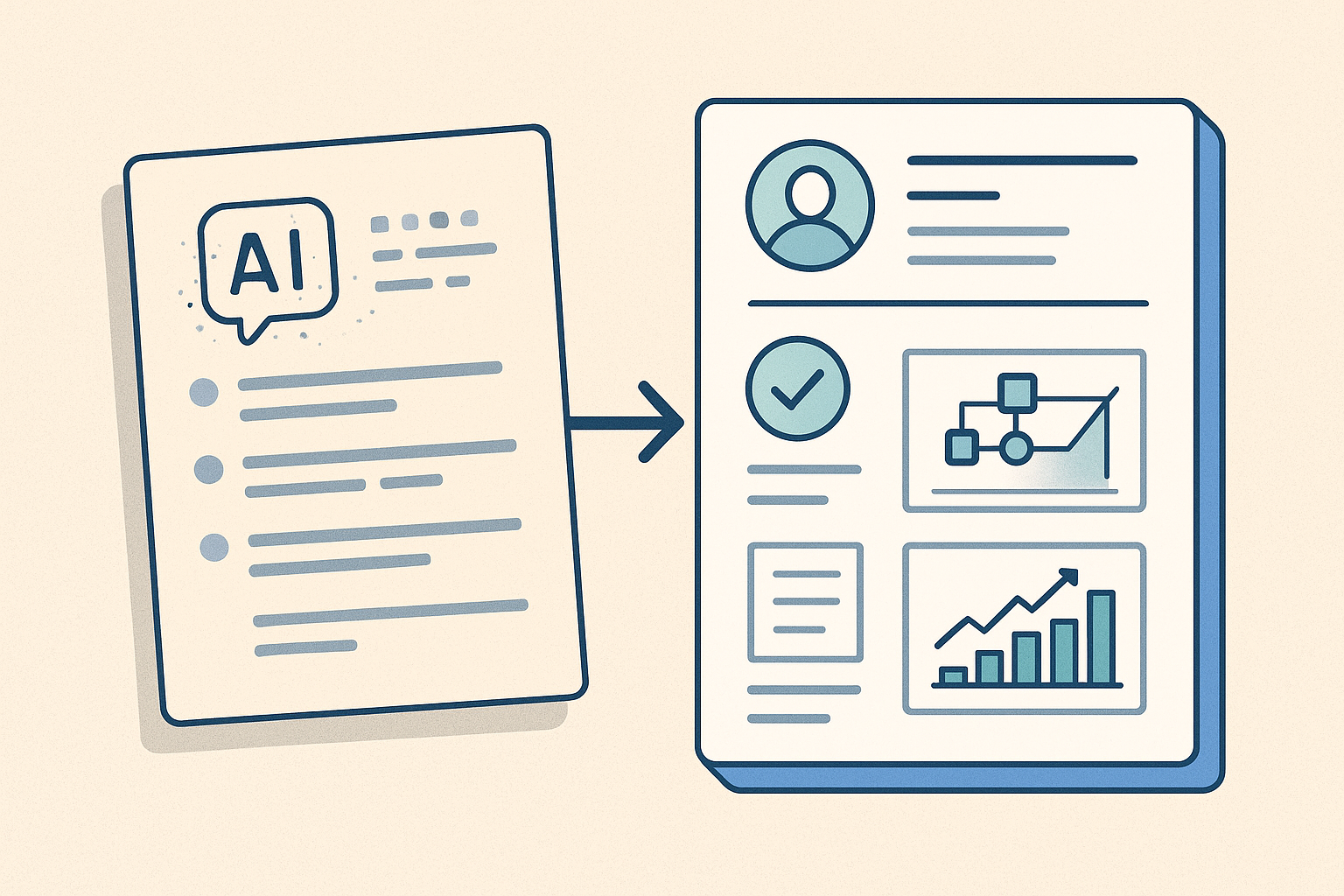
If you want to put AI on a resume in 2026, the main risk is not underselling yourself. It is sounding like everyone else. "Used ChatGPT," "leveraged AI," and "familiar with LLMs" can read a lot like "used Google" now. They may be true, but they do not tell an employer much about how you work, what you owned, or whether your output holds up under real constraints.
That does not mean you should hide AI-native work. It means you should describe it the same way strong candidates describe anything else: through relevance, specificity, evidence, and outcomes. Career centers at Harvard, MIT, and Columbia all push versions of the same principle in normal resume guidance: tailor for the role, use clear action language, provide context, and show results rather than vague responsibility lists.[1][2][3] AI changes some workflows, but it does not change that standard.
The more interesting shift is this: the AI signal itself is changing. In many product and engineering discussions, the useful conversation is about workflows, tools, evaluation, observability, review, and reliability, not about bragging that a model was present somewhere in the process.[4][5] That is a useful clue for job seekers. The strongest way to show AI-native work is not to advertise enthusiasm. It is to make your judgment visible.
Why generic AI claims are already weakening as resume signals
Part of this is simple saturation. Many candidates now use some mix of large language models for drafting, coding help, research, summarization, debugging, or documentation. Once a tool becomes common, saying you used it stops being a differentiator unless you also explain how you used it well.
There is also a credibility problem. Generic AI claims are hard to evaluate. If a bullet says, "Used AI to improve developer productivity," a recruiter or hiring manager still does not know:
- what part of the work was actually improved
- whether the candidate designed the workflow or just consumed output
- how quality was checked
- whether any security, privacy, or compliance constraints mattered
- what changed in cost, speed, coverage, or reliability
That ambiguity matters more now because hiring teams are hearing a lot of polished AI language. Some of it reflects real leverage. Some of it is just fashionable phrasing over ordinary work. A vague AI bullet does not fail because employers are anti-AI. It fails because it leaves too much room for doubt.
A second reason generic claims are weakening is that the underlying technology is maturing past novelty. Anthropic's guidance on agentic systems emphasizes choosing the simplest effective workflow, making tool use explicit, and understanding when extra complexity is actually justified.[4] OpenAI's recent platform guidance similarly frames useful agents around tools, orchestration, tracing, and evaluations rather than one-shot prompt magic.[5] In many teams, that shifts attention toward system design and reliability, not just whether someone can name the latest model.
That is why tool-name lists age so quickly. "Claude, ChatGPT, Cursor, Copilot, Ollama" can be fine in a skills section if the tools are directly relevant, but by themselves they rarely prove much. Stronger evidence comes from what you built around them.
What employers are more likely to trust instead
It is risky to claim that all employers want the same thing. Different teams care about different signals. A startup hiring a generalist product engineer may care about speed and initiative. A larger company may care more about review quality, risk controls, and collaboration. But across those differences, a few kinds of evidence tend to travel well.
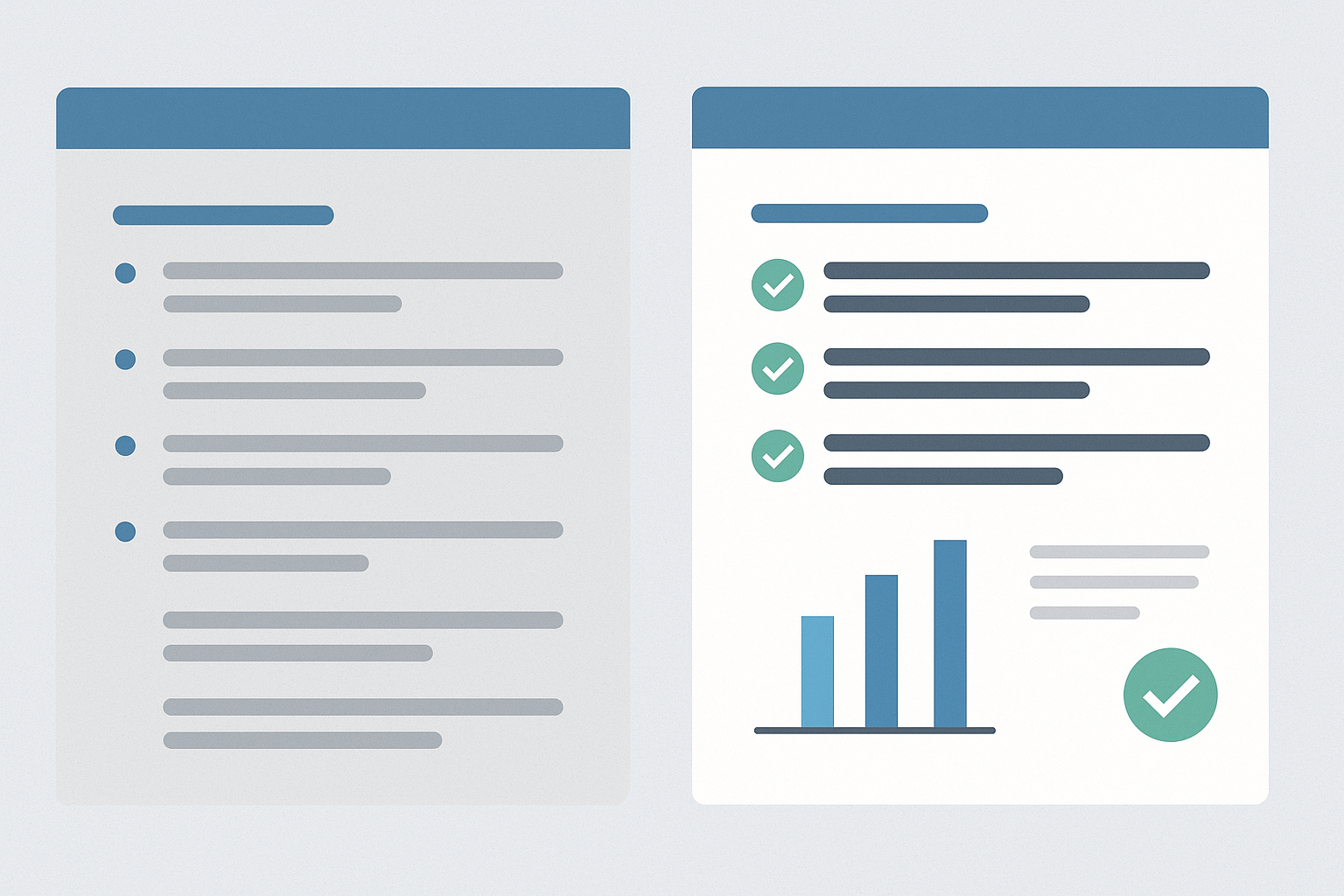
1. Judgment
Good AI-native work starts with deciding where AI should and should not be used. That could mean choosing retrieval over free-form generation, limiting model output to first drafts, refusing to send sensitive data to third-party tools, or knowing when manual work is still faster.
This maps surprisingly well to standard career-readiness categories. NACE's competency framework includes technology, communication, critical thinking, professionalism, and career self-development.[6] The strongest AI bullets usually combine several of those at once. They show technical fluency, but they also show restraint, reasoning, and professional accountability.
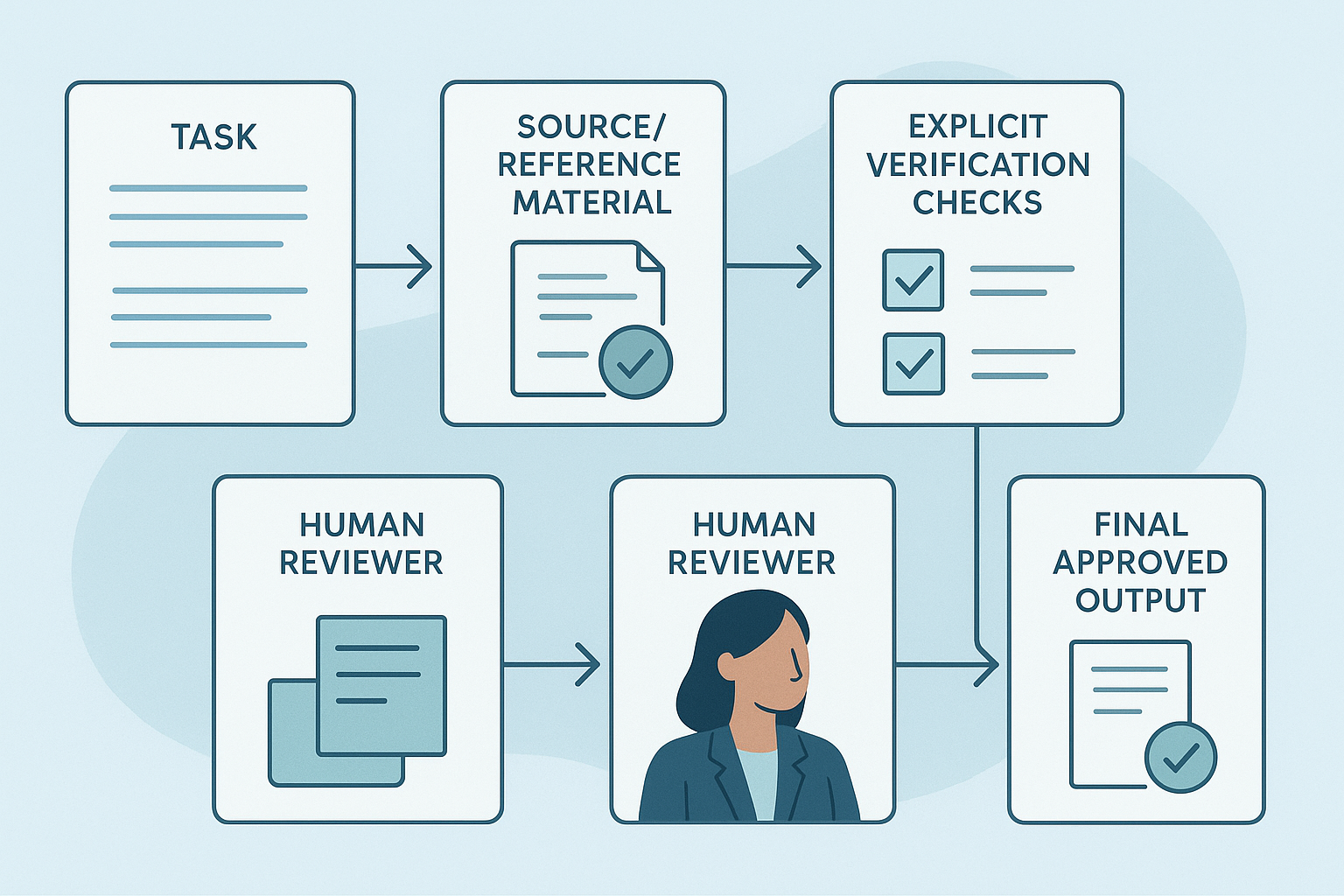
2. Verification
This is the difference between "used AI" and "used AI responsibly enough that the output could be trusted." Verification can show up in a lot of forms:
- evaluation harnesses or test cases
- human review steps
- benchmark comparisons
- regression checks
- source validation for generated research or content
- code review and security review before shipping
If AI helped you go faster but you still owned correctness, say that clearly. Candidates often hide the most important part of the story because they think verification sounds less impressive than generation. Usually it is the opposite.
3. Workflow design
One of the clearest signals in AI-native work is whether you designed a repeatable process instead of just getting a one-off answer. Anthropic explicitly distinguishes between predefined workflows and more autonomous agents, and recommends keeping systems as simple and composable as possible.[4] That is useful language for resumes too. A strong bullet can show that you:
- scoped the task
- selected tools or models deliberately
- added retrieval, review, or routing where needed
- documented handoffs
- turned a manual pattern into a repeatable internal workflow
This makes your contribution legible even to people who would never use the same vendor stack.
4. Outcomes under constraints
MIT and Columbia both stress specificity, context, and measurable results in resume bullets.[2][3] For AI-related work, the "under constraints" part matters as much as the number. Anyone can claim faster drafting. A more credible line is something like: reduced first-pass support ticket categorization time by 40% while keeping a human escalation path for low-confidence cases.
The constraint is part of the accomplishment. It signals maturity.
How to write AI-related resume bullets that show what you actually did
A useful test is whether someone reading the bullet can answer three questions:
- What problem were you solving?
- What did you personally design, decide, or own?
- How did you know the result was good enough?
If the bullet does not answer at least two of those, it is probably still too generic.
Weak patterns to avoid
These are the kinds of bullets that sound current but do not carry much weight:
- Used AI tools to improve productivity across engineering workflows.
- Leveraged LLMs to streamline content creation and documentation.
- Integrated ChatGPT into daily development processes.
- Built AI solutions to enhance team efficiency.
None of those tell the reader what changed, what the candidate owned, or whether the work held up.
Stronger patterns to use instead
A better pattern is:
action + scope + AI workflow detail + verification or constraint + outcome
For example:
- Designed an internal code-assistance workflow that used retrieval from service docs plus human review, cutting onboarding task turnaround by 30% without expanding production incident volume.
- Built a first-pass support triage pipeline using an LLM classifier with fallback rules and manual review for low-confidence cases, reducing queue sorting time by 45%.
- Prototyped a local
Ollama-based workflow for NDA-sensitive document summarization, validating that the team could keep experimentation on-device before considering any cloud deployment. - Added evaluation prompts and regression checks to an AI-assisted content workflow so edits could be reviewed against tone, accuracy, and policy requirements before publishing.
Notice what these bullets do not do. They do not pretend the model did the whole job. They show where automation helped and where the human still owned standards.
A simple rewrite framework
If you already have AI-related bullets, rewrite each one by adding one detail from each category below:
- Problem framing: what repetitive, ambiguous, or time-sensitive task existed?
- Workflow detail: what model, tool, retrieval step, classifier, or routing logic mattered?
- Control point: what review, evaluation, benchmark, or fallback protected quality?
- Outcome: what got faster, more accurate, easier to scale, or easier to maintain?
You do not need all four every time. But most good bullets have at least three.
Where to put AI on the resume
For most candidates, the best places are:
- inside experience bullets where AI materially changed the work
- inside project descriptions where the workflow itself is part of the accomplishment
- inside a short skills section only when the tool names support stronger evidence elsewhere
The worst place is usually a floating summary line like "AI enthusiast with passion for prompt engineering." That kind of language often sounds broad and under-evidenced unless the rest of the resume immediately proves it.
How to show AI-assisted projects or workflow improvements in a portfolio
Portfolios give you room to show process, which is exactly what resumes compress away. That makes them a better place to prove AI-native judgment.
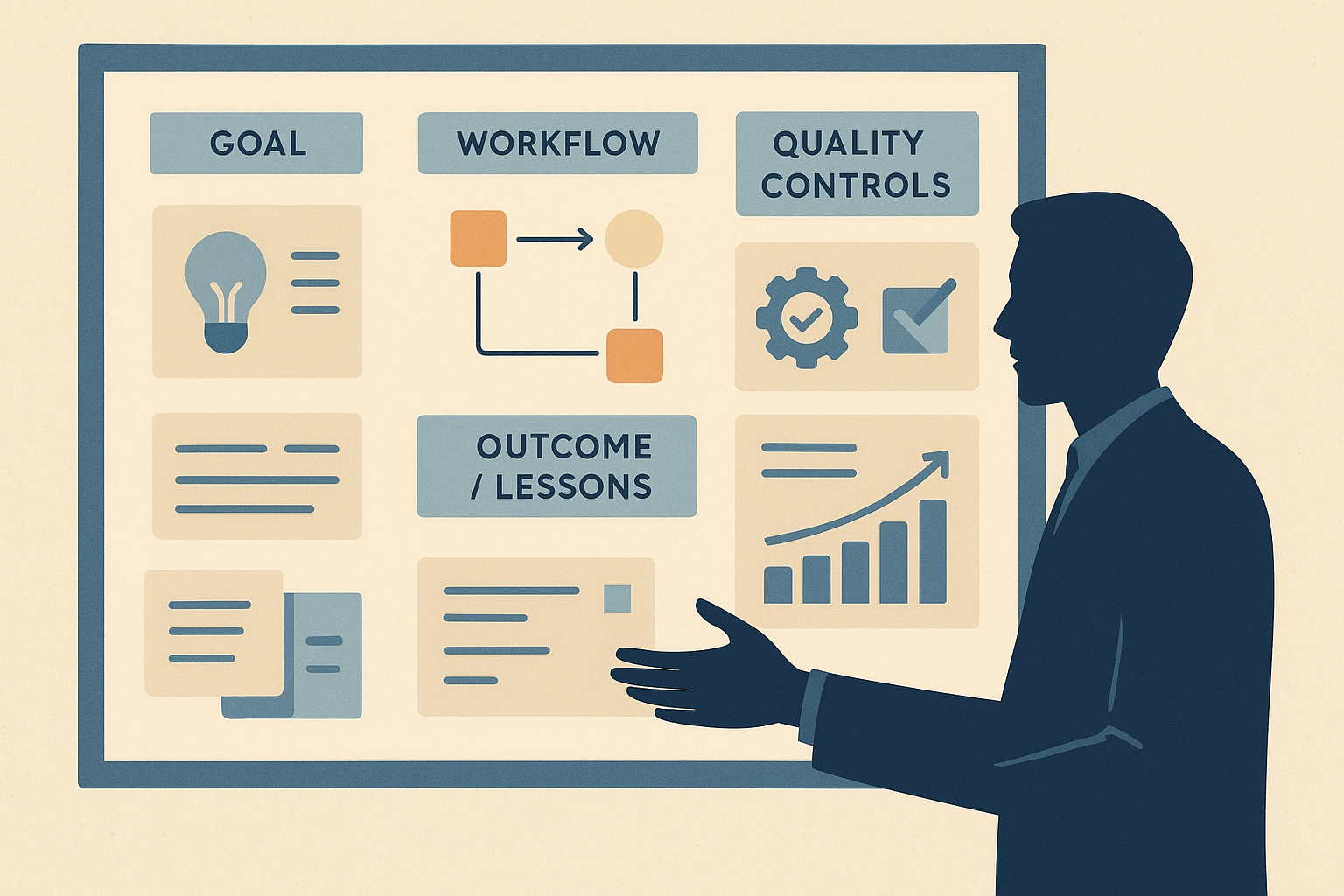
If a project used AI, the portfolio page should usually explain five things:
What the system was supposed to do
Keep this plain. Was it generating drafts, classifying inputs, assisting coding, extracting entities, summarizing documents, or routing tasks between tools and humans?
What you owned
Did you define the prompt contract, build retrieval, set up tool calling, write evals, add guardrails, review output, or measure errors after launch? This is where a lot of credibility lives.
How quality was controlled
Many candidates skip this section, even though it is often the most impressive part. If the system had review gates, manual overrides, test sets, confidence thresholds, or rollback conditions, write that down.
What constraints shaped the design
Good AI work is usually constrained by something real: privacy, latency, cost, hallucination risk, domain specificity, or the need to keep a human in the loop. Stating those constraints makes the project sound more grounded and more transferable.
What happened after deployment or testing
Even if the project was not production software, say what you learned. Did the first approach fail? Did a smaller or local model perform well enough for a narrow use case? Ollama's ecosystem is a good reminder that local and open-weight experimentation can be useful evidence of practical curiosity, but it should be framed as experimentation unless it truly supported production work.[7]
That last distinction matters. Running a model locally can be a strong supporting signal. It shows initiative, privacy awareness, or hands-on interest in model behavior. But it is not automatically equivalent to operating an AI feature in production. Say what it was.
How to talk about AI use in interviews without sounding careless or inflated
Interview framing should sound a lot like resume framing, just with more room for nuance.
The most credible candidates usually sound neither defensive nor overimpressed by the tooling. They do not say, "I barely use AI because I trust only myself," and they do not say, "I use AI for everything." Both answers raise concerns. One can sound rigid. The other can sound careless.
A better structure is:
Where AI helped
Be concrete. Drafting tests, exploring edge cases, summarizing large docs, generating first-pass copy, creating internal scaffolding, or speeding up repetitive transforms are all more credible than abstract enthusiasm.
What you still owned
This is the center of the answer. You still owned architecture decisions, code review, domain judgment, security calls, final wording, incident responsibility, stakeholder communication, or publication standards. Say that plainly.
How you controlled quality
This is where candidates earn trust. Mention tests, evals, source checks, manual review, peer review, confidence thresholds, or red-team style probing where relevant. Serious AI engineering guidance now spends a lot of time on observability and evaluation for exactly this reason.[4][5]
What you learned not to automate
This is a powerful differentiator because it signals maturity. Maybe a model was fine for summaries but weak on domain-specific reasoning. Maybe generated code was useful for scaffolding but not for secure auth flows. Maybe an agent loop was overkill compared with a simple workflow. Those are good interview answers because they show taste.
One strong sentence pattern is: "I use AI where it increases speed or coverage, but I make the control points explicit and keep ownership of correctness." That is a much better signal than trying to sound maximalist.
What to change this week on your resume, portfolio, and interview story
If this article is useful but stays theoretical, it does not do enough. Here is the practical version.
This week on your resume
Pick two to four bullets that currently mention AI, automation, research, documentation, analysis, support, or coding acceleration.
Rewrite them so each one includes:
- the problem or workflow you were improving
- the part you personally designed or decided
- the review or verification step
- the measurable result or clear operational outcome
Then check your skills section. If it is mostly a pile of AI tool names, trim it down and make sure the remaining tools are backed by real evidence in experience or projects.
This week in your portfolio
Choose one AI-assisted project or workflow and add a short case-study layer. You do not need a giant writeup. Add four compact sections:
- goal
- workflow
- quality controls
- outcome and lessons
If you keep a structured master resume and tailor variants for different roles, this is also a good time to make sure the project language can be adjusted without rewriting the facts every time. A tool like CoreCV can help keep that base resume organized while you vary the emphasis for platform, product, data, or operations roles.
This week in your interview story
Prepare one 60 to 90 second answer to this question: "How do you use AI in your work without letting it lower the quality bar?"
Your answer should cover:
- one real example
- where AI helped
- what you still owned
- how you verified output
- one limit or lesson you learned
Practice until it sounds like your normal speaking voice, not a manifesto.
The real signal is not AI usage. It is accountable AI usage.
Putting AI on a resume is not automatically smart or dumb. It depends on how you do it.
The weak version is a badge. The strong version is evidence.
If you show AI-native work through problem framing, workflow design, verification, constraints, and outcomes, you stop sounding like someone who touched a tool and start sounding like someone who can be trusted with modern work. That is the signal worth sending.
Sources
1. Harvard FAS Mignone Center for Career Success, Create a Strong Resume: https://careerservices.fas.harvard.edu/resources/create-a-strong-resume/
2. MIT Career Advising & Professional Development, Resumes: https://capd.mit.edu/resources/resumes/
3. Columbia Center for Career Education, Resumes with Impact: Creating Strong Bullet Points: https://www.careereducation.columbia.edu/resources/resumes-impact-creating-strong-bullet-points
4. Anthropic Engineering, Building effective agents: https://www.anthropic.com/engineering/building-effective-agents
5. OpenAI, New tools for building agents: https://openai.com/index/new-tools-for-building-agents/
6. National Association of Colleges and Employers, What is Career Readiness?: https://www.naceweb.org/career-readiness/competencies/career-readiness-defined
7. Ollama Blog: https://ollama.com/blog
Disclosure: This article is authored by the CoreCV team. While we mention CoreCV.ai, the strategies and advice here are intended to be useful whether or not you use our product.