How to Put Family Business or Informal Work on a Resume

Family business and informal work count if you were doing real work. Hiring teams do not need formal corporate structure. They need clear evidence of what you did and why it matters for the role you want now. Good resume guidance keeps landing in the same place: make the entry specific, factual, easy to scan, and centered on relevant accomplishments instead of vague duty lists.[1][2]
Start with the real employer and a functional title
If the business had a name, use it. If it was your parents' store, repair shop, catering business, or online business, list the business name like any other employer. Then use a title that describes the function you performed, not your family relationship.
That usually means titles like Operations Assistant, Inventory Coordinator, Bookkeeping Assistant, Sales Associate, or Office Manager. It usually does not mean Vice President because you were related to the owner. Readers trust experience more when they can quickly understand the context and scope, which is why resume and bullet-writing guidance push for specificity and relevance.[2][3]
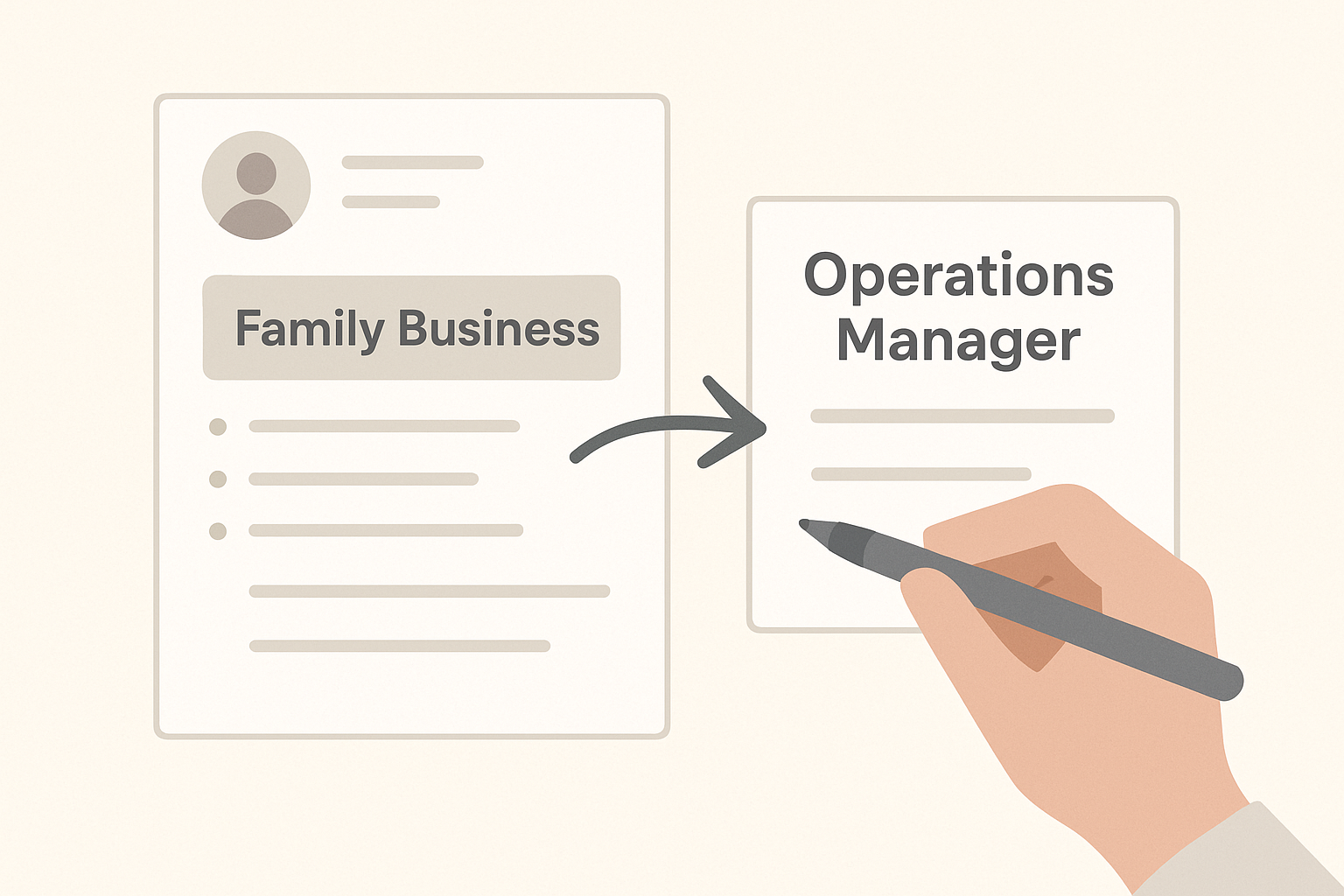 Use a title that describes the job you actually did, not the family relationship around it.
Make the arrangement easy to understand
Informal work starts looking suspicious when the structure is hard to decode, so fix that on the page. Include the dates and whether the work was full-time, part-time, seasonal, or overlapping with school or other work. You do not need a long explanation, just enough information to stop the reader from guessing.
For example:
Neighborhood Auto Parts | Inventory and Operations Assistant | 2022-2025
Part-time during school, full-time summers
That is much more credible than a business name and title with no context. Clear structure helps employers connect your experience to their needs.[4]
Use bullets that prove the work was real
This is the part that matters most. A family business entry becomes credible when the bullets show recognizable work, tools, stakeholders, and outcomes.
Columbia advises building bullets around action, context, and results, while Harvard recommends fact-based language that people and screening systems can scan quickly.[1][3] So instead of writing this:
- Helped with family business operations
- Assisted customers and handled admin tasks
Write something closer to this:
- Managed weekly inventory counts across 1,200-plus SKUs, reducing stockout issues and helping the owner reorder faster
- Handled customer phone orders, invoicing, and pickup coordination during peak periods, which shortened response time for repeat commercial clients
- Updated QuickBooks records and reconciled basic payment data so month-end paperwork was easier to close out
Those bullets show the work was concrete, what systems or processes you touched, and what transferable value you built in communication, reliability, operations, and judgment. Employers often care about broad competencies like communication, teamwork, professionalism, technology, and critical thinking, even when they were developed outside a formal corporate setting.[5]
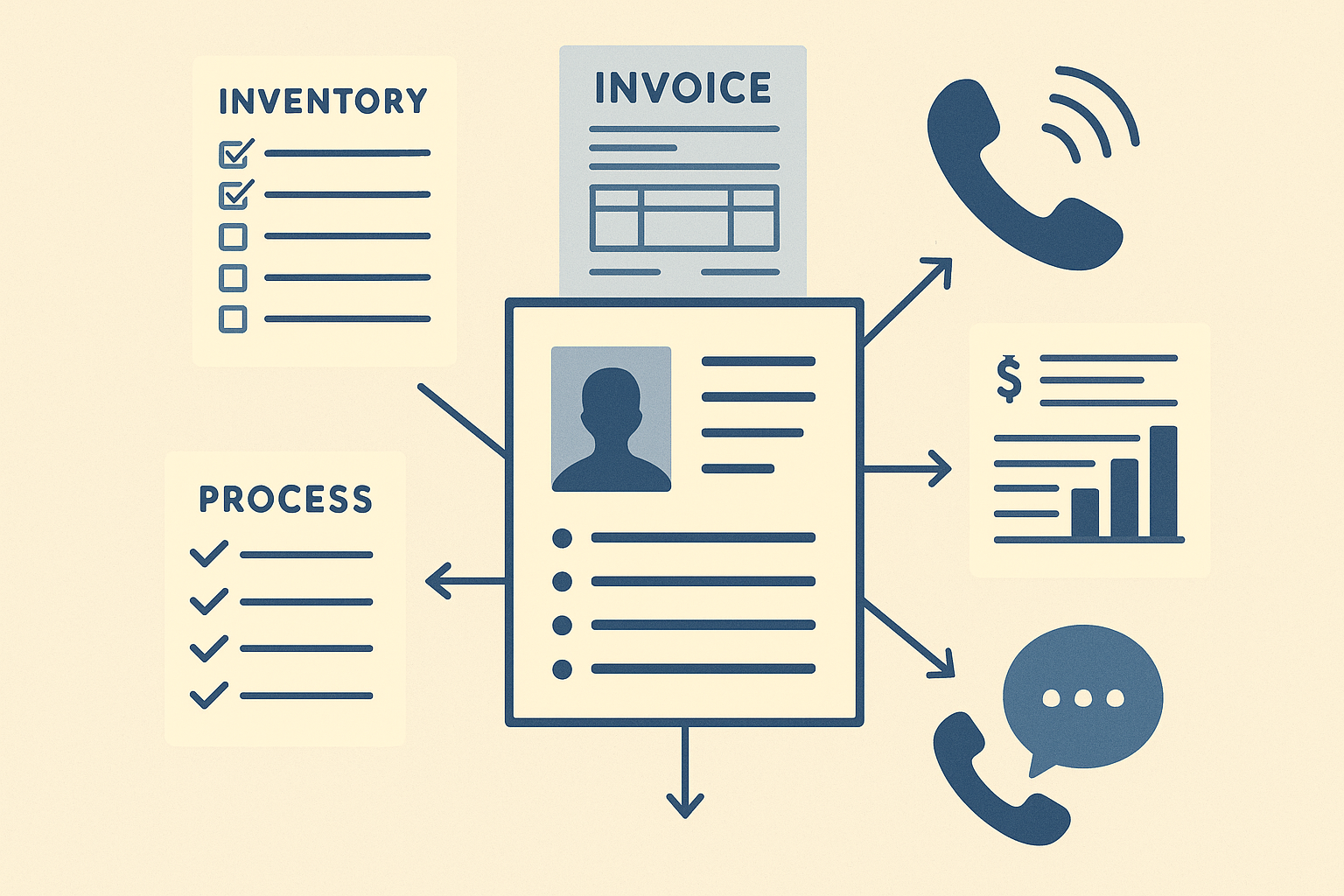 Concrete tools, processes, and outcomes make informal work easier to trust.
Add credibility without overselling
If the role was loosely structured, add operational detail. Mention customer volume, the type of business, the tools you used, or the process you owned. That detail makes legitimate experience easier to trust.
Do not pad the story. If you occasionally helped on weekends, do not write it as if you ran the company. If you were unpaid, you can still list the work if it was real and relevant, but the bullets should stay accurate about scope. Experience can come in many forms, including projects and other nontraditional work, as long as the relevance is clear.[2]
If the exit was awkward, keep the resume clean
A lot of people leave family businesses under strain. Maybe there was a pay dispute, a family conflict, a shutdown, or a messy handoff. If the work was real, you can still claim it. Keep the entry factual: employer, title, dates, and solid bullets. If an application or interviewer later asks why you left, keep the written explanation brief and save the fuller explanation for conversation only if needed.[6]
A line like this is enough: "I did operations work there for three years, but it stopped being the right fit, so I moved on."
 The resume should stay factual, while the fuller explanation can wait for conversation.
The standard to aim for
A hiring manager should be able to glance at the entry and understand four things: what the business was, what your role was, how substantial the work was, and what changed because of your contribution. If those four things are clear, family business or informal work can read just as credibly as more conventional experience.
If you keep a master resume with full detail, it also gets easier to tailor this kind of entry for different roles without changing the facts. CoreCV can help organize that source-of-truth workflow, but the larger principle matters more than the tool: preserve the real record, then present the clearest relevant version of it.
Sources
1. Harvard FAS Mignone Center for Career Success, Create a Strong Resume: https://careerservices.fas.harvard.edu/resources/create-a-strong-resume/
2. MIT Career Advising & Professional Development, Resumes: https://capd.mit.edu/resources/resumes/
3. Columbia Center for Career Education, Resumes with Impact: Creating Strong Bullet Points: https://www.careereducation.columbia.edu/resources/resumes-impact-creating-strong-bullet-points
4. UC Berkeley Career Engagement, Resumes: https://career.berkeley.edu/prepare-for-success/resumes/
5. National Association of Colleges and Employers, Career Readiness Defined: https://www.naceweb.org/career-readiness/competencies/career-readiness-defined/
6. MIT Sloan Career Development Office, How to Explain a Termination on Your Job Application: https://cdo.mit.edu/blog/2023/06/01/how-to-explain-a-termination-on-your-job-application/