Resume Age Bias in Tech: What to Remove, What to Keep, What Not to Hide
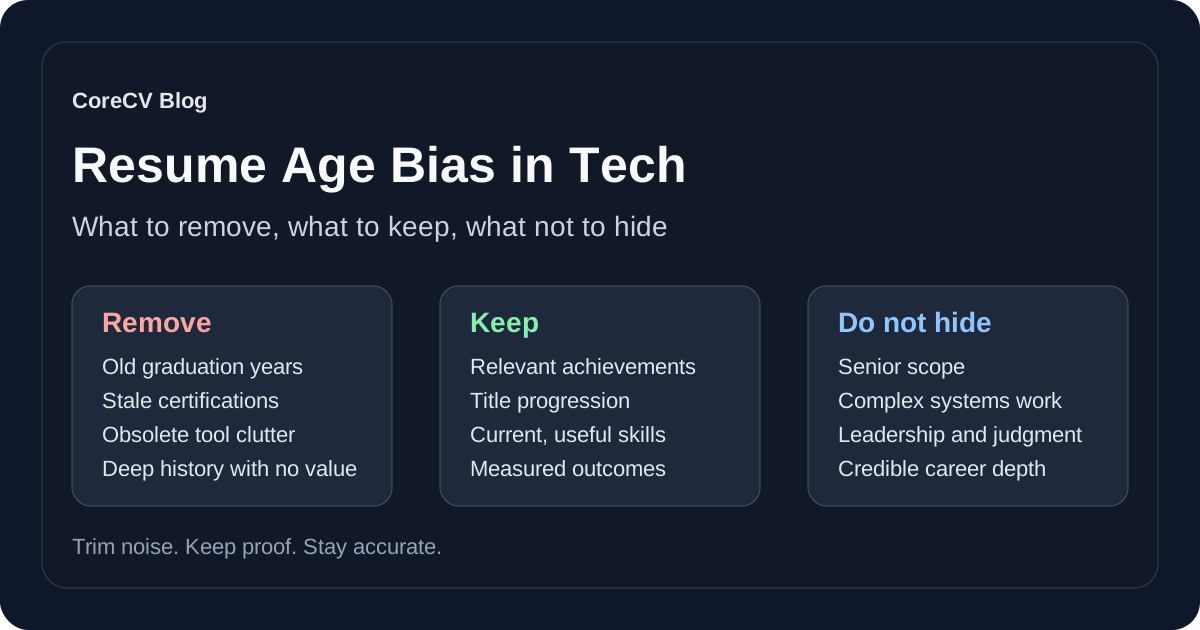
Age bias in hiring is real, and pretending otherwise does not help anyone. The U.S. Equal Employment Opportunity Commission says the Age Discrimination in Employment Act protects workers age 40 and older from discrimination in hiring and other employment decisions.[1] On a resume, that does not mean disguising your whole career. It means removing low-value details that make stereotyping easier while keeping the proof that you can do the job now.
Harvard's resume guidance says resumes should be written for people and systems that scan quickly and should not include age.[2] Berkeley and UCLA make the broader point that good resumes are tailored, easy to scan, and built around concrete results rather than exhaustive history.[3][4] For experienced engineers, that usually leads to a document that feels current, selective, and specific. Some conventions also vary by country, but the underlying principle travels well: keep what is relevant, cut what is not, and do not make the reader work to understand your fit.
What to remove
Start with details that add little hiring value but make your timeline easier to stereotype.
An old graduation year is the easiest example. If the degree matters, keep the degree and school. In many cases, the year adds nothing except a shortcut to your age, so removing it is a reasonable choice that fits Harvard's guidance.[2]
Next, trim outdated tools that no longer strengthen your case. A long skills section full of old frameworks, operating systems, or side technologies can make a profile look frozen even when the candidate is not. But older technology is not automatically a bad signal. In enterprise, embedded, government, infrastructure, and modernization work, older tools can still be highly relevant. The real question is not whether a tool is old. It is whether it still matters for the role.
Certifications need more care than a blanket rule. If a certification is current, active, or still recognized in your target market, keep it and present it clearly. If it expired long ago and the skill is already proven elsewhere, it is often better to remove it than to omit a date in a way that could look misleading. The goal is not to blur whether a credential is valid. It is to avoid giving space to credentials that no longer help.

Use this filter on older dates, tools, certifications, and achievements: if an item adds current proof, keep or compress it. If it mostly adds age signal, cut it.
Very old experience can usually be compressed, but here too the rule is not absolute. Rutgers' career guidance for older workers recommends focusing on the last 10 to 15 years and summarizing earlier work when it is less relevant.[5] That is a common default, not a universal law. If you work in a niche stack, have a research-heavy background, or are targeting roles where earlier domain experience is still directly relevant, older work may deserve more room. In many cases, though, a short "Earlier Experience" section preserves continuity without letting distant history dominate the page.
What to keep
The biggest mistake experienced candidates make is overcorrecting and cutting away the evidence that explains their level.
Keep older achievements when they still prove something useful about your fit. A platform migration, security program, architecture redesign, or systems reliability win from years ago may still matter if it shows judgment the target role needs today. Hiring managers are usually not asking whether an example is recent for its own sake. They are asking whether it helps them understand your relevance.
Keep title progression when it shows growth in scope and trust. If your path moved from engineer to senior, staff, principal, lead, or manager, that progression helps explain the level at which you operate. Removing all trace of that arc can flatten your story.
Keep durable strengths that are hard to fake: technical judgment, cross-functional leadership, incident handling, mentoring, and experience navigating messy production systems. Those signals matter most when they are shown through outcomes, not claims. Berkeley and UCLA both emphasize measurable results for exactly this reason.[3][4]
What not to hide
Do not try to make a twenty-year career look like a seven-year one. That usually reads as evasive, and it can backfire once someone opens LinkedIn, asks for context in an interview, or notices that your claimed scope does not match the timeline.
A better approach is to make your experience legible. Trim stale details, keep the examples that still carry weight, and make recent impact easy to spot. In tech especially, experience with tradeoffs, production risk, migrations, and long-lived systems is often part of the value proposition, not something to apologize for. This is practical guidance, not a guarantee against bias, but it gives you a cleaner and more credible resume.
A practical cleanup pass for tech resumes

The goal is not to hide a long career. It is to give recent proof the most space while keeping earlier experience credible and easy to scan.
A simple review pass usually works well:
- Remove graduation years unless the date itself adds meaningful value.
- Cut stale tools that no longer support the role, but keep older technologies when they are still relevant to the work.
- Keep certifications only when they are current, recognized, or useful context for the target role.
- Compress older experience by default, while giving more space to earlier work that still carries direct domain value.
- Make recent impact obvious with measurable outcomes, because fast resume scans reward specificity.[3][4]
If you keep a structured master resume, this gets much easier. You can preserve the full record for yourself, then tailor resume versions for specific roles without rewriting your history from scratch. That is also the useful part of CoreCV here: keeping a master resume, creating tailored versions, and tuning them against a pasted job description or job URL.
The strongest resume for an experienced engineer is not trying to look younger. It is trying to look relevant, accurate, and easy to trust. Cut the details that add noise, keep the proof that matters, and let the document show current value without pretending your career happened yesterday.
Sources
1. U.S. Equal Employment Opportunity Commission, Age Discrimination: https://www.eeoc.gov/age-discrimination
2. Harvard FAS Mignone Center for Career Success, Create a Strong Resume: https://careerservices.fas.harvard.edu/resources/create-a-strong-resume/
3. UC Berkeley Career Engagement, Resumes: https://career.berkeley.edu/prepare-for-success/resumes/
4. UCLA Career Center, Resumes & Cover Letters: https://career.ucla.edu/resources/resumes-cover-letters/
5. Rutgers University Newark Career Resources, Resume Tips for Older Workers: How to Craft a Standout One (With Examples!): https://careers.newark.rutgers.edu/blog/2024/11/01/resume-tips-for-older-workers-how-to-craft-a-standout-one-with-examples/