What Anthropic's AI Labor Market Study Really Says, and What It Means for Your Resume
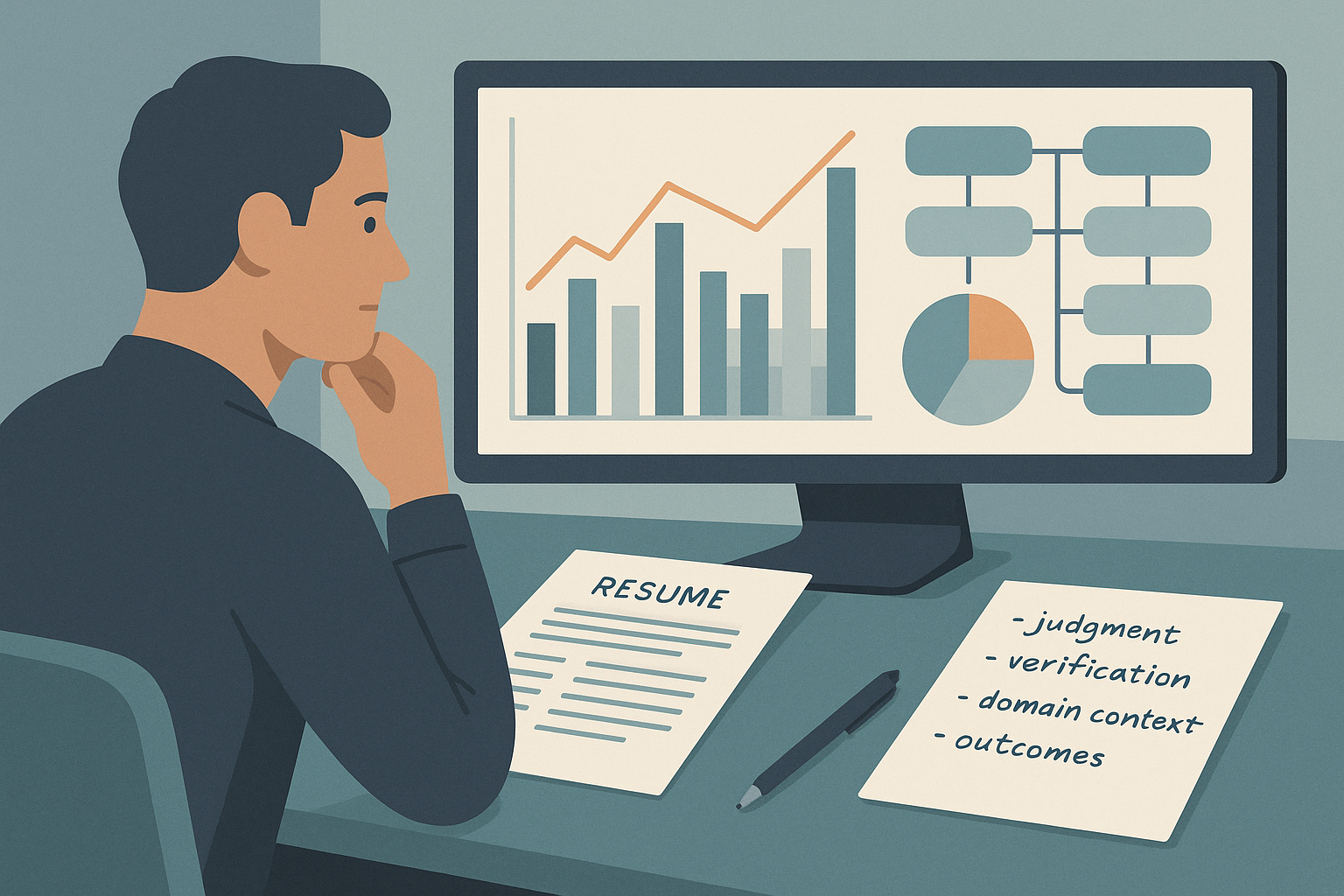
Anthropic's new report on AI and the labor market is one of the more useful pieces of evidence we have so far, partly because it is more careful than most hot takes. The paper does not claim that AI has already caused mass job loss. It claims something narrower: tasks that large language models can plausibly help with are showing up in real usage patterns, those patterns are concentrated in certain occupations, and the most exposed occupations also tend to line up with weaker long-run growth projections from the U.S. Bureau of Labor Statistics. That is worth paying attention to, but it is not the same as proof that AI is already replacing workers at scale.[1]
That distinction matters for job seekers. Research like this is most useful when it helps you update your positioning without panicking or pretending nothing is changing.
What Anthropic actually measured
The core idea in Anthropic's report is "observed exposure." In plain language, it asks: of the tasks AI could theoretically help with, which ones are we actually seeing in work-related use right now?[1]
That is more grounded than a simple "AI could do X" list. Anthropic blends occupational task data from O*NET, earlier estimates of where LLMs could help, and its own Economic Index usage data, with more weight given to work-related and more automated use cases.[1] For a job seeker, the important point is straightforward: theoretical capability and real adoption are not the same thing. Anthropic's own finding is that actual coverage is still much smaller than what current models might theoretically be able to do. In its category breakdown, Computer and Math jobs had very high theoretical exposure, but Claude's observed task coverage was still only a fraction of that potential.[1]
That gap is one of the most important parts of the paper. It suggests that diffusion, workflow design, trust, legal constraints, systems integration, and human review still matter a lot. In other words, "AI can help with this task" does not automatically mean "this job is about to disappear."

Where the evidence looks strongest
The report is most convincing when it stays descriptive. It shows that exposure is not evenly spread across the economy. Coding, customer service, analysis, and some administrative work appear much more exposed than jobs built around physical work, in-person service, or responsibility that cannot be cleanly handed to a model.[1]
That broad pattern is consistent with other research. Brookings argues that generative AI is unusual because it reaches into cognitive and nonroutine work, especially in middle- and higher-paid occupations, rather than mainly routine manual work.[2] Anthropic's finding that more exposed workers skew more educated and higher paid fits that pattern too.[1]
Some of the occupation examples also line up with BLS outlook data. BLS projects employment from 2024 to 2034 to decline 6% for computer programmers and 5% for customer service representatives.[3][4] That does not prove AI caused those projections, because BLS outlooks reflect many forces, but it does make Anthropic's exposure map feel more plausible rather than random.
What the paper does not prove
This is where a lot of coverage will overreach.
Anthropic does not show a broad rise in unemployment for workers in the most exposed occupations since late 2022. Its own result is that the difference is small and statistically indistinguishable from zero so far.[1] It also does not prove that usage observed on Anthropic's platform captures the whole labor market. It is a smart dataset, but still a partial one, and some adoption will always happen inside proprietary tools and internal workflows that never appear in Claude traffic.
Just as important, exposure is not the same as replacement. A task can be exposed because AI helps do part of it faster, while the job still depends on context, QA, client handling, compliance, prioritization, or cross-functional judgment. That distinction matches one of the clearest field studies we have so far: in a large customer support experiment, access to a generative AI assistant raised productivity by 14% on average and helped less experienced workers the most, which reads more like augmentation than clean one-for-one replacement.[5]
The most important tentative signal: entry-level hiring
The part of Anthropic's report job seekers should watch most closely is not unemployment. It is the tentative evidence around younger workers entering highly exposed occupations.
Anthropic finds suggestive evidence that workers ages 22 to 25 became less likely to start new jobs in the most exposed occupations after ChatGPT's release, estimating about a 14% drop in the job-finding rate relative to 2022, though the result is only barely statistically significant and the authors explicitly note alternative explanations.[1]
So this section is best read as a watchpoint, not a verdict. The paper does not establish that AI is the reason junior hiring got harder, and it does not show that entry-level paths are broadly closing. What it does offer is an early signal worth tracking, especially in roles where first-draft, support, research, or coding-assistance tasks make up a large share of the junior workload.
If you are early-career, that means the bar for evidence may shift even if the overall opportunity set does not disappear. Employers may increasingly favor juniors who can use AI tools productively while also showing judgment, verification, communication, and the ability to carry a scoped task to completion.

What to change on your resume
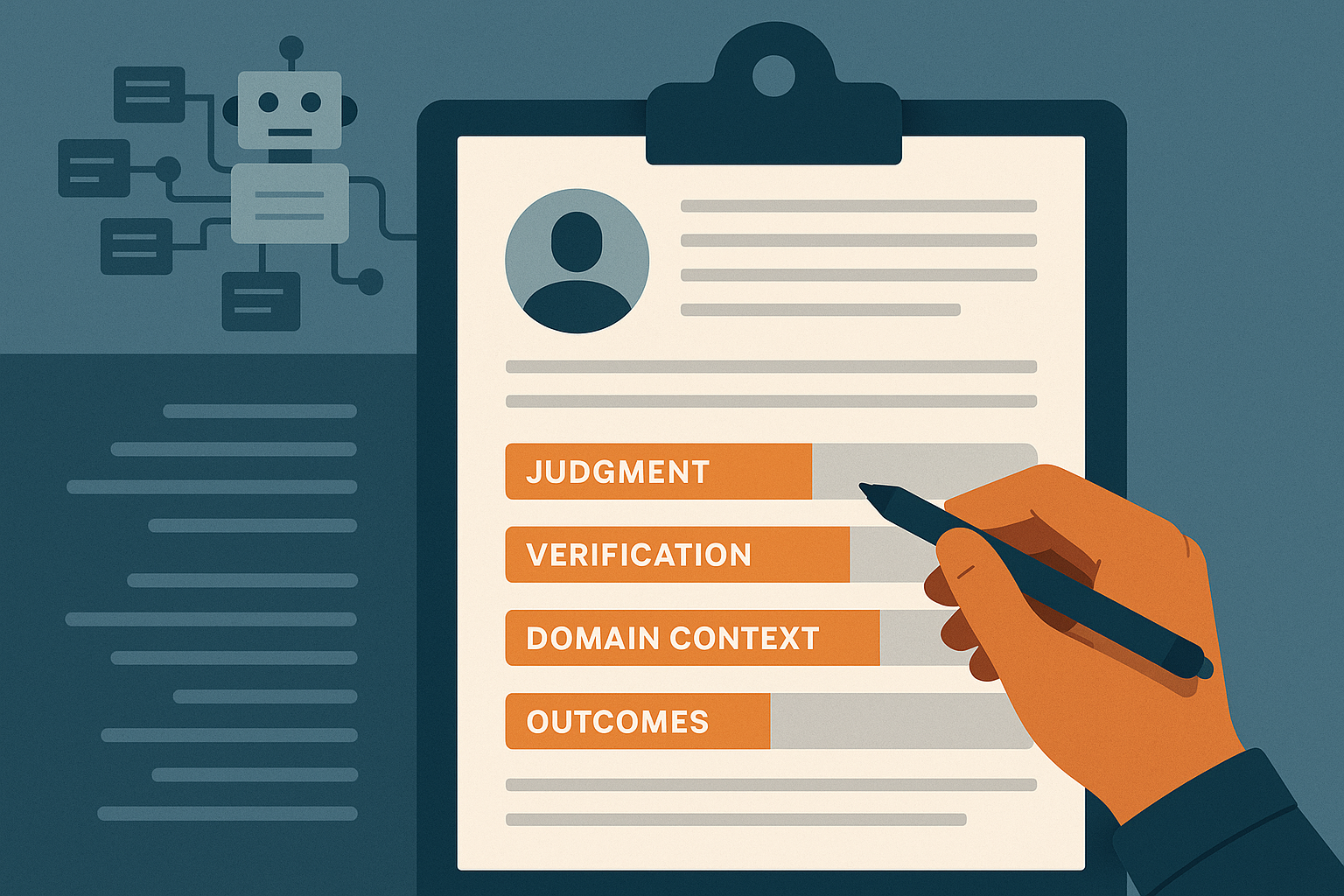
The practical takeaway is not "hide from AI" or "put AI on every line." It is to make your evidence harder to mistake for generic output. My read of the market, based on this paper and the broader adoption pattern around it, is that employers will put more weight on judgment, verification, context, and outcomes than on sheer volume of draftable work.
Start with your bullets. If they mainly say you produced reports, tickets, code, documentation, or analysis, rewrite them to surface the decision-making around that work. Show what you diagnosed, prioritized, redesigned, validated, or unblocked. Then make reliability visible. Testing, QA, evaluation, incident reduction, stakeholder review, compliance checks, and process improvements all signal that your contribution held up under real constraints.
The same applies to projects and AI usage. Strong projects show leverage with boundaries: a shipped workflow, an internal tool, an analysis pipeline, or a product feature with clear constraints and measurable results. And if AI tools are part of your workflow, mention them only where they materially improved speed, quality, or coverage. "Used AI to boost productivity" is too vague to help. A concrete line about building an evaluation loop, automating first-pass classification with human review, or cutting turnaround time while preserving quality checks is much stronger.
Domain context also deserves more space than many resumes give it. Industry knowledge, system constraints, regulatory understanding, customer nuance, and cross-team coordination are all forms of value that become more legible as generic task execution gets cheaper. If you keep a structured master resume, it becomes much easier to preserve that fuller evidence and tailor different versions toward roles that reward implementation, review, domain fluency, or customer-facing judgment. CoreCV can help with that workflow, but the bigger point is simply to organize your evidence so you can reposition it quickly as hiring signals change.
A calm way to read this moment
Anthropic's paper is useful because it is measured. It suggests that AI exposure is real, uneven, and already visible at the task level. It also suggests that labor market damage, at least in the aggregate unemployment data, is not yet obvious.[1]
So the right response is neither denial nor doom. If your target role overlaps with writing, coding, support, analysis, or administrative coordination, it is reasonable to prepare for some task compression even if the pace and shape remain uncertain. Then update your resume so it shows the parts of your value that are hardest to commoditize: judgment, integration, verification, domain context, and outcomes.
That is not just a defensive move. It is also a clearer description of what strong candidates have always done.
Sources
1. Anthropic, Labor market impacts of AI: A new measure and early evidence: https://www.anthropic.com/research/labor-market-impacts
2. Brookings, Generative AI, the American worker, and the future of work: https://www.brookings.edu/articles/generative-ai-the-american-worker-and-the-future-of-work/
3. U.S. Bureau of Labor Statistics, Computer Programmers: https://www.bls.gov/ooh/computer-and-information-technology/computer-programmers.htm
4. U.S. Bureau of Labor Statistics, Customer Service Representatives: https://www.bls.gov/ooh/office-and-administrative-support/customer-service-representatives.htm
5. Erik Brynjolfsson, Danielle Li, and Lindsey R. Raymond, Generative AI at Work, NBER Working Paper 31161: https://www.nber.org/papers/w31161
Disclosure: This article is authored by the CoreCV team. While we mention CoreCV.ai, the strategies and advice here are intended to be useful whether or not you use our product.