8 posts tagged with "career-growth"

View All Tags

Should You Take a Step-Down Job After a Layoff?

· 7 min read
Should You Take a Step-Down Job After a Layoff?

A step-down job after a layoff is not automatically a bad decision. In a market where layoffs still happen even while job openings remain in the millions, the real question is not whether the next role looks perfect on paper. It is whether the role protects your finances, keeps your skills current, and leaves you with a believable story about where your career is going next.[1][2]

How to Explain Being Fired Without Tanking Your Job Search

· 7 min read
How to Explain Being Fired Without Tanking Your Job Search

Being fired feels bigger than it usually looks to an employer. Many hiring teams are really trying to answer a narrower question: can you explain the situation clearly, and is your next role likely to go better? The best approach is usually simple. Keep the resume focused on work and results, answer direct questions honestly, and do not turn one exit into the center of your professional identity.[1][2][3]

Crafting an Elevator Pitch: Summarizing Your Value Proposition in 60 Seconds

· 8 min read
Crafting an Elevator Pitch: Summarizing Your Value Proposition in 60 Seconds

A good elevator pitch does not need to sound clever. It needs to help another person understand you quickly. In practice, that means giving a short introduction that explains who you are, what kind of work or problems you are best suited for, and what you want next. Career centers generally frame the pitch as a 30 to 60 second summary for networking, career fairs, and informational conversations, not a memorized speech for impressing strangers.[1][2]

Building a Developer Blog: Sharing Knowledge to Advance Your Career

· 7 min read
Building a Developer Blog: Sharing Knowledge to Advance Your Career

A developer blog is useful because it gives people more than a claim. Lots of engineers say they care about performance, architecture, debugging, or developer experience. A blog can help you show how you think about those topics in concrete terms. That matters because resumes still need to stay selective and easy to scan, so they cannot carry every example or lesson you have learned.[1] Technical writing also emphasizes clarity, conciseness, and audience awareness, which can sharpen your understanding while making your work easier for other people to follow.[2]

Engineering Your Professional Growth: Agile Approaches to Career Development

· 7 min read
Engineering Your Professional Growth: Agile Approaches to Career Development

A lot of career advice still assumes you should pick one big destination and follow a long-range plan without changing much. That is a poor fit for most developers. Technologies shift, teams reorganize, and the market moves with them. Agile is useful here because it treats progress as something you inspect and adapt, not something you lock in once and defend forever.[1][2] In a field where the U.S. Bureau of Labor Statistics projects 15% growth for software developers, QA analysts, and testers from 2024 to 2034, static career plans tend to go stale faster than people expect.[3]

How to Show Promotions on a Resume Without Losing the Story

· 7 min read
How to Show Promotions on a Resume Without Losing the Story

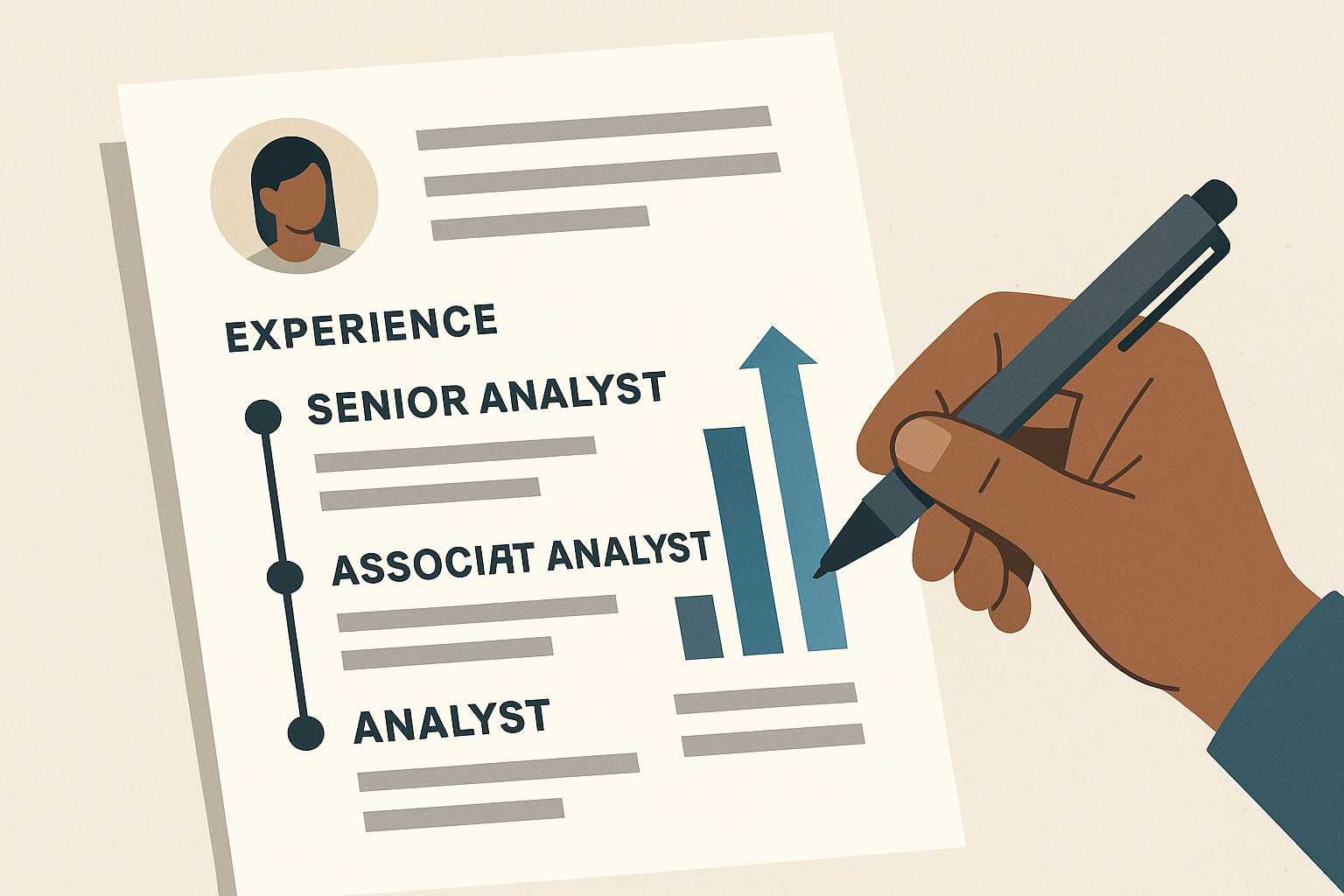
Promotions are one of the strongest signals on a resume because they show that one employer kept increasing your scope and trust. The problem is that many resumes hide that signal under clutter. If the reader cannot quickly tell whether you moved from engineer to senior engineer to staff engineer, or whether those title changes actually came with broader ownership, the story gets lost. Harvard advises candidates to tailor resumes to the role they want and to write for readers and systems that scan quickly. MIT likewise recommends using the position description to decide what belongs on the page and making relevant information immediately visible.[1][2]

Addressing Employment Gaps: Turning Time Off into a Narrative of Growth

· 8 min read
Addressing Employment Gaps: Turning Time Off into a Narrative of Growth

Employment gaps become a problem mostly when the resume leaves too much work for the reader. If a hiring manager cannot quickly tell what happened, whether your skills stayed relevant, or why you still fit the role, the gap starts to carry more weight than it should. Harvard advises candidates to tailor resumes to the job they want and to write for people and systems that scan quickly. MIT similarly recommends using the position description to decide what belongs on the page. That is the right frame for gaps too: keep the document clear, credible, and focused on evidence.[1][2]

Securing Strong References: Building Relationships That Endorse You

· 7 min read
Securing Strong References: Building Relationships That Endorse You

Most strong references are built long before anyone asks for them. When the moment comes, a former manager who can recall how you handled a messy launch is far more useful than a big-name contact who barely knows your work. By the time an employer wants to check references, the real work is already done: someone has seen how you operate, remembers specific examples, and is willing to speak about you with detail and confidence. That is why the best reference strategy is not scrambling for names at the end of a job search. It is building professional relationships that naturally produce credible endorsements later.[1]