The Right Way to List AI-Assisted Projects Without Sounding Like You Pressed a Button

A lot of AI project descriptions already sound interchangeable. "Built with ChatGPT," "used Copilot," and "leveraged LLMs" tell a hiring team almost nothing about the problem, the difficulty, or whether the result held up under real use. Stronger resume guidance still points to the same standard: be specific, show relevant accomplishments, and make the work easy to evaluate quickly.[1][2][3]
Why tool-name lists already read thin
If you want your AI projects resume section to land well, start by assuming the tool itself is the least interesting part. A lot of candidates now have access to the same models and assistants, so the part that stands out is whether you used them with judgment.
That is also how current AI guidance reads. GitHub's Copilot documentation explicitly calls out hallucinations as a known risk and stresses the importance of human review for AI-generated output.[4] NIST frames trustworthy AI around governance, measurement, and risk management rather than simple adoption.[5] So when a project description stops at "I used AI," it reads more like a workflow note than evidence of strong work.
Use a stronger proof pattern
A credible AI-assisted project description usually makes four things visible.
Start with the real problem. "Built an AI tool" is vague. "Built a support triage assistant that drafted escalation summaries from internal docs and ticket history" gives the reader something concrete to picture.
Then show the constraint the project had to respect. Microsoft recently showed how the same coding task can fail when an agent relies on stale assumptions and succeed when it is grounded in current documentation.[6] If your project had to stay inside approved data sources, latency limits, or quality thresholds, say that. Constraints make the work sound real.
From there, separate assistance from ownership. Recent eval guidance from Anthropic and OpenAI lands in a similar place: useful agent work still needs explicit success criteria, checks, and human interpretation.[7][8] Your description should make clear what the model drafted versus what you designed, tested, corrected, or approved.
Finally, show verification and outcome. OpenAI's Codex safety write-up emphasizes bounded environments, approvals, and logs for higher-risk actions, and OWASP's LLM risk guidance explicitly warns about overreliance on model output.[9][10] The hiring translation is simple: if you checked outputs through evals, sampled review, tests, or human signoff, that belongs in the description.
If you are trying to keep one accurate base version of a project while changing emphasis for different roles, CoreCV's resume builder is a practical way to preserve the underlying truth, then tune the framing against a job description or job URL.
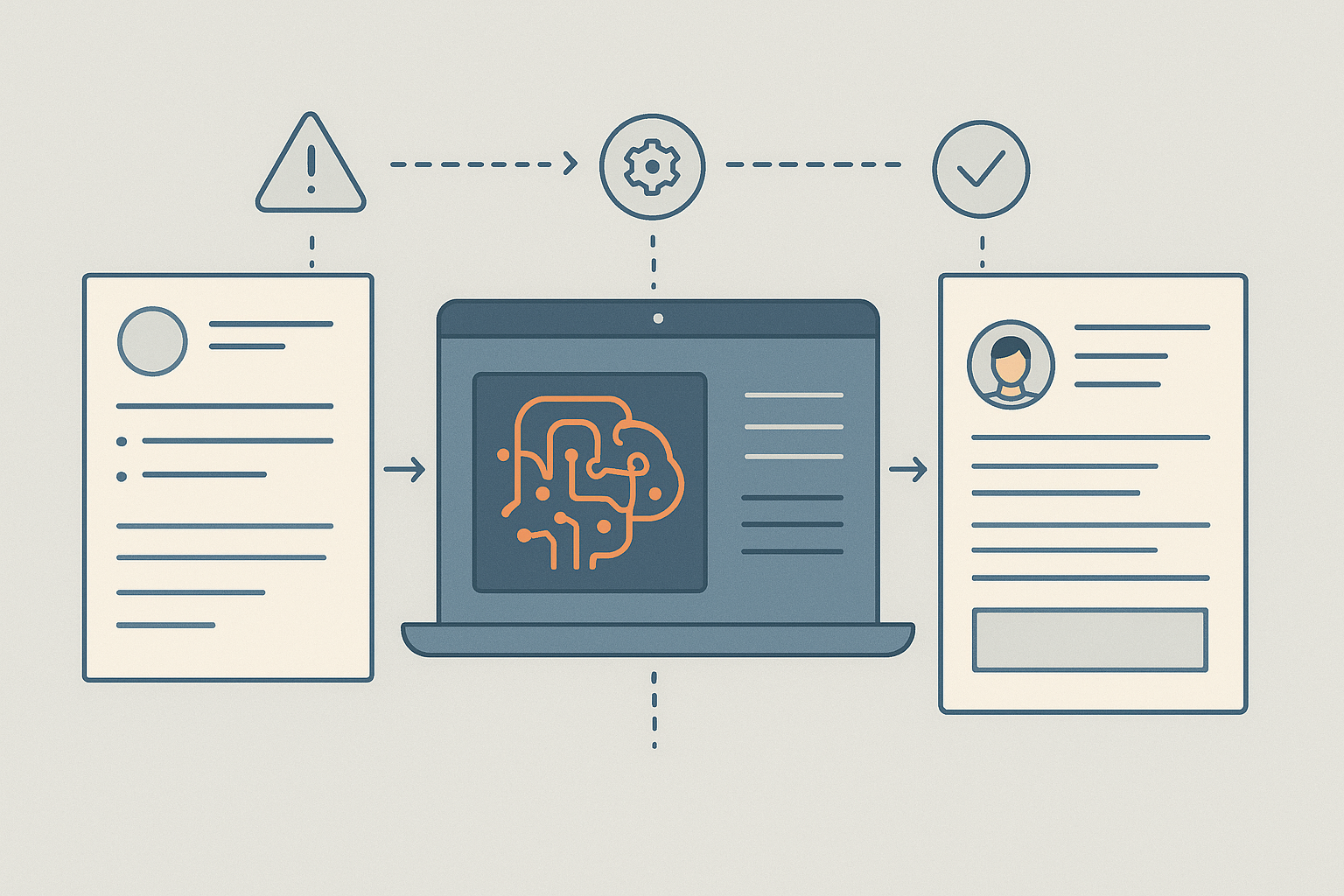
A weak bullet versus a stronger one
Here is the kind of line that sounds flimsy:
Built an AI chatbot with OpenAI that improved support efficiency.
The problem is not that it mentions AI. The problem is that it hides everything that would make the project credible.
A stronger resume bullet might look like this:
Built a docs-grounded support triage assistant that drafted escalation summaries from ticket history, added confidence checks before handoff, and cut manual triage time for common issues.
That version gives the reader a problem, a constraint, a workflow clue, and an outcome. It also leaves room to explain your ownership in an interview.
A portfolio version can carry a little more detail:
Designed an internal support assistant that retrieved approved troubleshooting docs, drafted first-pass escalation notes, and routed low-confidence cases to humans. I owned the prompt structure, retrieval setup, review criteria, and sampled QA against resolved tickets.
A LinkedIn profile version can stay short without going hollow:
Built an internal AI support assistant with docs grounding, confidence checks, and human-review gates so it sped up triage without turning bad answers into silent failures.
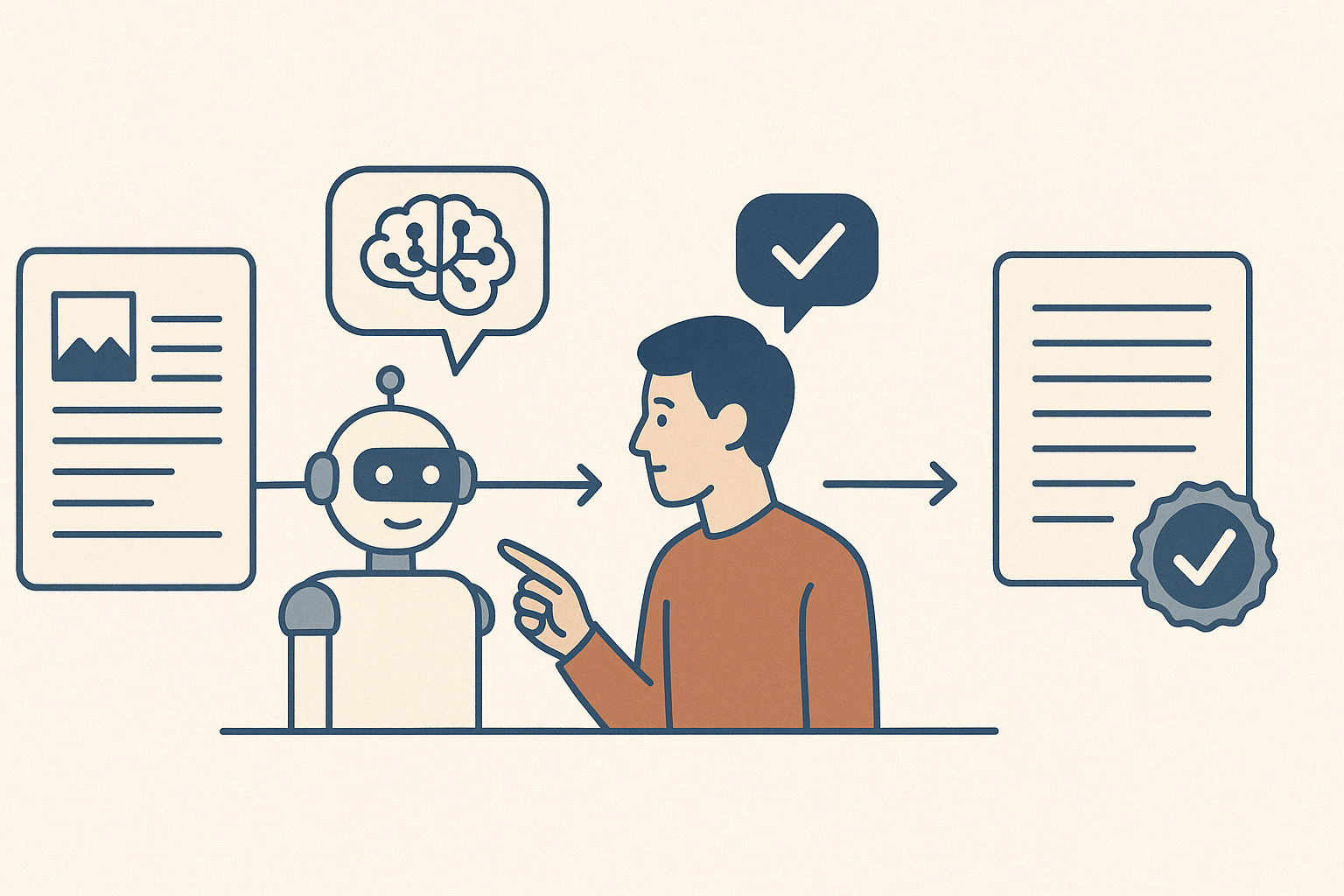
What hiring teams actually infer
Good project descriptions help a technical reader infer how you work. Specificity suggests you understand the system. Constraints suggest you dealt with reality instead of demo conditions. Verification suggests you know AI output is not self-authenticating. Outcomes suggest the project mattered to someone beyond you.[2][3][5]
Weak phrasing creates the opposite inference. "Used AI to build X" can sound like you mostly prompted a model and stopped there. That may be unfair, but it is still the risk you are creating.
Phrases worth cutting
Try removing phrases like these unless you immediately make them more specific:
- used AI to build
- leveraged LLMs
- created a chatbot
- automated workflows with GPT
- improved productivity with AI
Those lines are not wrong. They are just too cheap on their own. Replace them with the job the project did, the boundary it had to respect, the part you owned, and the evidence that it worked.
For a useful next pass, compare your draft project language with How to Show AI-Native Work on a Resume Without Sounding Generic, How to Talk About AI Tool Use in Interviews Without Sounding Reckless, and Grounded and Measurable AI Work Is Becoming a Hiring Signal.
The standard to aim for
The right AI-assisted project description does not hide the tool. It puts the tool in its proper place. Lead with the problem, make the constraints visible, separate assistance from ownership, and show how you verified the result. That is what makes the work sound like yours.
If you want the repeat-touch version of this topic, follow the AI tag archive on the CoreCV blog and keep going with The New AI Career Signal: Can You Steer and Verify AI Work? and ATS Resume for Software Engineers: 3 Ways You Can Be Rejected Before a Human Reads It.
Sources
1. Harvard FAS, Create a Strong Resume: https://careerservices.fas.harvard.edu/resources/create-a-strong-resume/
2. MIT Career Advising & Professional Development, Resumes: https://capd.mit.edu/resources/resumes/
3. Columbia Center for Career Education, Resumes with Impact: Creating Strong Bullet Points: https://www.careereducation.columbia.edu/resources/resumes-impact-creating-strong-bullet-points
4. GitHub Docs, Responsible use of GitHub Copilot inline suggestions: https://docs.github.com/en/copilot/responsible-use/inline-suggestions
5. NIST, AI Risk Management Framework: https://airc.nist.gov/airmf-resources/airmf/
6. Microsoft Developer Blog, Improve your agentic developer tools by grounding in Microsoft Learn: https://developer.microsoft.com/blog/improve-your-agentic-developer-tools-by-grounding-in-microsoft-learn
7. Anthropic Engineering, Demystifying evals for AI agents: https://www.anthropic.com/engineering/demystifying-evals-for-ai-agents
8. OpenAI Developer Blog, Testing Agent Skills Systematically with Evals: https://developers.openai.com/blog/eval-skills
9. OpenAI, Running Codex safely at OpenAI: https://openai.com/index/running-codex-safely/
10. OWASP Gen AI Security Project, LLM09:2025 Misinformation: https://genai.owasp.org/llmrisk/llm092025-misinformation/