Grounded and Measurable AI Work Is Becoming a Hiring Signal
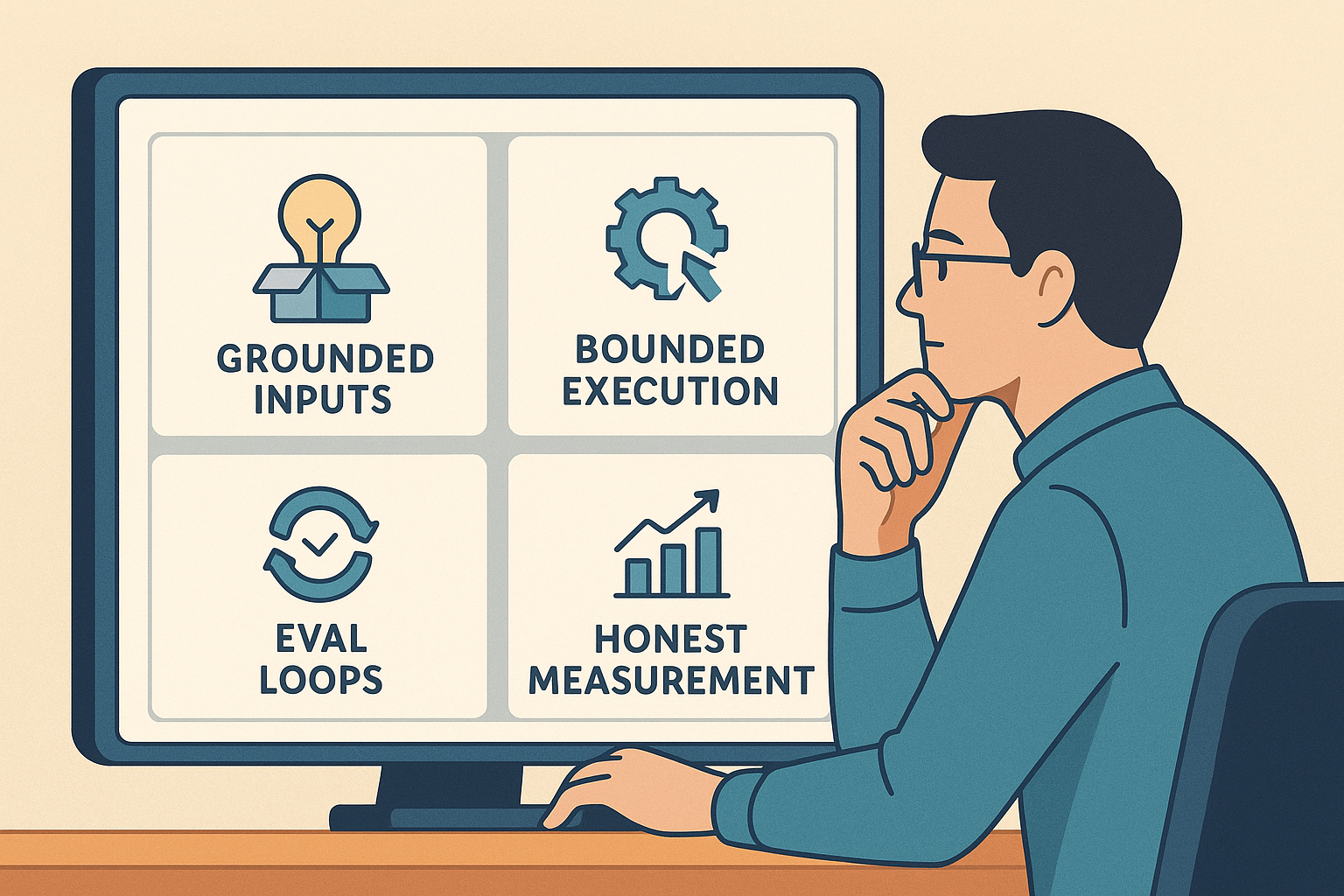
Generic agent enthusiasm is aging fast. A lot of candidates can now say they use AI. The stronger signal is narrower and more useful: can you show that your workflow stayed grounded in current source material, operated inside clear boundaries, and produced evidence you could actually defend when someone asked how you knew it worked?[1][2][3]
What changed is not just that more people use AI. It is that the best current examples keep pointing to the same workflow disciplines: grounded documentation, bounded execution, evaluation harnesses, recoverability, and visible audit trails.[4][1][5] That is why the more credible accomplishment now sounds like a workflow description, not a tool slogan.
A practical way to see the difference is to use a four-part test:
- Grounded inputs: what current docs, rules, or source-of-truth material did the workflow rely on?
- Bounded execution: what could the AI actually do, and what stayed restricted or human-owned?
- Eval loops: what tests, rubric checks, or sampled reviews told you whether it worked?
- Honest measurement: what did you track, where did it still fail, and what did you refuse to overclaim?
If your example cannot answer at least three of those clearly, the signal is probably weaker than you think.
If you already have one solid AI accomplishment and need help tailoring how much workflow detail to surface for different roles, CoreCV's resume builder is useful for keeping the base facts stable while you adjust the emphasis for engineering, platform, product, or operations roles, then fine-tuning that version against a specific job description or job URL.
Why this got stronger this week
The clearest new clue came from Microsoft's documentation-grounding example. Same prompt. Same model. Different result because one workflow had direct access to current Microsoft Learn docs and the other relied on stale assumptions. The grounded version reached the current API surface immediately and produced a working deployment script without the same debugging detour.[1] That is a great hiring translation because it shows that prompt fluency alone is no longer the interesting part. The stronger skill is knowing that current source material should be part of the workflow itself.
Anthropic's recent writing points in the same direction from a different angle. Its managed-agents work argues for stable interfaces between the session, the harness, and the execution environment so failures can be isolated and recovered cleanly.[4] Its evals guide makes the companion point that teams eventually get stuck if they rely on intuition instead of explicit tasks, graders, transcripts, and outcome checks.[2] OpenAI's eval-skills piece says much the same in smaller, more practical terms: define success first, capture the run, add deterministic checks, and compare outcomes over time instead of asking whether the latest version merely feels better.[5]
Put those together and the career implication gets sharp: generic AI use is becoming common, but grounded and measurable AI work is still legible as maturity.
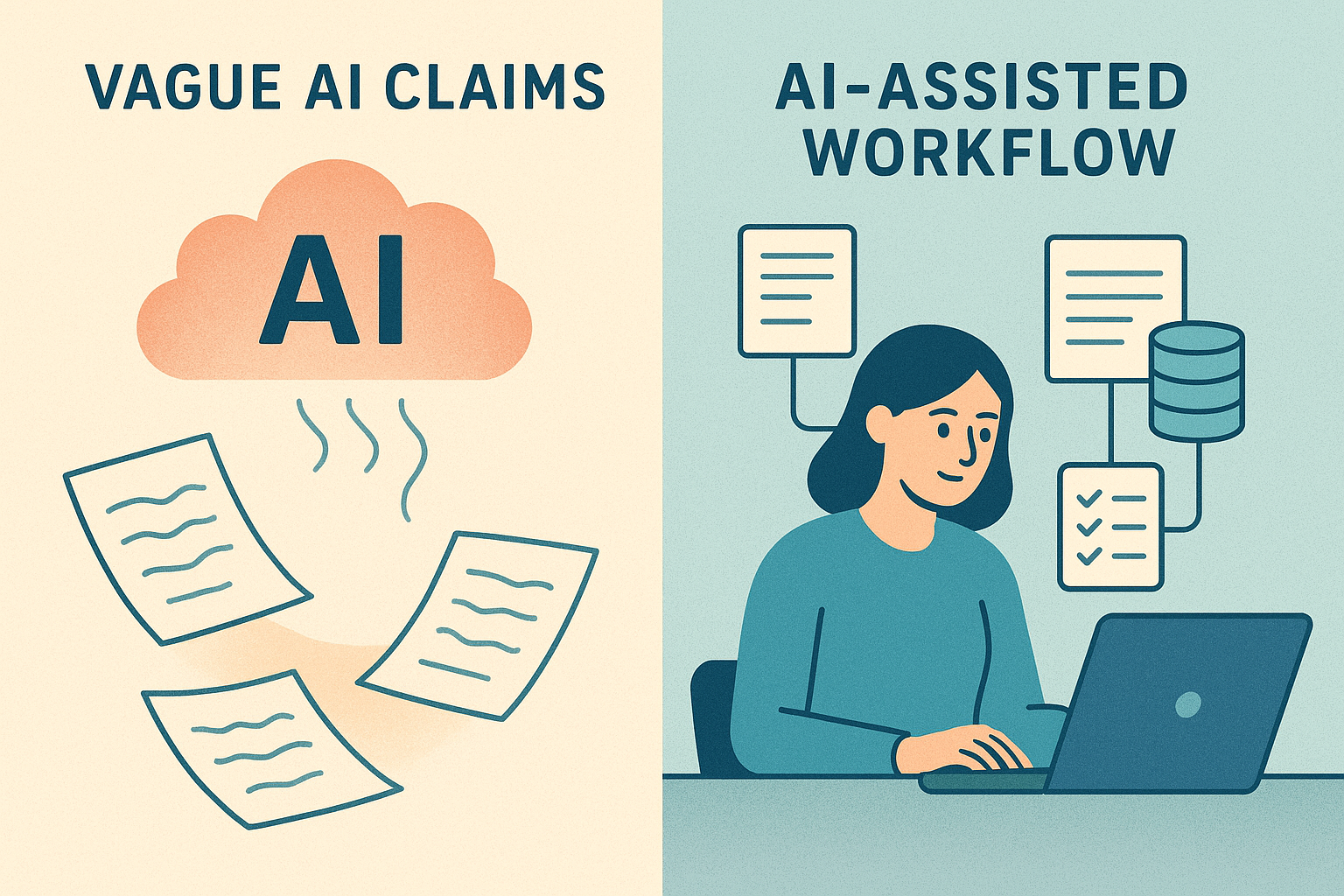 The stronger signal is not generic AI usage. It is a workflow that stays attached to current source material and clear operating structure.
What hiring teams can infer from the four proof layers
1. Grounded inputs suggest current judgment, not stale prompting
When a candidate says they grounded a workflow in current docs, internal runbooks, schema rules, or validated source material, the hiring team hears something specific. They hear that the candidate knows a model can sound fluent while aiming at an old API, an outdated policy, or a made-up assumption.[1]
This matters because a lot of weak AI stories still treat the model like the source of truth. Stronger candidates treat it like a reasoning layer that still needs a live foundation.
2. Bounded execution suggests operational discipline
Boundaries are not just a security topic. They are part of basic workflow credibility. OpenAI's Codex safety post is explicit that useful agent deployment depends on sandboxes, approval thresholds, network policies, and logs that explain what happened.[3] Anthropic's managed-agents architecture also keeps the "brain" separate from the "hands" so execution surfaces can fail or be replaced independently.[4]
For a job seeker, the translation is simple: if your AI accomplishment has no visible boundary, it sounds less mature. Employers do not just want to hear that work got automated. They want to hear what stayed reviewable, what needed approval, and what the system was not allowed to do.
3. Eval loops suggest you can tell the difference between output and quality
This is where a lot of candidates still undersell themselves. They talk about generation and skip the checking layer, even though the checking layer is often the more senior part of the work.
Anthropic's evals guide emphasizes defined tasks, multiple trials, graders, transcripts, and environment outcomes because agent behavior can drift across turns and failures compound over time.[2] OpenAI's eval-skills piece narrows that into an easy mental model: prompt, captured run, checks, score.[5] That is exactly the kind of detail that makes a resume bullet or portfolio case study sound real.
4. Honest measurement suggests you are not hiding behind AI theater
This is where the eval sources matter most. Anthropic's guide stresses that teams need clear tasks, trials, graders, transcripts, and outcome checks so they can see behavioral changes before users feel them.[2] OpenAI's version is simpler but points the same way: define success, capture the run, apply a small set of checks, and compare results over time.[5] Mature candidates do not just say a workflow improved efficiency. They say what they measured, how they checked it, and where it still broke.
That last part matters more than many people realize. Honest failure language often makes an AI story sound stronger, not weaker. A candidate who can say, "The grounded workflow worked well for standard deployments but still needed manual review on edge-case permissions," sounds more trustworthy than someone who implies the agent simply handled everything.
One through-line example that shows the full pattern
Take an AI-assisted internal deployment helper for a fast-changing cloud workflow.
A weak version of the story sounds like this:
- Used AI to speed up deployment scripting and cloud setup.
A stronger version sounds like this:
- Built an AI-assisted deployment helper that checked current vendor docs before generating scripts, ran dry-run validation before any live change, paused for approval when credentials or production settings were involved, and logged recurring failure patterns for weekly review.
That stronger version works because every important layer is visible: current source material, live-change boundaries, check loops, and a clear record of where the workflow still needed judgment.
How to translate that across resume, portfolio, and interview
Resume
A resume bullet should show the workflow shape in compressed form.
Weak:
- Used AI tools to improve cloud deployment efficiency.
Stronger:
- Built a docs-grounded deployment helper that generated first-pass scripts, enforced dry-run checks before live changes, and kept production approvals human-owned.
That bullet still needs tailoring for role and context, but it already tells a hiring team more about judgment.
Portfolio
A portfolio case study should show what the resume cannot fit.
Use a short structure:
- the workflow problem
- the source-of-truth material the system used
- the execution boundary
- the checks that determined success or failure
- the failure patterns or edge cases that stayed manual
That last line is especially important. Many portfolios prove that a workflow existed. Fewer prove that the candidate understood where it broke.
If you want a companion read on making AI project proof more legible in general, How to Show AI-Native Work on a Resume Without Sounding Generic is still the right starting point.
Interview
A strong interview answer should sound calm and concrete:
"I used AI to speed up first-pass deployment scripting, but the real work was in grounding the workflow in current docs, keeping live changes behind approvals, and checking outputs with dry runs before anything touched production. It saved time on setup, but we still kept exception handling and rollout decisions human-owned."
That answer works because it does not pretend the model was the accomplishment. The workflow design was.
If you want the interview-specific version of this playbook, pair this piece with How to Talk About AI Tool Use in Interviews Without Sounding Reckless.
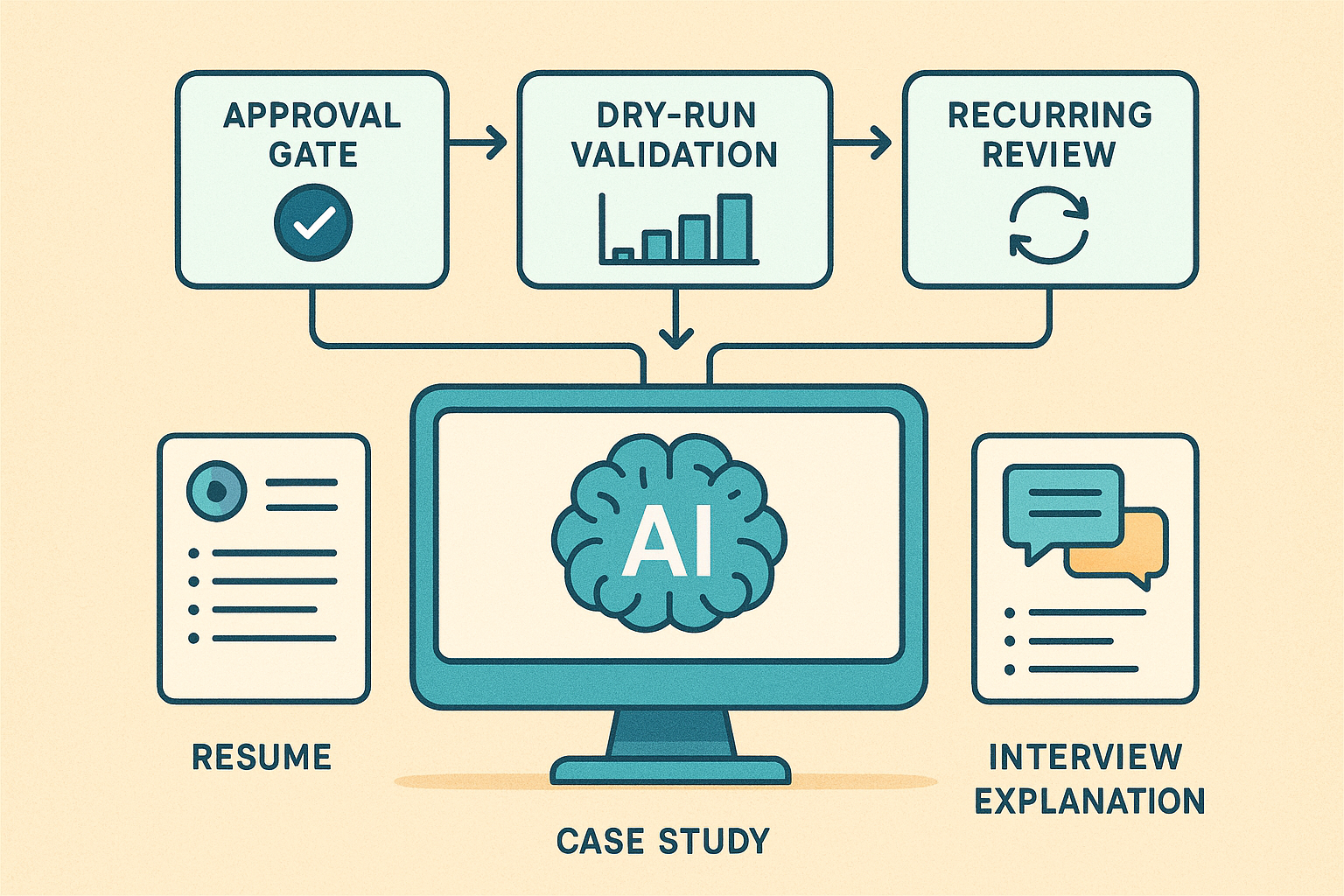 One grounded workflow becomes stronger hiring proof when the checks stay visible across resume, portfolio, and interview formats.
What to rewrite this week
Do not add more tool names. Rewrite one existing AI bullet or project summary so it makes the four proof layers visible.
Ask yourself:
- What live source material grounded the work?
- What was the boundary?
- What check loop proved quality?
- What did you measure honestly, including what still needed human judgment?
If your current wording cannot answer those questions, that is the real problem. The missing signal is not another model name. It is missing evidence.
This also pairs well with the broader series arc. Which AI Skills Actually Help You Get Hired in 2026 gives the wider market frame. The New AI Career Signal: Can You Steer and Verify AI Work? explains the workflow-ownership layer. Security-Aware AI Tool Use Is Becoming a Hiring Signal covers approvals and guardrails. And if your resume language is still too vague to survive early screening, ATS Resume for Software Engineers: 3 Ways You Can Be Rejected Before a Human Reads It is the right next read.
The bigger point
In a market where more people can access powerful models, simple usage stops standing out. What travels better is disciplined operation: grounded inputs, bounded execution, eval loops, and honest measurement.
That is a better hiring story because it is easier to trust.
If this is the kind of signal you want to sharpen every week, follow the AI Career Signals archive for more practical breakdowns on resumes, portfolios, interviews, and AI-assisted work.
Disclosure: This article is authored by the CoreCV team. While we mention CoreCV.ai, the strategies and advice presented here are intended to be useful whether or not you use our product.
Sources
- Microsoft Developer Blog, Improve your agentic developer tools by grounding in Microsoft Learn: https://developer.microsoft.com/blog/improve-your-agentic-developer-tools-by-grounding-in-microsoft-learn
- Anthropic Engineering, Demystifying evals for AI agents: https://www.anthropic.com/engineering/demystifying-evals-for-ai-agents
- OpenAI, Running Codex safely at OpenAI: https://openai.com/index/running-codex-safely/
- Anthropic Engineering, Scaling Managed Agents: Decoupling the brain from the hands: https://www.anthropic.com/engineering/managed-agents
- OpenAI Developer Blog, Testing Agent Skills Systematically with Evals: https://developers.openai.com/blog/eval-skills