Agentic Coding Is Raising the Value of Domain Expertise
The lazy story says agentic coding will flatten expertise because more people can now produce software. The better story is almost the opposite: as implementation gets cheaper to delegate, the value shifts toward people who know what should be built, what it must respect, what can go wrong, and how to tell whether the output is actually good.[1][2][3]
That is not a philosophical claim. It is showing up in the behavior of real systems. Anthropic's large session study found that the more domain expertise a person brings, the more work Claude can do per instruction and the more often the session succeeds. The striking part is that success tracks understanding of the problem more than formal coding identity alone.[1] Microsoft's grounding example shows the same logic from another angle: the same model can either waste time on stale assumptions or get to a working result quickly depending on whether the workflow includes current documentation at the point of action.[2]
So yes, agentic coding changes the market. But it does not reward everyone equally. It rewards candidates who can bring domain context, decision quality, and evaluation discipline into the loop.
Why implementation abundance increases the value of expertise
The market usually overreacts to new capability and underreacts to changed bottlenecks.
Right now the visible capability is obvious: coding agents can plan, edit files, run checks, debug, retrieve sources, and push through longer chains of work than simple autocomplete ever could.[1] That makes it tempting to assume the human role shrinks. But when a capability becomes abundant, the scarcer layer becomes more valuable.
In agentic workflows, the scarce layer is not raw text generation. It is informed judgment. Someone still has to define the real objective, bring in the right context, decide where autonomy should stop, and judge whether the output is merely finished or actually fit for purpose.
If that sounds familiar, it should. This is the same reason many teams still value senior engineers, domain experts, operators, and product-minded technical people even after making coding easier. Easier implementation does not remove the need for judgment. It increases the penalty for missing it because the wrong thing can now be produced faster and more convincingly.
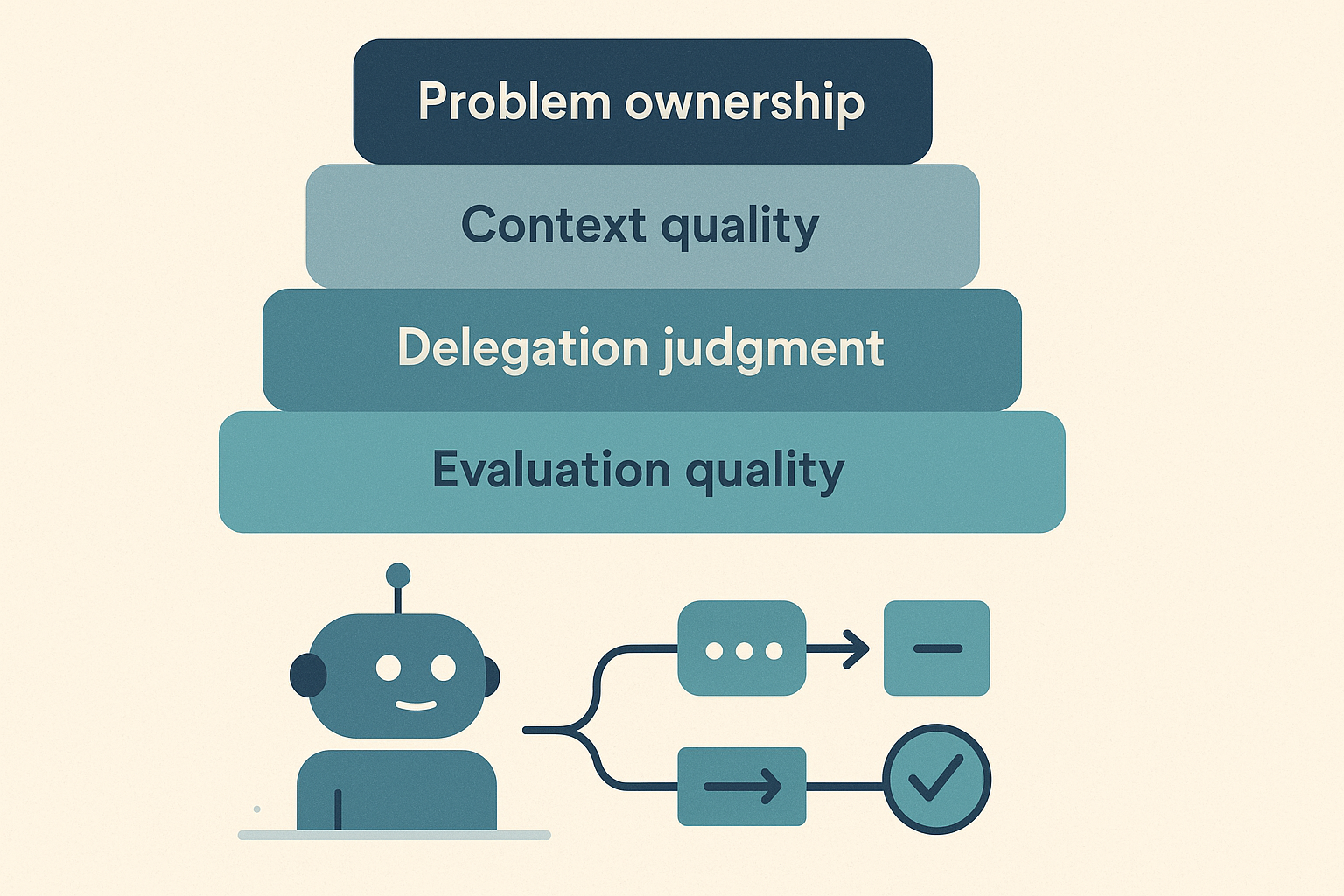 The scarce layer in agentic work is not output volume. It is the human judgment that defines, grounds, delegates, and evaluates the work.
The evidence is getting more specific
Anthropic's agentic coding report is useful because it cuts through a lot of vague market commentary. In a typical session, the human still makes most planning decisions while Claude makes most execution decisions. The human decides what to build. The agent increasingly decides how to execute the instruction chain.[1]
That division matters for hiring. If execution becomes cheaper, the strongest signal moves upstream.
Anthropic also found that expert users trigger longer action chains and more output per prompt.[1] The report's expertise rubric looks at signals like how precisely users frame directions, what they ask Claude to verify, and whether they tend to correct the model or get corrected by it. So the safer takeaway is not that Anthropic proved a single causal mechanism. It is that the sessions labeled as more expert tend to be the ones where the human brings sharper task understanding into the loop. In other words, expertise amplifies the agent.
Microsoft's Learn MCP example shows why that amplification is practical, not abstract. The same deployment request produced very different outcomes depending on whether the agent checked current Microsoft Learn documentation first. One path burned time debugging an outdated API choice. The grounded path used the current surface and produced a working deployment script immediately.[2] The valuable human here is not just the person who can read the final script. It is the person who knows the workflow should be grounded before code generation begins.
That is a domain-expertise signal. Not because only experts can code, but because experts are more likely to know which live source of truth matters and when stale context will quietly poison the result.
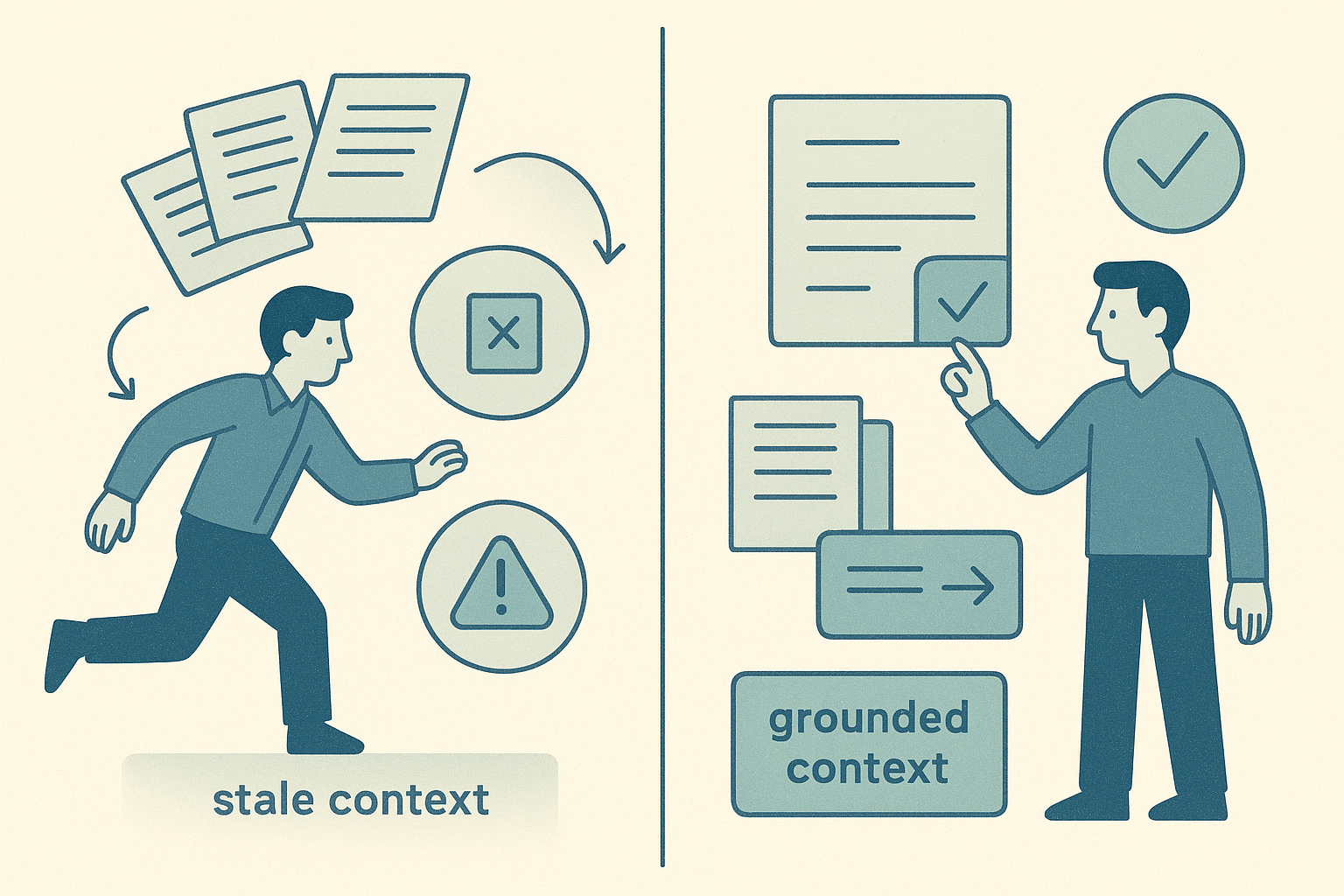 Grounded workflows usually look calmer for a reason: current context and clean verification remove a lot of fake progress.
Where weak AI stories break
A lot of candidates still describe AI work as if speed were the main thing employers care about.
- Used AI to automate part of a review workflow.
- Built an agent to handle support operations.
- Leveraged LLMs to accelerate internal tooling.
Those lines are not useless. They are just no longer very strong.
They hide the part that matters most: what domain understanding changed the workflow from plausible to trustworthy?
Take two different examples. In a regulated operations setting, maybe the workflow helped staff process exceptions, draft first-pass explanations, and pull the right policy references. In a platform team, maybe the workflow generated migration scripts or deployment steps, but only after checking current vendor docs and environment constraints. In both cases, the weak story is "the agent made us faster." The stronger story is that the human made the workflow reliable by supplying the rules, source hierarchy, privacy boundaries, and escalation logic that the model did not already have.
That is the version hiring teams care about. It makes the domain work visible. It shows policy awareness, source awareness, escalation judgment, and evaluation logic. It does not just say that the agent produced output. It shows that someone knew what the output had to respect.
If you want the broader series context for that rewrite pattern, pair this piece with Grounded and Measurable AI Work Is Becoming a Hiring Signal and The Best AI Candidates Know When to Stop and Ask.
User interests, not just task completion
One reason domain expertise is getting more valuable is that agentic work increasingly affects other people, not just local code quality.
Microsoft Research's SocialReasoning-Bench is a clean example. The benchmark tests whether agents acting on a user's behalf can negotiate well in calendar coordination and marketplace settings. The important finding is that completion and quality can diverge. Agents often complete the task while still leaving value on the table for the user. They accept suboptimal meeting times or poor deals because acting in someone's best interest requires more than finishing the workflow.[3]
That matters far beyond scheduling and bargaining. Once an agent is triaging support escalations, drafting customer outreach, prioritizing operations work, or helping choose an implementation path, domain expertise includes knowing whose interests are being represented and what a competent process looks like.
Project Deal makes this even less theoretical. Anthropic's office marketplace experiment found that stronger models got better objective outcomes for the humans they represented, while weaker representation often left people worse off without them noticing.[4] That is a useful hiring translation: if your workflow lets the system represent users or business interests, your value is not just building the loop. Your value is designing the loop so it advocates competently and fails visibly.
Candidates who can explain that difference sound more senior because they are thinking about delegated judgment, not just automation.
Privacy, policy, and other things the model will not magically care about for you
Another reason expertise rises in value is that better task performance can create new failure modes.
MosaicLeaks is one of the clearest examples. In that research setup, improving a deep research agent's task success also increased privacy leakage when the agent carried private details into web queries. The core lesson is uncomfortable and useful: telling an agent to be careful is weak protection. The workflow needs explicit incentives, constraints, and evaluation around how it searches and what it reveals.[5]
That is exactly where domain experts matter. They know which details are sensitive, which terms are harmless alone but dangerous in combination, and which shortcuts are unacceptable even if they help retrieval.
Project Vend phase two makes a similar point in a more chaotic real-world setting. Better tools and more procedure helped Anthropic's AI shopkeeper perform more competently, but the experiment still relied on ongoing human scaffolding around purchases, legal constraints, bad incentives, and adversarial behavior.[6] Capability improved. Robust judgment did not appear automatically.
This is why domain expertise is becoming easier to notice in AI-assisted work. The agent can write code, draft language, and move the task forward. The expert decides what must not be violated on the way there.
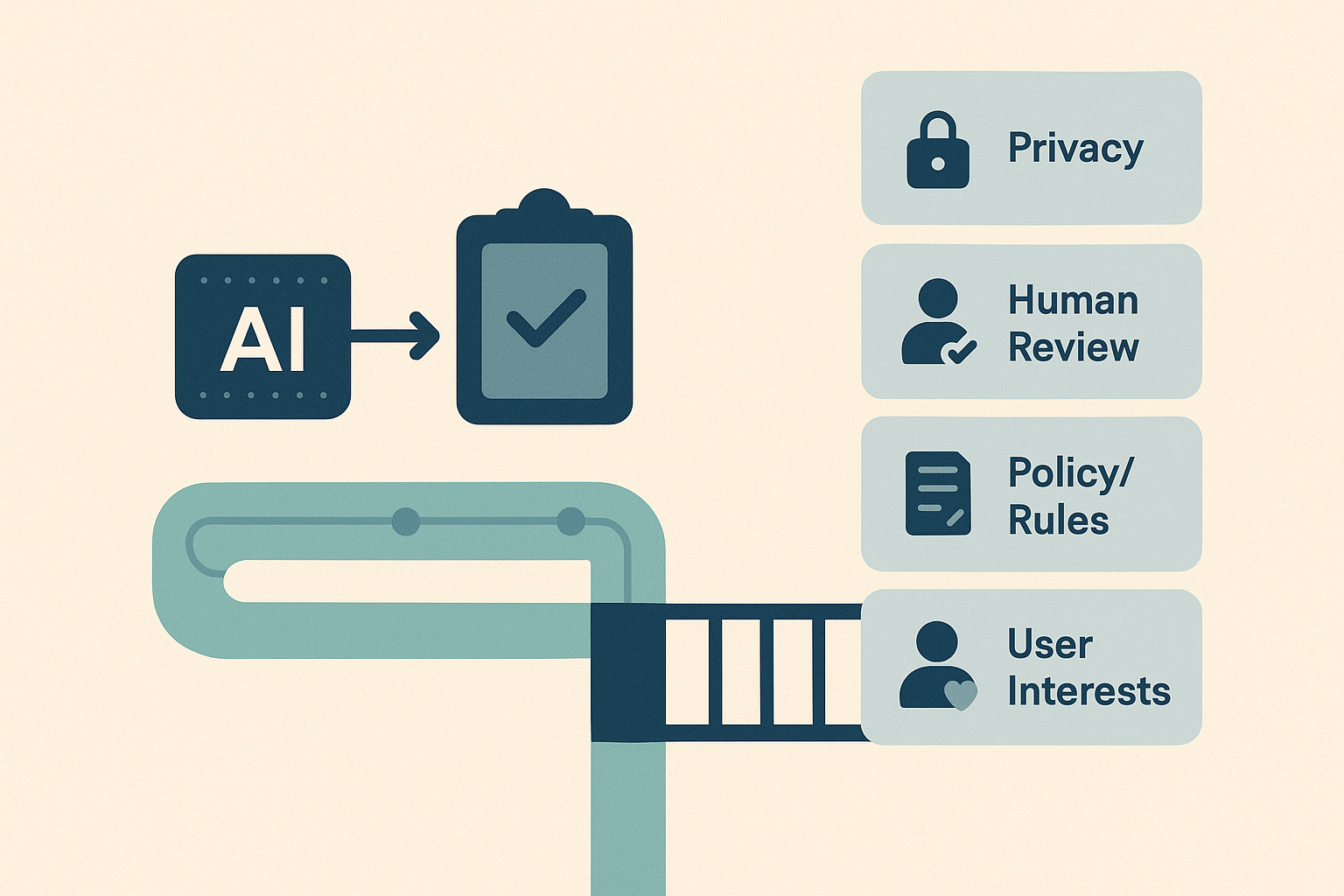 Completion is not enough. The workflow gets stronger when privacy, review, policy, and user-interest checks are designed into the path.
What hiring teams can now read from a strong AI example
A strong AI example communicates much more than tool familiarity.
Grounding the workflow in current policy or vendor docs signals that you understand stale-context risk.[2] Explaining where the system had to pause for review shows judgment about ambiguity, blast radius, and trust-sensitive actions. The New AI Career Signal: Can You Steer and Verify AI Work? and How to Talk About AI Tool Use in Interviews Without Sounding Reckless go deeper on that layer. Showing that outputs were checked against domain-specific rules or user-interest criteria signals that you know completion is not the same as quality.[3] And making it clear that sensitive context stayed out of external queries tells the reader you understand operational risk, not just prototype success.[5]
That is why "domain expertise" should not be read narrowly here. It is not only about a formal subject-matter credential. It includes practical rule knowledge, environment familiarity, risk awareness, user empathy, and the ability to tell when a neat output is missing the point.
How to show this on a resume
Your resume does not need to narrate the full system. It needs to make the expertise layer legible.
Weak:
Used AI agents to speed up internal compliance operations.
Stronger:
Designed an AI-assisted compliance workflow grounded in current policy sources, with protected-data safeguards, human escalation for ambiguous cases, and rule-based review before recommendations reached operators.
Weak:
Built internal tools with LLMs for support teams.
Stronger:
Built an AI-assisted support workflow that retrieved current product and policy guidance, prevented auto-send on trust-sensitive cases, and scored draft responses against internal quality rules before human release.
Notice what changed. The stronger bullets surface context quality, delegation logic, and evaluation. They make expertise visible without turning the bullet into a wall of text.
If you want help translating that kind of judgment into resume language, CoreCV's resume builder is a practical way to keep a stable base resume and then tailor the emphasis for engineering, product, platform, operations, or other domain-heavy roles against a job description or job URL.
This pairs naturally with The Right Way to List AI-Assisted Projects Without Sounding Like You Pressed a Button and, if your work was heavily internal, How to Position Internal Tools, Automations, and Dev Productivity Work as Career-Making Impact.
How to show it in a portfolio or case study
A portfolio gives you room to show the before and after more explicitly. The strongest case studies make the control points easy to see: what the workflow needed to accomplish, which live sources or domain rules it depended on, what the agent could do alone, what still required review, and how you judged output quality. The last part matters most. A candidate who can say, "The workflow handled standard provisioning requests well but still escalated contradictory billing or policy edge cases," sounds much more credible than someone who implies the agent solved the whole problem.
The portfolio goal is not to prove that you used advanced AI. It is to prove that you exercised judgment around a workflow with real consequences.
How to say it in interviews
A strong interview answer should sound normal, not defensive.
"The agent handled a lot of first-pass implementation and retrieval work. My value was in defining the policy boundaries, making sure it used current sources, keeping sensitive context from leaking into external search, and setting the review criteria for cases where completion alone was not enough. The speed mattered, but the real work was making the output trustworthy."
That answer works because it does not deny the agent's capability. It explains why capability still needed expertise.
What to rewrite this week
Take one AI bullet, one AI project summary, or one interview story and pressure-test it with four questions: what problem understanding did the human contribute, what current context or domain rules had to be brought in, where did the workflow need review or user-interest protection, and how was success judged in a domain-relevant way instead of by surface completion alone?
If your current wording cannot answer those questions, it is probably underselling the most valuable part of the work.
The bigger point
Agentic coding is not making expertise obsolete. It is making shallow implementation less rare.
That changes what stands out. The market is not paying extra for people who can merely ask for code. It is paying more for people who know whether the code should exist, what it must respect, what outcome best serves the user, and how to tell when the answer is polished but wrong.
That is good news for candidates with real judgment. They just need to describe it clearly.
If you want more weekly breakdowns like this, follow the AI Career Signals archive for practical guidance on resumes, portfolios, interviews, and AI-assisted work.
Disclosure: This article is authored by the CoreCV team. While we mention CoreCV.ai, the strategies and advice presented here are intended to be useful whether or not you use our product.
Sources
- Anthropic Research, Agentic coding and persistent returns to expertise: https://www.anthropic.com/research/claude-code-expertise
- Microsoft Developer Blog, Improve your agentic developer tools by grounding in Microsoft Learn: https://developer.microsoft.com/blog/improve-your-agentic-developer-tools-by-grounding-in-microsoft-learn
- Microsoft Research Blog, SocialReasoning-Bench: Measuring whether AI agents act in users' best interests: https://www.microsoft.com/en-us/research/blog/socialreasoning-bench-measuring-whether-ai-agents-act-in-users-best-interests/
- Anthropic, Project Deal: our Claude-run marketplace experiment: https://www.anthropic.com/features/project-deal
- Hugging Face x ServiceNow, MosaicLeaks: Can your research agent keep a secret?: https://huggingface.co/blog/ServiceNow/mosaicleaks
- Anthropic Research, Project Vend: Phase two: https://www.anthropic.com/research/project-vend-2