The Best Resume Strategy for Engineers Re-Entering the Market After a Long Stable Job

The risk in a long tenure is not the tenure itself. It is letting ten years of promotions, harder systems, and wider ownership collapse into one job entry that reads flatter than the work really was. If you are re-entering the market after a long stable run, your resume has to surface growth, current relevance, and decision-making fast instead of assuming the reader will infer it from the dates alone.[1][2][3]
Your biggest risk is hidden progression
Engineers who stayed put for years often have more signal than they think. They led harder migrations, took on wider scope, learned new systems, and earned more trust. Then they flatten all of it into one company line and five vague bullets.
That format hides the very thing a hiring team wants to infer: whether you grew, whether your work stayed current, and whether your recent scope still matches the market you are entering now. Recruiters scan quickly, and they use the job description to decide what evidence matters most.[2][3] In a market where skill requirements keep shifting, tenure alone does not do much to prove current, role-matched fit.[4][5]
If your raw career story lives across multiple internal projects, title changes, and resume drafts, CoreCV's resume builder is useful for keeping one structured base resume, spinning out role-specific versions, and fine-tuning them against a pasted job description or job URL without rewriting your entire history each time.
Rebuild the story around phases of growth
The most useful rewrite is usually not a cosmetic refresh. It is a reframing.
Instead of treating a long company tenure as one undifferentiated block, show the phases that matter. Maybe the first phase was implementation, the next was platform ownership, and the latest was architecture, migration leadership, or cross-team decision work. If you were promoted, make that progression obvious. If your official titles were noisy or overly internal, make the scope progression obvious in the bullets.
A weak version says this:
Senior Software Engineer, 2016-2026
Worked on backend systems, improved performance, collaborated across teams, mentored engineers.
A stronger version sounds more like this:
Senior Software Engineer, 2022-2026
Led service decomposition for billing and identity workflows, set migration sequencing across three teams, and reduced operational drag by replacing manual release checks with clearer rollout guardrails.
That second version works because it gives the reader a problem, a level of ownership, and a consequence. Strong bullet guidance keeps pointing to the same rule: be specific about what you did, how you did it, and what changed because of it.[6]
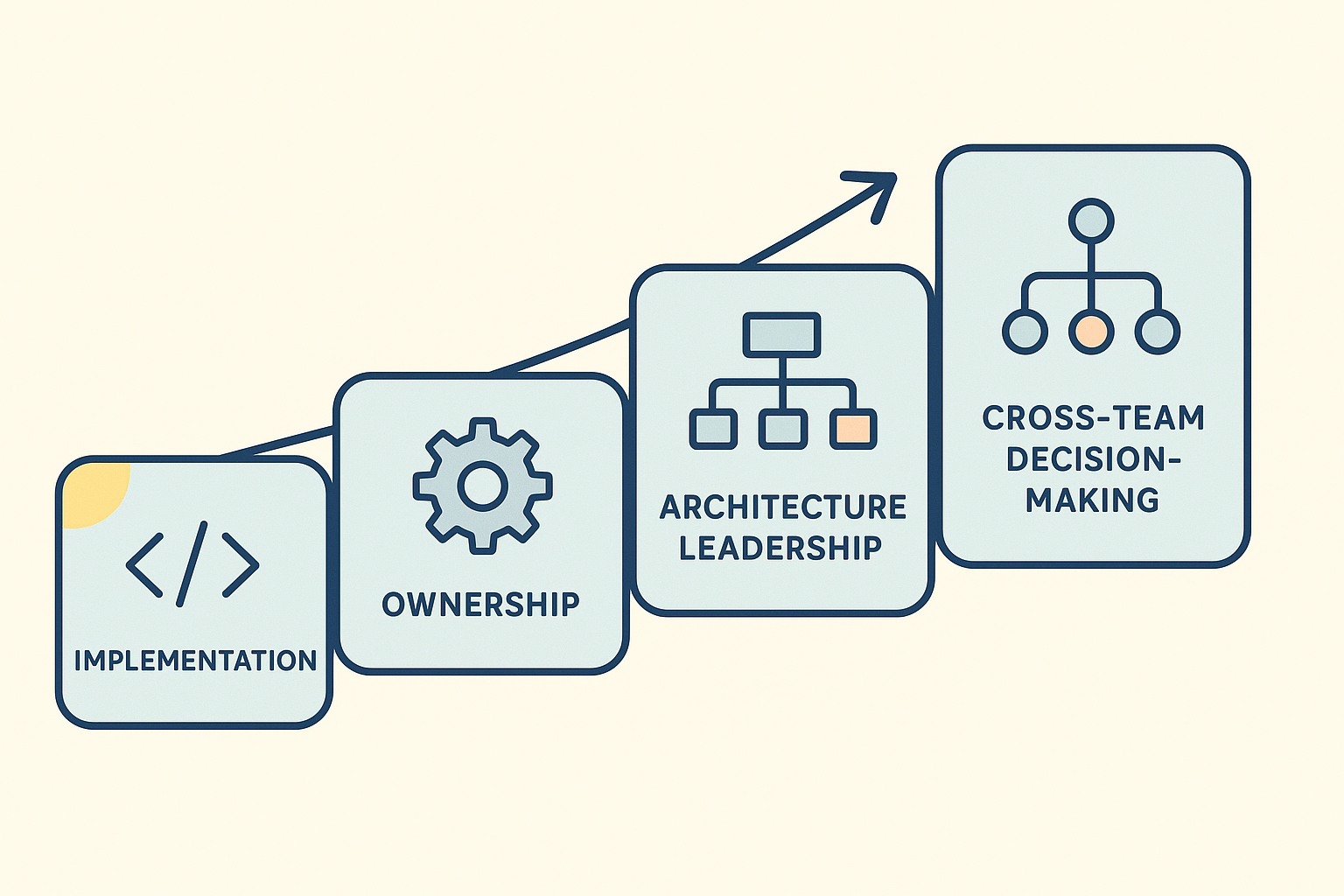 A long tenure reads stronger when the resume makes the growth phases visible instead of flattening everything into one company block.
Make current relevance carry more weight than loyalty
Long tenure can accidentally make a resume feel older than it is. Keep the dates, but foreground the most current and market-relevant work.
That means the top half of the experience section should lean hard on recent systems, recent decisions, and recent scope. If you spent ten years at one company but the last three included cloud migration, AI-assisted workflow design, platform modernization, stronger observability, or ownership across multiple teams, that is the material that should carry the page.
Older bullets should shrink unless they are still highly relevant. Early accomplishments matter less once they stop helping the reader understand your present fit. The better principle is simple: keep the evidence that sharpens present fit, and compress the history that no longer changes the hiring decision.[1][3]
 Recent, role-matched work should carry the hiring argument, while older history supports it more quietly.
This is also where many re-entry resumes get too loyal to internal language. Project codenames, company-specific org labels, and titles like MTS II or SWE3 may be perfectly real, but they do not help an outside reader unless the surrounding wording translates them into recognizable scope.
Translate internal success into external meaning
A long stable job often gives you plenty of real leverage and very little portable wording.
Your resume should explain your work in terms an outside hiring team can use. Name the system class, the business problem, the technical constraint, and the decision weight. "Owned Falcon migration readiness" may be meaningful internally. Outside the company, it is mush. "Owned migration readiness for a legacy Java service fleet moving to Kubernetes, including rollout sequencing, dependency cleanup, and failure-path planning" is much better because the work becomes legible.
The same rule applies to promotions and title changes. If the promotion path is a strong signal, make it easy to see. If the company used confusing internal levels, let the bullets show the progression in scope and trust. For a related formatting playbook, How to Show Promotions on a Resume Without Losing the Story is the closest companion to this problem.
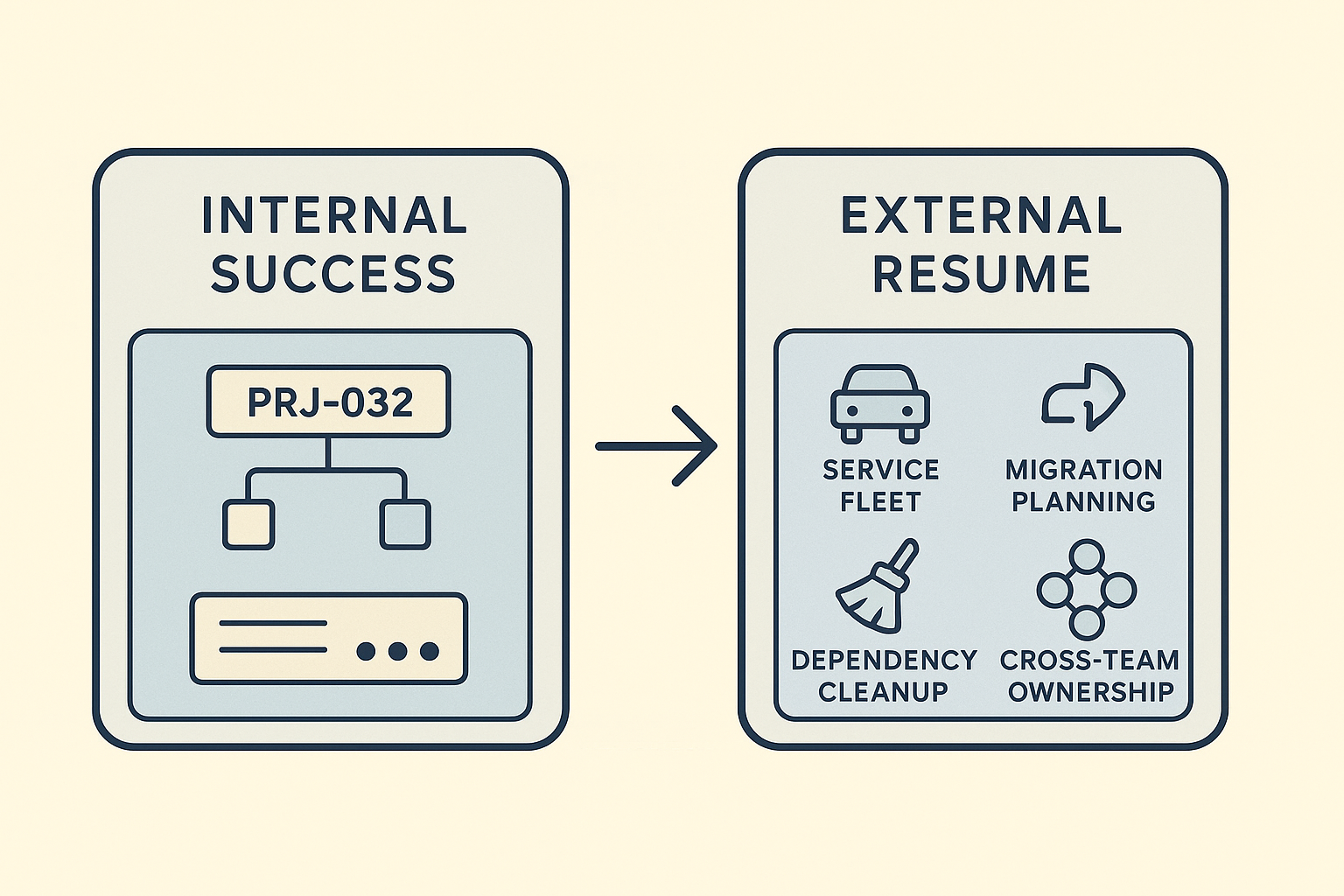 Internal wins need outside-facing language that makes the system, scope, and decision weight legible fast.
Rewrite bullets around inflection points, not responsibilities
The fastest way to modernize a long-tenure resume is to find the inflection points where your role changed meaningfully. Maybe you went from shipping features to owning a brittle service, then later became the engineer people trusted to sequence a migration without breaking adjacent teams. That arc tells a hiring team far more than five bullets about coding, collaboration, and support.
Those inflection points are what help a reader infer level. They also make tailoring easier. A platform role may want the reliability and migration material. A backend role may care more about service design and delivery. An engineering-lead role may care more about coordination and decision weight.
If your best recent work was hard to explain because it lived in platform, infrastructure, or internal systems, How to Write a Resume When Your Best Work Was Infrastructure No One Noticed and How to Position Internal Tools, Automations, and Dev Productivity Work as Career-Making Impact are the next two reads I would use.
Treat the rewrite like a market re-entry, not a document cleanup
After a long stable job, the resume rewrite is really a repositioning exercise. You are deciding what your last several years prove now.
Keep the long tenure. Make the growth visible. Put current, role-matched evidence near the top. Translate internal language into external meaning. Cut older bullets that no longer earn their space. Then tailor from that stronger base version instead of carrying one giant company block into every application. If you need help turning a long internal career story into sharper, role-specific versions, CoreCV is useful for keeping one structured base resume and adapting it to the role in front of you without starting over each time.
For a repeat-touch next step, follow the resume advice archive, then continue with The Best Resume Format for Senior Engineers Who Haven't Coded Full-Time in Years if the bigger challenge is showing leverage over day-to-day coding.
Sources
1. Harvard FAS Mignone Center for Career Success, Create a Strong Resume: https://careerservices.fas.harvard.edu/resources/create-a-strong-resume/
2. MIT Career Advising & Professional Development, Resumes: https://capd.mit.edu/resources/resumes/
3. UC Berkeley Career Engagement, Resumes: https://career.berkeley.edu/prepare-for-success/resumes/
4. LinkedIn Economic Graph, Skills-First: Reimagining the Labor Market and Breaking Down Barriers: https://economicgraph.linkedin.com/research/skills-first-report
5. Burning Glass Institute, Skills-Based Hiring: The Long Road from Pronouncements to Practice: https://www.burningglassinstitute.org/research/skills-based-hiring-2024
6. Columbia Center for Career Education, Resumes with Impact: Creating Strong Bullet Points: https://www.careereducation.columbia.edu/resources/resumes-impact-creating-strong-bullet-points