How to Show Systems Thinking on a Resume Without Writing a Wall of Text

A lot of engineers try to show systems thinking on a resume by naming it directly. That usually fails. Hiring teams do not infer strong technical judgment from labels like "strategic thinker" or "designed scalable systems." They infer it from specifics: what you had to balance, what you changed, what constraints shaped the decision, and what happened afterward. Strong resume guidance keeps returning to the same basics here: tailor for the role,[1][4] make relevant information visible quickly,[2] and describe work with specific context and outcomes.[3]
Systems thinking is not a skill line. It is an inference.
If a resume says systems thinking but the bullets only say built APIs, fixed bugs, and collaborated cross-functionally, the reader has to guess. A better approach is to make your decision quality visible. That usually means showing one or more of these elements inside a bullet:
- the system problem or constraint
- the tradeoff you had to navigate
- the interface between teams, services, or workflows
- the operational or business consequence of the decision
That structure fits how strong bullet-writing guidance works anyway: specific action, useful context, and a concrete result or consequence.[3][4]
Translate architecture judgment into a visible decision
A lot of mid-career and senior engineers hide the interesting part of their work behind vague verbs.
Weak:
Designed scalable backend architecture.
Stronger:
Split a batch-heavy billing pipeline into event-driven services with idempotent consumers and retry controls, which reduced duplicate processing incidents during peak-volume periods.
The second version works better because it gives the reader something to infer from. There is a system shape, an operational constraint, and a consequence. The useful principle is to show how you performed the work, not just what you did.[2]
 A stronger systems-thinking bullet gives the reader a visible decision, a constraint, and a consequence.
If your resume also needs to show how that scope grew over time, pair this with How to Show Promotions on a Resume Without Losing the Story.
Make constraints and tradeoffs legible in one line
Systems thinking usually shows up when there was no perfect option. Maybe latency fought with correctness, migration speed fought with reliability, or product flexibility fought with operational simplicity. That tension is often the real seniority signal.
You do not need a miniature postmortem. You just need enough detail for the reader to see the decision surface.
For example:
- Reworked search indexing to prioritize freshness for recruiter-facing queries while keeping nightly backfills for lower-value long-tail records, which improved visible result quality without overwhelming compute budgets.
- Introduced asynchronous document parsing for resume uploads, trading instant completion for clearer queue control and fewer timeout-related failures at peak traffic.
- Consolidated duplicated service configuration into shared deployment templates, reducing environment drift without blocking team-level overrides for regulated customers.
Those bullets are concise, but they still show judgment under constraints. That is much more credible than writing "balanced competing priorities" and expecting the reader to supply the story.
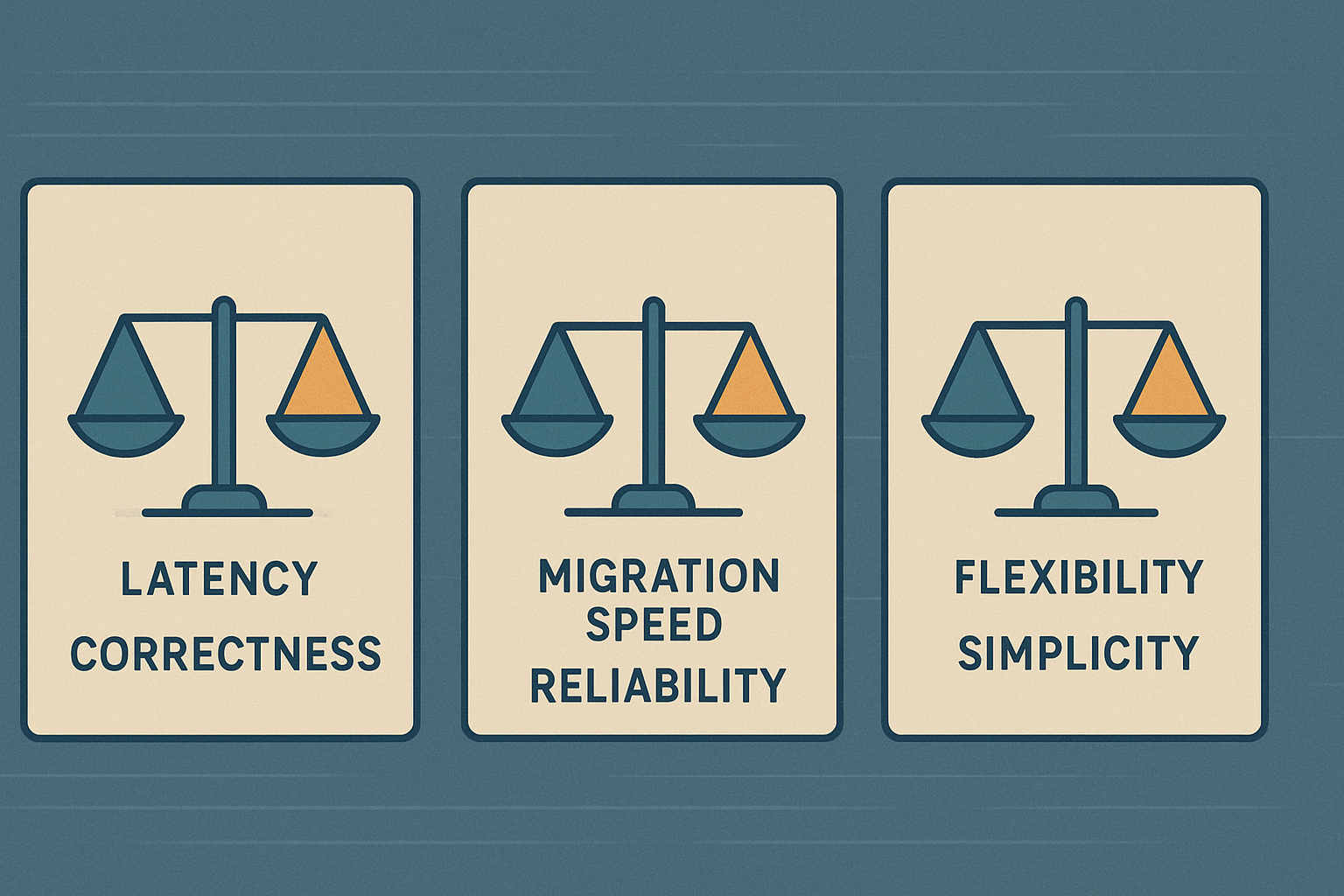 Tradeoffs are often the real seniority signal, especially when a bullet shows what got balanced and why.
If you have the raw material but your base resume keeps getting too long, CoreCV's resume builder can help you keep a fuller source version, then fine-tune a role-facing resume against a job description or job URL without rewriting your history from scratch.
Show cross-team scope by naming the interface, not just the collaboration
A lot of resumes waste good systems work with phrases like worked across teams or partnered with stakeholders. That language is not wrong. It is just too blurry.
If the cross-team part mattered, show what actually crossed the boundary. Was it data contracts, release coordination, incident ownership, compliance requirements, platform adoption, or migration sequencing? The clearer rule is to name what you did, how you did it, and why it mattered.[3]
Compare these:
Weak:
Collaborated cross-functionally to improve platform reliability.
Stronger:
Aligned backend, SRE, and analytics teams on shared alert thresholds and rollback triggers for a high-volume ingestion service, which shortened incident handoff time and reduced noisy escalations.
The stronger version makes the interface visible. The phrase cross-functionally is no longer doing all the work.
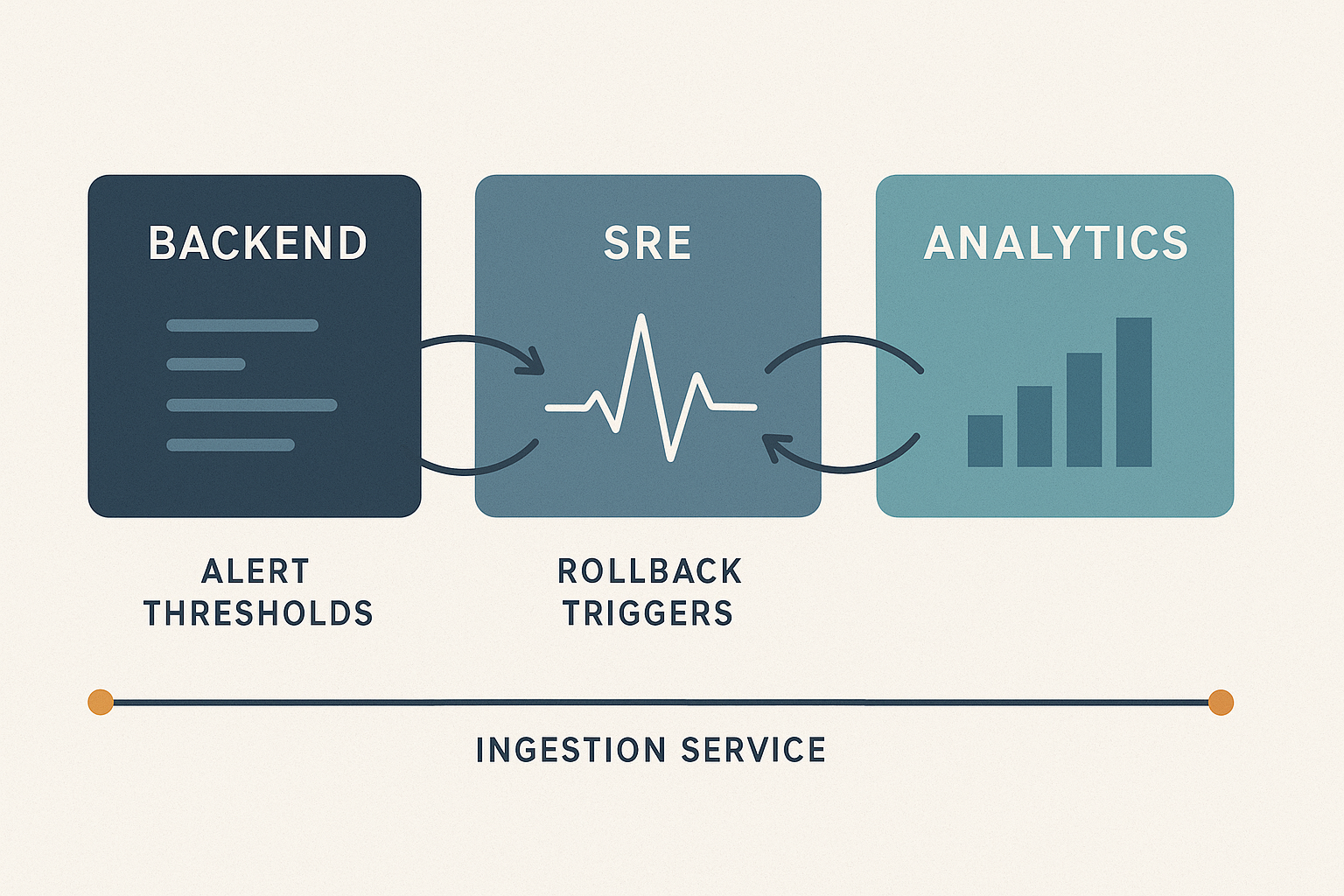 Naming the interface makes cross-team systems work legible faster than generic collaboration language.
That same clarity also helps with resume scanning. Recruiters and hiring managers do not have much time, so relevant information needs to become legible fast.[2] If your current resume already buries the important parts under vague summary language or layout noise, read ATS Resume for Software Engineers: 3 Ways You Can Be Rejected Before a Human Reads It.
A simple rewrite test for systems-thinking bullets
Before you keep a bullet, ask four questions:
- What decision did I make or influence?
- What constraint or tradeoff shaped it?
- What interface or dependency made it a systems problem?
- What changed because of that work?
If the bullet cannot answer at least two or three of those clearly, it probably is not showing systems thinking yet. Draw a clear parallel between the work you did and the need the employer is trying to fill.[4] The point is not to sound more senior. The point is to make the work easier to interpret correctly.
This is also why tailoring matters. The same experience can be framed differently for a platform role, a backend product role, or a staff-plus role focused on architecture and technical leadership. If you are still treating every application as a one-resume blast, read Do You Need to Tailor Your Resume for Every Job?.
A strong systems thinking resume does not read like a whitepaper. It reads like a set of compact proofs that you understand consequences, not just tasks.
For a repeat-touch next step, keep an eye on the CoreCV blog for more signal-first breakdowns on resume bullets, technical scope, and hiring inference.
Sources
1. Harvard FAS Mignone Center for Career Success, Create a Strong Resume: https://careerservices.fas.harvard.edu/resources/create-a-strong-resume/
2. MIT Career Advising & Professional Development, Resumes: https://capd.mit.edu/resources/resumes/
3. Columbia Career Education, Resumes with Impact: Creating Strong Bullet Points: https://www.careereducation.columbia.edu/resources/resumes-impact-creating-strong-bullet-points
4. UC Berkeley Career Engagement, Resumes: https://career.berkeley.edu/prepare-for-success/resumes/