Are You Overqualified or Just Misframed? Fixing Resume Signals That Price You Out

A lot of "overqualified" feedback is lazy shorthand. Often the problem is not too much experience. It is that your resume makes you look pointed at a different job: broader scope, heavier management, higher compensation, or less willingness to do the hands-on work. Strong resume guidance keeps returning to the same principle: tailor for the role in front of you and make relevance obvious.[1][2][3]
Overqualified is often a role-fit story, not an experience story
Hiring teams do not usually reject a candidate because extra experience is inherently bad. They reject when the resume creates friction. If your title history says Head of Engineering and the target role is a senior individual contributor position, the reader may infer that you will be bored, expensive, or gone in six months.
Do not hide seniority. Control the inference. Align the resume to the target role instead of treating it like a full autobiography.[1][4] A resume is supposed to make this role feel plausible.
Titles can create false distance
Inflated or unusually broad titles are one of the fastest ways to look misaligned. In smaller or less standardized environments, titles and actual scope do not always map neatly to larger-company ladders. If the role you want is Senior Software Engineer and your resume leads with VP of Technology, the reader may stop before they learn that you were still writing code most days.
Use the position description to decide what to include, then favor context and outcome over vague status language.[2][3] In practice, that means keeping the real title if needed, but making the functional scope visible fast. A clarifying pattern like "VP of Technology (hands-on founding engineer scope)" can reduce bad assumptions without rewriting history.
 A title can create the wrong inference before the reader ever gets to your actual work.
Leadership-heavy bullets can price you out
A second problem is bullet language that sounds too managerial for the role. Candidates often reach for words like led, directed, owned strategy, and oversaw cross-functional alignment. Those words become a problem when every bullet reads like you have not touched the real work in years.
The mistake is presenting only the coordination layer and none of the applied layer. For hands-on roles, employers still want evidence that you solved concrete problems, stayed close to the work, and delivered results. Strong bullet guidance is consistent on this point: specific action plus context and outcome beats vague responsibility language.[3]
A weak version looks like this:
Led strategic modernization across engineering functions.
A stronger version keeps the seniority but restores the work:
Led a payment-platform modernization by redesigning core service boundaries, migrating critical workflows off a brittle monolith, and cutting incident volume.
The second one still signals leadership. It proves you were close enough to the work to matter.
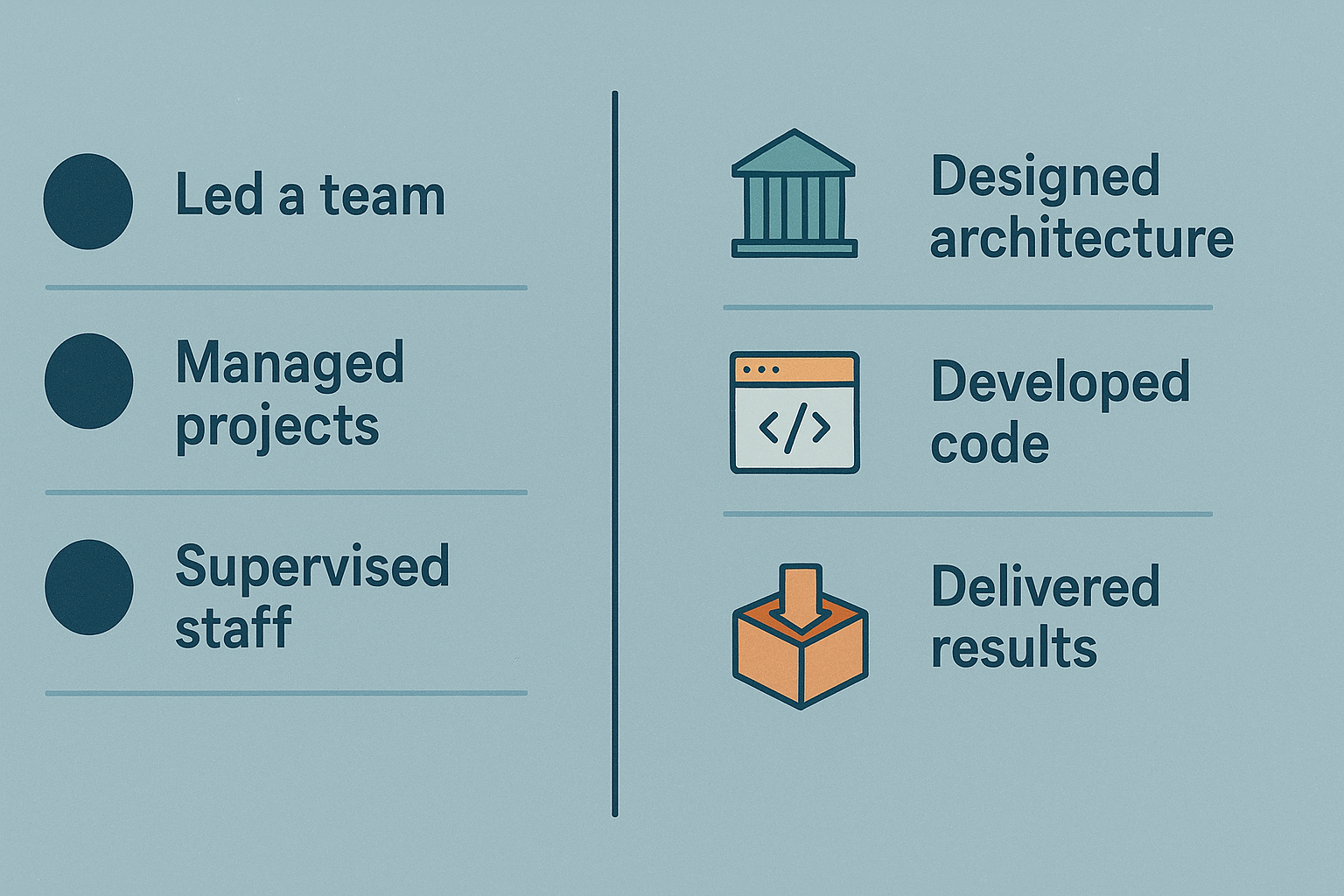 Stronger bullets keep the seniority signal, but they also show that you still do real work.
If your resume also needs to show title progression without making you look detached from execution, pair this advice with How to Show Promotions on a Resume Without Losing the Story.
Narrow the story without dumbing yourself down
This is the part many experienced candidates resist. Tailoring for a narrower role can feel like self-erasure. It is prioritization.
The standard is simple: make the relevant evidence easy to see, quantify outcomes where possible, and trim what does not support the target.[1][2][4] That may mean compressing board-facing bullets, reducing older leadership detail, and foregrounding the work that maps to the job now.
A practical filter is simple:
- Does this bullet make me look closer to the target work or farther from it?
- Does it imply compensation and scope well above the posted role?
- Does it prove I still execute, not just supervise?
If too many bullets fail that test, the resume will feel expensive.
 A simple filter helps you keep the evidence that supports fit and cut the evidence that creates pricing-out risk.
Role-level keywords and phrases you can actually use
This is where the article becomes practical. Different levels signal different value. If your resume borrows too much language from the wrong level, you can accidentally position yourself above or beside the job you actually want.
Use these phrase banks as raw material, not as a script. Copy what matches your real work, then attach it to concrete outcomes.
VP, CTO, Head of Engineering, and broader leadership roles
This level should sound like organizational direction, cross-team leverage, hiring judgment, and business accountability.
Useful keywords and phrases:
- engineering strategy
- organizational design
- multi-team execution
- cross-functional alignment
- budget ownership
- hiring and team building
- technical roadmap
- stakeholder management
- platform strategy
- operating cadence
- portfolio prioritization
- executive communication
- scaling teams
- leadership development
- business impact
Sample phrases:
- Set engineering strategy for a multi-team platform roadmap
- Built and scaled engineering teams across product areas
- Led org planning, headcount prioritization, and delivery tradeoffs
- Partnered with product and business leaders on roadmap and investment decisions
- Improved execution quality across teams through clearer operating rhythms and technical standards
Senior individual contributor roles
This level should sound like technical depth, ownership, system judgment, and hands-on delivery without overplaying people management.
Useful keywords and phrases:
- system design
- architecture
- technical leadership
- end-to-end delivery
- service boundaries
- performance optimization
- incident reduction
- mentoring
- migration planning
- reliability improvements
- API design
- developer experience
- infrastructure improvements
- production debugging
- technical decision-making
Sample phrases:
- Designed and shipped core backend services for high-volume workflows
- Led a complex migration while staying hands-on with implementation details
- Reduced incident volume by redesigning brittle service boundaries
- Drove architecture decisions for reliability, performance, and maintainability
- Mentored engineers through design reviews and technical problem-solving
Mid-level and hands-on individual contributor roles
This level should sound like execution, collaboration, problem-solving, and visible delivery close to the work itself.
Useful keywords and phrases:
- feature delivery
- implementation
- bug fixing
- testing
- code review
- collaboration
- troubleshooting
- sprint execution
- user-facing improvements
- automation
- documentation
- integration work
- quality improvements
- release support
- measurable outcomes
Sample phrases:
- Built and shipped product features used by internal and external users
- Improved application performance by fixing bottlenecks in critical workflows
- Collaborated with designers and product managers to deliver scoped releases
- Wrote tests and debugging tools that reduced repeat production issues
- Automated repetitive engineering tasks to improve team speed and consistency
A quick way to use this without sounding fake
If you are aiming downward in scope, keep the strongest hands-on phrases and trim language that overstates org ownership. If you are aiming upward, make sure your resume does not just show execution. It needs to show decision-making range, leverage, and business context.
A good test is simple: if someone removed your title, would the bullets still signal the level you want?
If you want a faster way to rebuild a role-matched version, try CoreCV's resume builder. Paste in a job description or job URL, then pressure-test which bullets actually support the role. The value is making the mapping step faster without rewriting your history.
The standard to aim for
Your resume should make a hiring team think, "This person can do the work and actually wants this version of the work." That is a different goal from "show the maximum possible seniority." For many experienced candidates, especially in a tighter market, that shift matters more than one more prestige signal.
For a true repeat-touch next step, copy the three-question filter above into your notes and run it against the next five roles you target. If this guidance is useful, keep an eye on the CoreCV blog for future resume and role-fit breakdowns.
If this problem sounds familiar, keep going with Resume Age Bias in Tech: What to Remove, What to Keep, What Not to Hide and Do You Need to Tailor Your Resume for Every Job?.
Sources
1. Harvard FAS Mignone Center for Career Success, Create a Strong Resume: https://careerservices.fas.harvard.edu/resources/create-a-strong-resume/
2. MIT Career Advising & Professional Development, Resumes: https://capd.mit.edu/resources/resumes/
3. Columbia Center for Career Education, Resumes with Impact: Creating Strong Bullet Points: https://www.careereducation.columbia.edu/resources/resumes-impact-creating-strong-bullet-points
4. UC Berkeley Career Engagement, Resumes: https://career.berkeley.edu/prepare-for-success/resumes/