Security Clearance, Regulated Work, and NDAs: How to Talk About Confidential Technical Experience

A lot of strong technical candidates have the same frustrating problem: their best work happened inside environments where they cannot name the customer, the system, or the exact implementation details. That does not mean the work has to disappear behind empty phrases like "worked on confidential projects." Strong resumes still need specificity, relevance, and visible accomplishment.[1][2][3][4] The trick is not to reveal more. It is to make the safe parts legible.
"Confidential" is a warning label, not a resume bullet
Hiring teams cannot evaluate what they cannot picture. If a bullet only says you supported confidential systems or handled sensitive work, the reader learns almost nothing about your level, scope, or judgment.
You can usually say much more than that without crossing the line. In many regulated or controlled environments, the boundary is around protected information, not around the fact that meaningful engineering work happened at all.[5] That means your job is to preserve the parts a hiring team can still assess: the environment, the type of problem, the constraints, and the operational result.
A weak bullet:
Worked on confidential infrastructure projects for a regulated client.
A stronger rewrite:
Improved deployment reliability for a regulated healthcare platform by adding release checks, rollback safeguards, and clearer failure handling across internal services.
The second version still avoids naming the client, the system, or protected data. But now the reader can infer what kind of engineer you were trusted to be.
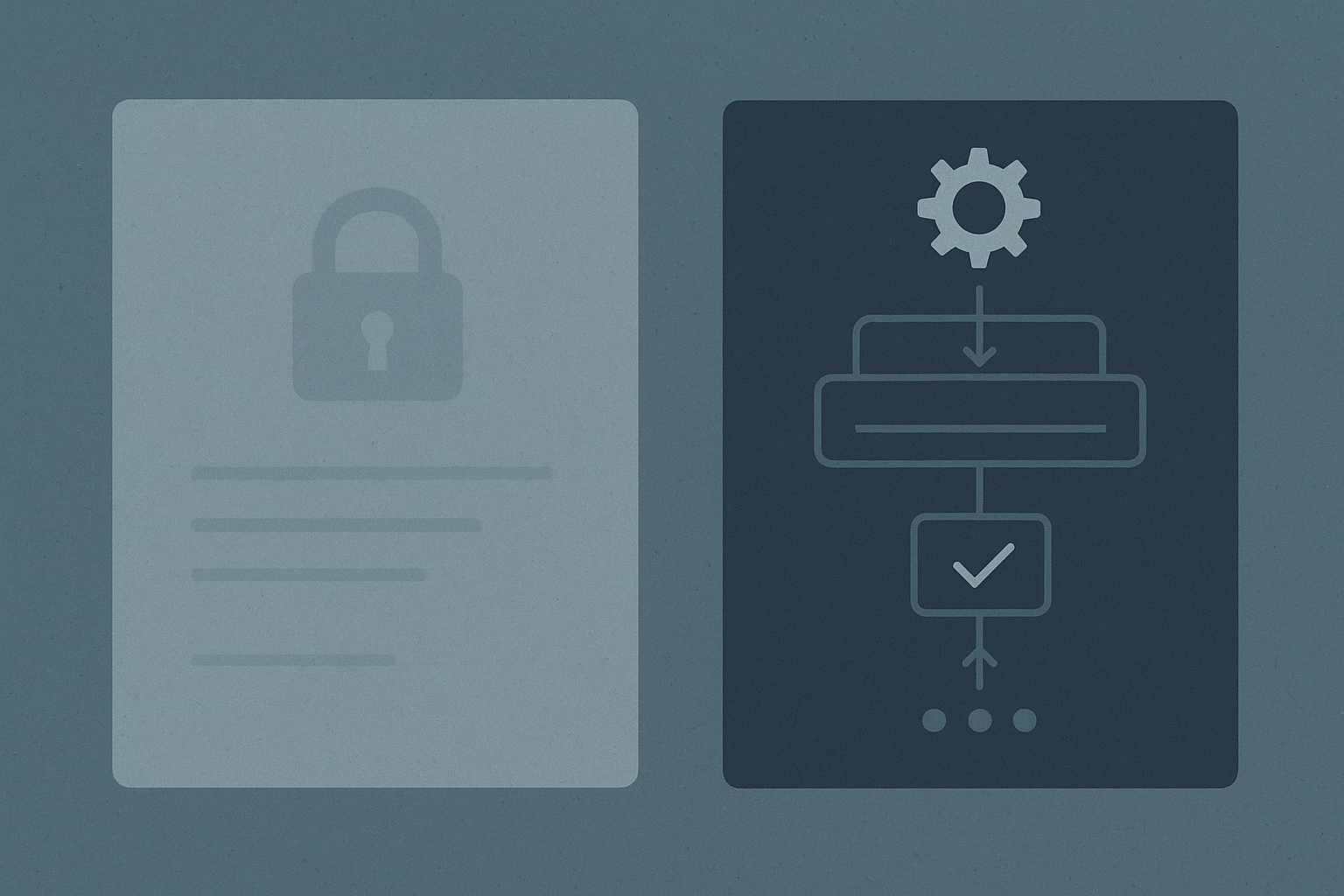 A stronger bullet gives the reader a problem, a constraint, and an outcome instead of just a secrecy label.
Use safe specificity, not total redaction
The safest useful details are usually high-level ones:
- the environment: defense contractor, healthcare platform, financial services infrastructure, internal enterprise tooling
- the problem type: migration, reliability, access control, data pipeline, release process, incident response
- the constraint: regulated data, export controls, classified context, NDA-limited client work, internal-only systems
- the result: faster recovery, lower operational friction, more reliable releases, cleaner auditability, reduced manual work
That structure lines up with standard resume guidance anyway. Strong bullets explain what you did, how you did it, and what changed because of it.[1][3][4]
If you need a cleaner way to manage a detailed private base resume and a more public, role-specific version, CoreCV's resume builder is useful for keeping the full record structured, then tailoring a safer version against a job description or job URL without rewriting from scratch.
 Safe specificity is usually enough: give the reader the environment, the problem, the constraint, and the result.
Security clearance can help, but it is not the whole signal
If you are allowed to mention an active or recently held clearance, it can be worth listing because it signals trust, vetting, and may reduce hiring friction for certain employers.[6][7] Public trust or other role-relevant vetting statuses can also be worth listing when they apply, but they should not be framed as equivalent to a security clearance.
But do not let status replace substance. "Active Secret clearance" is useful context. It is not a substitute for showing what technical problems you solved.
That means the stronger pattern is usually:
- list the clearance or vetting status cleanly if it is relevant and permitted
- keep the bullet focused on engineering work, constraints, and results
- avoid implying access alone was the accomplishment
For example:
Active Secret clearance. Built internal automation that reduced manual compliance checks for deployment readiness across a multi-team platform.
That reads much better than treating the clearance itself as the entire story.
Regulated work often gives you stronger constraints to write from
Candidates sometimes assume regulated work is harder to describe. In practice, it often gives you better raw material because the constraints are more concrete.
You may not be able to name the system, but you can often name the kind of boundary you had to work inside: audit requirements, access controls, change management, protected data handling, approval chains, or reliability expectations in a sensitive environment.[5][7]
Those constraints are useful because they show judgment. A hiring team can understand the value of engineering work that made releases safer, shortened incident response, reduced manual review load, or improved traceability in a controlled environment.
That is much more informative than scrubbing the bullet down to "assisted with confidential initiatives."
Portfolio and GitHub rules are stricter than resume rules
A resume can get away with compressed, sanitized context. A public portfolio needs a harder filter.
If the project details are truly sensitive, do not recreate them in a case study just because you want stronger proof. Instead, write about the reusable engineering pattern: what class of problem existed, what constraints shaped the solution, what tradeoffs mattered, and what outcome your work improved.
For example, a safe portfolio frame might describe a role as "designed internal approval-aware deployment tooling for a regulated environment" instead of naming the employer, architecture, or dataset. That still gives the reader real signal while respecting the boundary.
This is the same judgment test you should use before linking public work at all. Should You Put GitHub on Your Resume? Sometimes. is a good companion read if you are deciding what public evidence actually helps.
 A public case study should preserve the pattern and the outcome, not the protected implementation details.
A simple filter for each bullet
Before you keep a confidential-work bullet, run four questions:
- Does it name the environment at the highest safe level?
- Does it describe the problem or responsibility clearly enough to picture?
- Does it show a constraint or decision quality that matters?
- Does it describe an outcome without exposing protected specifics?
If the answer to most of those is no, the bullet is probably too vague. If the bullet starts naming systems, customers, or data that an agreement or policy protects, it is probably too detailed.
The middle ground is the target.
The standard to aim for
Your resume does not need to publish secrets to prove you did serious work. It needs enough safe specificity for another technical reader to understand the kind of problems you handled, the constraints you worked under, and why that experience should transfer.[2][3][4]
Confidential experience is still experience. Do not hide it behind one vague adjective.
For a practical next step, review one sensitive bullet on your current resume and rewrite it using only four ingredients: environment, problem type, constraint, and result.
If you want one companion read after that, start with Should You Put GitHub on Your Resume? Sometimes. for a stricter look at what public evidence helps versus what just adds noise.
For more evidence-first resume guidance, follow the CoreCV blog.
Sources
1. Harvard FAS Mignone Center for Career Success, Create a Strong Resume: https://careerservices.fas.harvard.edu/resources/create-a-strong-resume/
2. MIT Career Advising & Professional Development, Resumes: https://capd.mit.edu/resources/resumes/
3. Columbia Center for Career Education, Resumes with Impact: Creating Strong Bullet Points: https://www.careereducation.columbia.edu/resources/resumes-impact-creating-strong-bullet-points
4. UC Berkeley Career Engagement, Resumes: https://career.berkeley.edu/prepare-for-success/resumes/
5. National Archives, Controlled Unclassified Information (CUI): https://www.archives.gov/cui
6. Defense Counterintelligence and Security Agency, Personnel Vetting: https://www.dcsa.mil/Personnel-Vetting/
7. U.S. Department of State, Security Clearances / Personnel Vetting: https://www.state.gov/securityclearances