16 posts tagged with "resume"

View All Tags

The Resume Stack: How to Organize Multiple Versions

· 10 min read
The Resume Stack: How to Organize Multiple Versions

Most engineers don't fail because they're unqualified. They fail because the resume they sent didn't match the role that was hiring.

That mismatch is rarely dramatic. It's usually small, avoidable drift.

You apply to a backend role, but the resume you used last week leans full-stack. You swap a couple bullets, forget to update a date, and now you have two "truths" floating around. Two weeks later a recruiter replies and asks for the same resume again. You can't remember which file you sent.

Recruiters and hiring managers scan fast. If the first screen doesn't make the match obvious, you lose the opportunity before anyone gets to the interesting parts. Multiple sources put that first pass in seconds, not minutes [1], [2].

The fix isn't "write one perfect resume." The fix is to build a small system: a resume stack.

Resume Red Flags Tech Hiring Managers Notice Immediately

· 13 min read
Resume Red Flags Tech Hiring Managers Notice Immediately

Hiring managers spend seconds scanning your resume. Not minutes. Seconds. Research shows recruiters take an average of 6-7 seconds on an initial pass, and they're looking for reasons to eliminate you, not reasons to move forward.[1] Every red flag in those first few seconds increases the odds your resume gets rejected before anyone reads the second bullet point.

The problem is most candidates don't know what those red flags look like until it's too late.

The Resume-LinkedIn Disconnect: Why They Shouldn't Be Identical

· 10 min read
The Resume-LinkedIn Disconnect: Why They Shouldn't Be Identical

Stop treating your resume and LinkedIn profile like mirror images. They serve entirely different purposes, optimize for different audiences, and get evaluated by fundamentally different systems. Copying content verbatim from one to the other is a strategic mistake that costs you opportunities.

This disconnect isn't a problem to solve by harmonizing both platforms. It's an advantage to leverage.

Inside a Tech Recruiter's Mind: What They Really Look For

· 5 min read
Inside a Tech Recruiter's Mind: What They Really Look For

Note: The insights in this article are based on observed patterns in tech recruiting workflows, industry best practices, and documented recruiter behavior rather than a specific research study.

The tech job market in 2025 is not short on candidates. It is short on attention.

Recruiters and hiring managers operate under severe time constraints, supported by ATS filters and internal heuristics designed to reduce volume quickly. The result is a screening process optimized for signal extraction, not holistic storytelling. Understanding this constraint explains nearly every resume decision that actually matters.

This post distills recurring patterns observed across tech recruiting workflows - without anecdotes, quotes, or folklore. Just what consistently survives review.

The Future of Tech Resumes: AI Personalization + Structured Data

· 8 min read
The Future of Tech Resumes: AI Personalization + Structured Data

If you are an experienced engineer, you have probably revised your resume dozens of times. The familiar ritual of tweaking bullet points and selecting fonts is no longer enough. Currently, the first "reader" of your resume is often software. Applicant Tracking Systems (ATS) parse a document and extract structured fields such as job titles, dates, skills and education. Recruiters then search and filter based on those fields to manage hundreds of applicants. Meanwhile, job-seekers are using AI to generate generic resumes and cover letters, so the competition for attention is fierce. This post argues that the static, one-size-fits-all resume is dying. Instead, modern hiring pipelines reward resumes that are both role-specific and machine-readable.

Resume-as-Code: Building Your Developer CV with JSON

· 10 min read
Resume-as-Code: Building Your Developer CV with JSON

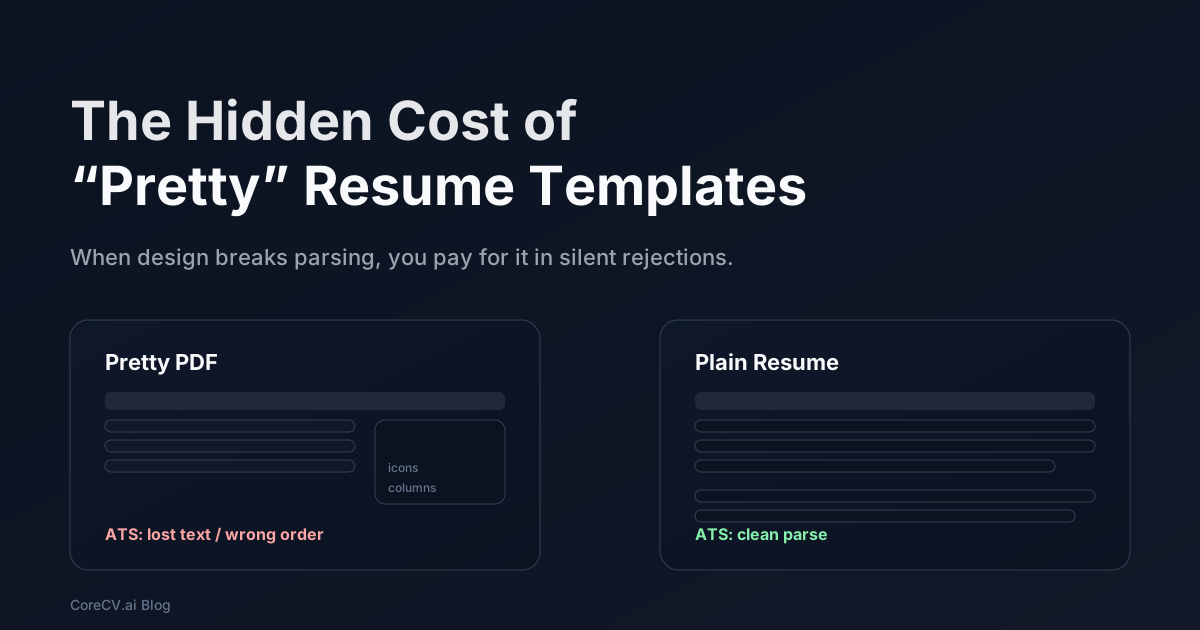
Ask any developer about the most frustrating part of job hunting and they'll likely mention wrestling with resume templates. Word and PDF files force you into rigid layouts, and tweaking a single bullet point can break the entire design. Worse, these files don't always play nicely with automated hiring systems. Modern applicant tracking systems (ATS) are everywhere - according to a 2023 study, nearly 98% of Fortune 500 companies and approximately 75% of employers overall use ATS systems to filter candidates. Yet complex designs and fancy formatting can confuse ATS parsers, causing important information to get lost. When a significant majority of employers report they may be missing qualified candidates because resumes aren't ATS-friendly, it's clear that our approach to resumes needs to change. Enter the resume-as-code movement.