Stop Naming the Model. Show Why It Was Enough.

"Built with the newest frontier model" has a short shelf life. It tells a hiring manager what you could access, but almost nothing about what you understood. The stronger story explains why that model, a smaller model, or a non-AI rule was sufficient for a defined workload. As model families multiply and prices fall, choosing the system is becoming more revealing than naming it.
The September release cycle made that distinction unusually clear. Benchmark margins can now imply larger real-world differences than users experience, even as new model families widen the choice among quality, latency, and cost.[1][2] Another emerging approach narrows the output itself: TypeSafe AI's Jev is designed to return a typed decision and a confidence score for workflow steps that do not need open-ended prose.[3]
These are vendor claims and product choices, not a new hiring standard. Their shared implication is still useful. The model leaderboard is becoming a weak proxy for implementation judgment. A candidate who says "I used the best model" has left the important questions unanswered:
- Best for which cases?
- What counted as acceptable quality?
- Which failures mattered most?
- What latency and cost could the workflow tolerate?
- When did the system escalate to a person or a stronger model?
- What evidence would cause you to change the design?
Your portfolio should answer those questions. A model name proves access. A selection record proves judgment.
Model choice is part of the product
AI projects are often presented as if model selection happened before the real engineering. Pick the strongest model, connect the API, and then begin designing the application. That framing hides consequential work.
A support classifier that labels a billing ticket as a product question creates inconvenience. A medical workflow that routes an urgent message incorrectly can create harm. A code assistant that takes forty seconds during an occasional migration may be acceptable. The same delay inside every keystroke is unusable. A research tool that runs twice a month can afford a different cost profile from a feature invoked ten times per second.
The model participates in the product contract. Its useful quality depends on the inputs it receives, the output shape the application needs, the failure distribution, the fallback path, and the service constraints around it. Public benchmarks can help form a shortlist, but they cannot write that contract for you.
OpenAI recommends establishing a quality baseline before optimizing cost and latency, then evaluating smaller or faster options against that baseline.[2] Anthropic's cost guidance similarly describes routing simple queries to smaller models and reserving more capable models for harder work.[4] Neither pattern means always use the cheap model. Quality is a threshold tied to a task, while cost and latency are design variables.
That decision is excellent career material because it exposes how you reason under constraints. Employers do not merely need people who can call an API. They need people who can decide what deserves intelligence, how much, under which safeguards, and with what evidence.
Use FITS to make selection inspectable
Before comparing models, write a one-page selection record using FITS: Failure cost, Inputs, Tests, and Service constraints. The framework forces the evaluation to describe your workload instead of repeating a vendor's marketing page.

FITS turns model selection into an inspectable path from failure cost and inputs through tests and service constraints.
Failure cost: decide which errors are expensive
"Accuracy" compresses different mistakes into one number. That can produce a model that looks strong while failing in the direction users care about most.
Suppose a ticket-routing system has four outcomes: billing, account access, product help, and urgent security review. Misrouting a product question to billing creates delay. Misrouting a credible account-takeover report to ordinary product support creates a much larger risk. A single aggregate score can hide that difference.
List failure types and assign an operational response. Which errors can be corrected later? Which require immediate escalation? Which should block automation? Which can be caught with a deterministic rule before any model runs?
This is consequence-adjusted evaluation. You are not claiming a universal moral cost. You are making local operating priorities explicit enough to test. The Measure function in NIST's AI Risk Management Framework Core calls for context-appropriate metrics, documented testing, and regular monitoring over time.[5] A portfolio project can apply that discipline at a smaller scale.
| Failure | Consequence | Detection | Response |
|---|---|---|---|
| Routine ticket sent to wrong queue | Slower response | Weekly labeled sample | Correct and add case to eval set |
| Security concern treated as routine | Material user risk | High-recall rule plus reviewer sample | Block auto-route and escalate |
| Unsupported category returned | Workflow break | Schema validation | Retry once, then human queue |
| Low-confidence case auto-routed | Hidden ambiguity | Confidence threshold | Route to triage |
The table is more persuasive than "achieved 92% accuracy" because it explains whether the remaining 8% is tolerable.
Inputs: define the workload you serve
Public benchmark prompts rarely match your users, data, context length, language mix, or tool environment. Build a representative set from the shape of the real task.
For a personal project, gather public or synthetic examples across common, ambiguous, adversarial, and edge cases. Document how they were produced. Separate the development set you inspect repeatedly from a holdout set you use less often. If several examples are variations of the same template, say so instead of treating them as independent evidence.
Include cases that should bypass AI. An exact account number format may be validated with code. A known prohibited action may require a fixed policy response. A blank input should fail before it consumes tokens. The mature question is not only which model should answer. It is whether a model belongs at that step.
TypeSafe's Jev announcement pushes this distinction. The company argues that some steps need constrained options, confidence, and consistency instead of open-ended strings, and it evaluates the model inside code workflows.[3] Treat its performance statements as early vendor evidence. Treat any model-emitted confidence value as a raw score too. Before it controls routing, test it on held-out cases and verify that higher score bands actually correspond to higher observed accuracy. The durable design question is: what is the smallest output contract the workflow requires?
Tests: grade downstream behavior
An evaluation should score the result the application consumes. Exact match may work for a fixed label. Structured output also needs schema validity. A generated answer may need factual support, completeness, tone, and refusal behavior. An agent may need to leave the environment in the correct state, not merely produce a plausible transcript.
OpenAI's evaluation guidance recommends task-specific tests, logging, continuous evaluation, and datasets that include edge and adversarial cases.[6] Anthropic's agent-evaluation guide similarly emphasizes representative tasks, multiple trials, graders, transcript inspection, and environment outcomes.[7] The overlap matters more than either vendor's tooling: define success outside the model, then preserve enough evidence to inspect failures.
Use three layers when the workflow warrants them:
- Deterministic checks: schema validity, allowed labels, citations, tool permissions, tests, and final state.
- Reference checks: comparison with labeled examples, known facts, expected decisions, or a human-authored rubric.
- Review samples: inspection of borderline, high-consequence, and random cases by someone who can challenge the result.
Do not let an LLM grader become invisible authority. Record which grader was used, validate it against human judgments, and inspect disagreement. If the evaluated model and grader share the same blind spot, a clean score can create false confidence.
Service constraints: measure what users experience
Quality alone does not select a production system. Record the constraints that determine whether the workflow can run:
- p50 and p95 latency, not one fast demonstration
- total cost per accepted task, including retries and grader calls
- throughput at expected volume
- context preparation and retrieval cost
- fallback frequency and human-review load
- privacy, residency, observability, and reproducibility requirements
Cost per token is only an ingredient. A cheap model that retries frequently, produces invalid output, or escalates most cases can cost more per accepted task. A premium model may be economical when the workload is rare and errors are expensive. A rules-first system may outperform both on stable cases.
The goal is to choose the least expensive system that clears the consequence-adjusted quality bar, not the least expensive model on a pricing page.
If you want to tailor this evidence to a role without changing the facts, CoreCV's role-targeted resume workflow can help you emphasize the selection criteria most relevant to a pasted job description or job URL.
Worked example: routing support tickets without leaderboard theater
Imagine a platform engineer building a portfolio project that routes support tickets. The weak version selects the newest frontier model because it leads a general benchmark, sends every ticket through it, and reports accuracy on 50 clean examples. The numbers below are illustrative, not results from a deployed CoreCV or customer system.
The polished demo may work. The selection evidence does not.
The engineer rebuilds the project around FITS.
Failure cost: Security and account-access misses are high consequence, so those categories prioritize recall and default to human review when confidence is low. Billing and product-help confusion is lower consequence and can be corrected in queue.
Inputs: The engineer creates 320 sanitized and synthetic tickets: 180 ordinary examples, 60 ambiguous cross-category examples, 30 malformed inputs, 25 prompt-injection attempts, and 25 security-related cases. Templates and near-duplicates are grouped before splitting so paraphrases do not leak across sets.
Tests: Every response must match a typed schema with category, confidence, and an evidence span. The evaluation reports per-category precision and recall, schema failures, calibration by confidence band, and human disagreement on 40 cases. Injection attempts and the security rule are scored separately.
Service constraints: The target is p95 response below two seconds, less than two cents per accepted route, and human review below 18% after the first tuning cycle. The system records retries and escalation cost.
Three candidates are compared:
- System A: a frontier model on every ticket
- System B: a smaller model for routine cases with low-confidence escalation to the frontier model
- System C: deterministic validation and security rules, then the smaller model, then human review for uncertain or high-consequence cases
In this illustrative comparison, System A earns the highest aggregate label accuracy but misses the latency target and offers only a small gain on routine cases. System B costs less but occasionally routes malformed inputs after retry. System C rejects malformed inputs before inference, catches the defined security patterns, meets latency and cost targets, and sends 14% of cases to review. Its aggregate accuracy is slightly below System A, but it performs better against the operating contract.
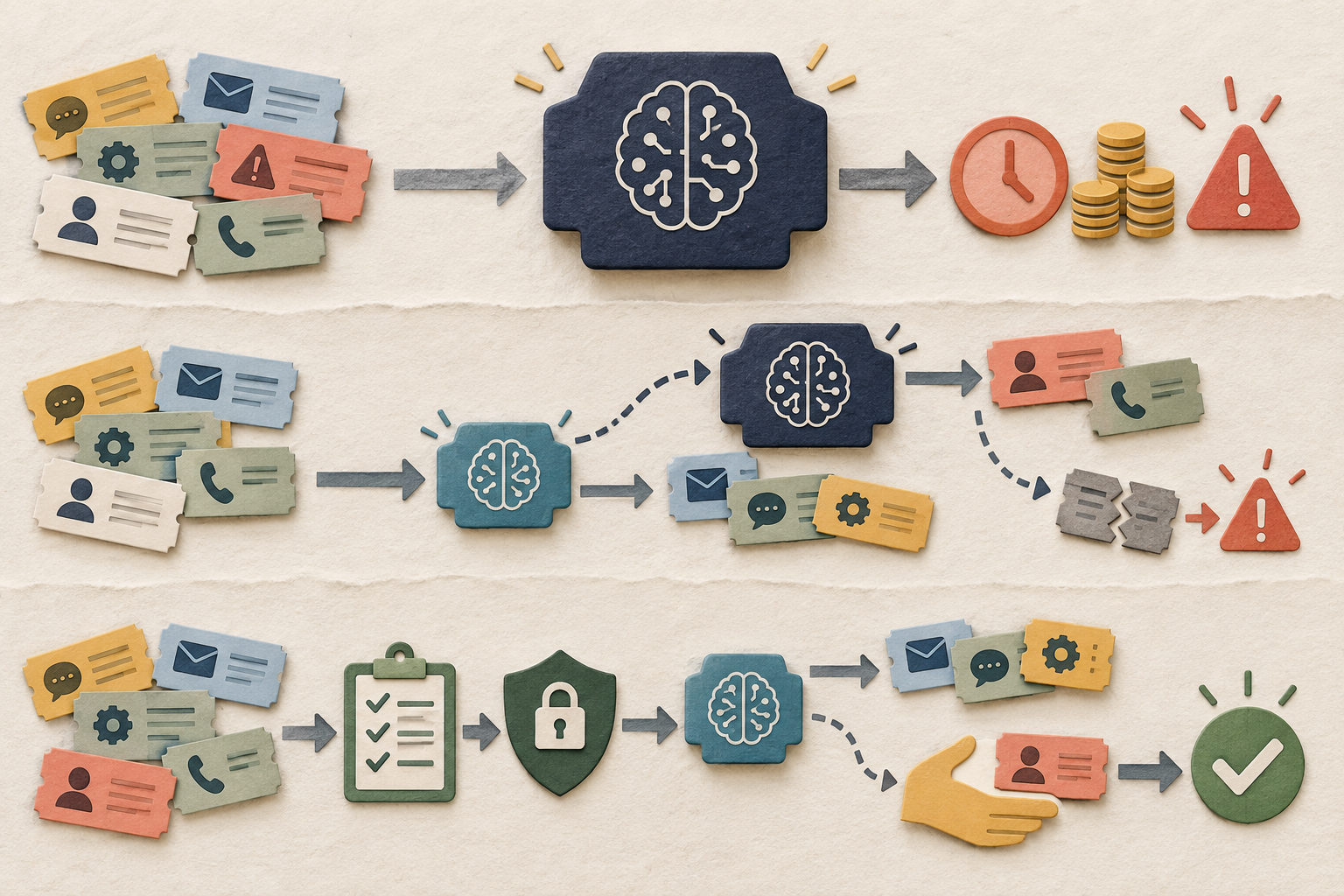
The strongest system is the one that clears the workload's operating contract, not necessarily the one with the largest model.
The engineer chooses System C.
The project now demonstrates the ability to define a consequence, design a representative set, prevent leakage, compare architectures, inspect errors, and defend a fallback. Model names move to an appendix. When a new release appears, the candidate can rerun the harness and decide whether migration is warranted.
Record the model identifier, prompt or configuration version, date, dataset version, and execution settings. The claim should be reproducible enough that a reviewer can see what changed even if they cannot access private inputs.
Publish a decision record, not a benchmark trophy
A strong portfolio page makes the path to the decision easy to inspect. It does not need every prompt or raw transcript. Use this compact record.
Decision
State what you selected and where it applies. Include rules, retrieval, routing, and human-review components. "Selected Model X" is rarely a complete system decision.
Workload
Describe users, frequency, input distribution, required output, and excluded cases. Mark synthetic and reconstructed data clearly.
Acceptance bar
List quality thresholds and service constraints written before the final comparison. If a threshold changed, preserve why.
Alternatives
Show at least one plausible rejected system and which evidence ruled it out. A fake alternative included only to flatter the winner weakens the case.
Results
Report quality by meaningful slice, latency distribution, cost per accepted task, invalid-output rate, escalation rate, and reviewer corrections. Include uncertainty when the sample is small.
Failure, revision, and revisit trigger
Keep one failure that changed the design. Perhaps near-duplicate leakage inflated the first result. Explain the correction. Then define what would cause reevaluation: a price change, volume increase, new language, quality drift, provider deprecation, or a new failure pattern.
This complements an agent work ledger but answers a different question. The ledger reconstructs what happened during delegated work. The selection record explains why this system was fit for a recurring workload.
Avoid four credibility traps
Selecting on a public leaderboard alone. A leaderboard can identify candidates. It cannot establish performance on your data, constraints, or failure costs. Show the local evaluation that made the decision.
Hiding cost behind token prices. Include retries, fallback calls, retrieval, graders, failed tasks, and review time. Report cost per accepted outcome. Do not convert a small prototype into an unsupported annual savings claim.
Optimizing the test until your favorite model wins. If you tune one system while leaving competitors at defaults, say so. Better yet, allocate comparable tuning effort and retain a holdout set. TypeSafe says it avoids public-benchmark performance partly because repeated optimization against a fixed benchmark can distort what the score means.[3]
Publishing data you do not own. Do not upload employer tickets, customer messages, internal prompts, or proprietary evaluations. Publish the evaluation design, sanitized examples, summary results, and evidence links you are authorized to share.
Use the defend-every-line audit so every percentage, cost, and ownership verb can survive follow-up.
Turn one decision into three career artifacts
The portfolio holds the evidence. The resume compresses it. The interview restores the reasoning. All three should make the same claim.

A single defensible decision record can support three career artifacts without changing the underlying claim.
Portfolio: invite a challenge
Lead with the workload and selected architecture. Put the acceptance bar beside the result. Include a comparison table, one error-analysis example, the fallback path, and a link to the versioned harness when it is public.
Replace chat screenshots with artifacts that survive a model change: dataset schema, graders, slice definitions, decision record, cost calculation, and rerun instructions. A project that survives a handoff is especially valuable because another person can challenge or update the selection.
Resume: lead with the owned decision
Weak:
Built an AI support router with Claude Opus 5.5 and GPT-6.
Stronger:
Designed and evaluated a tiered support-routing system across 320 representative cases, combining deterministic security checks, low-confidence review, and model escalation to meet a two-second p95 target while limiting review to 14% of tickets.
The stronger bullet does not hide AI. It places AI inside an owned engineering decision. If the role emphasizes platform economics, add measured cost per accepted route. If it emphasizes safety, foreground the high-consequence slice and escalation boundary. Do not add both unless you can defend both.
This follows the broader rule from showing AI-native work without sounding generic: the tool matters less than the judgment, verification, and outcome around it.
Interview: explain what changed your mind
Use a decision arc:
- "The workload required..."
- "The expensive failure was..."
- "We compared..."
- "The first result misled us because..."
- "After separating this slice, we changed..."
- "We accepted the system when..."
- "We would reevaluate if..."
The correction is often the strongest moment. A candidate who can explain why the first benchmark was misleading shows more judgment than one who presents a perfect chart with no uncertainty.
Run a seven-day model-selection sprint
You do not need a production budget or research team. Choose one narrow decision inside an existing project and create a reviewable record in a week.
Day 1: write the contract. Define the user, output, volume, expensive failures, and non-goals. Decide what should never be automated.
Day 2: build the input set. Collect or create representative, ambiguous, malformed, and adversarial cases. Label synthetic data and group near-duplicates.
Day 3: create the graders. Add deterministic checks first. Write a rubric for judgment calls and choose the slices needing human review.
Day 4: establish a quality baseline. Run a capable system and inspect failures. Fix the evaluation when it rewards behavior the product would reject.
Day 5: compare alternatives. Test a smaller model, a routed system, and a non-model rule where appropriate. Measure whole accepted-task cost.
Day 6: challenge the winner. Ask another person to inspect a sample, reproduce the run, or attack the failure boundary. Record disagreement and corrections.
Day 7: package the evidence. Publish the selection record, sanitized cases, evaluation code, result table, limitation, and revisit trigger. Then write one resume bullet and rehearse the decision arc.
Avoid turning seven days into a miniature procurement process. The point is to make one decision falsifiable. Keep the comparison small enough that readers can inspect its limitations and understand why the evidence supports the choice.
Make the selection easy to inspect and change
Model releases will keep arriving with better benchmarks, lower prices, longer context, new output modes, and faster inference. Those improvements matter. They also make model-name signaling decay faster.
The candidate with durable evidence can explain where a capable model was necessary, where a smaller one was sufficient, where a deterministic check was safer, and where a person still owned the decision. They can show the workload, consequence-adjusted bar, rejected alternative, correction, and revisit trigger.
This evidence remains useful after this week's leaderboard changes. It shows that you can fit an AI system to real operating constraints and leave a record that another person can inspect and revise.
For one practical research breakdown each week, follow the AI Career Signals archive. The series translates changes in AI work into decisions you can use across your resume, portfolio, interviews, and job search.
Disclosure: This article is authored by the CoreCV team. While we mention CoreCV.ai, the strategies and advice presented here are intended to be useful whether or not you use our product.
Sources
- Anthropic, "Introducing Claude Opus 5.5", September 22, 2026.
- OpenAI, "Choose a model", accessed September 26, 2026.
- TypeSafe AI, "Introducing System One Models & Jev", September 21, 2026.
- Anthropic, "Optimizing for cost and intelligence", accessed September 26, 2026.
- National Institute of Standards and Technology, "AI RMF Core: Measure", accessed September 26, 2026.
- OpenAI, "Evaluation best practices", accessed September 26, 2026.
- Anthropic, "Demystifying evals for AI agents", January 9, 2026.