AI Is Expanding Your Job Before Your Title Changes

AI is changing jobs in a quieter way than the usual replacement headlines suggest. Your title may stay the same while your task mix expands into analysis, troubleshooting, writing, operations, or product work that once required a handoff. That expansion can become valuable career evidence, but only if you can show more than access to a model. You need to connect the borrowed task to your real role, explain the judgment you supplied, and prove the output deserved to be used.
New OpenAI research gives this pattern a useful name: task crossover. In an analysis of more than 800,000 work-related messages from U.S. ChatGPT business users, OpenAI found that 43.5% of the messages classified as occupation-specific concerned tasks associated with an occupation other than the user's own.[1] The figure is not a share of all ChatGPT messages or of anyone's working hours. Nor does it mean a person gained another profession by asking for help. It does show something job descriptions tend to capture late: people are already experimenting with different divisions of work.
For technical candidates, the immediate question is not whether to call yourself a generalist. It is how to make a changing task mix legible without looking scattered or inflated. "Used AI for marketing, analytics, legal research, and code" reads like a list of browser tabs. A stronger story shows why you crossed a boundary, what you could responsibly own, how you checked the result, and what improved because the handoff changed.
Job titles are lagging indicators
Most organizations do not rewrite a job family every time someone finds a faster way to complete an adjacent task. Work changes first. Teams notice later. Formal responsibilities, promotion criteria, and titles may take much longer.
The OpenAI analysis suggests engineering and marketing tasks travel especially widely across occupations. Technology troubleshooting appears among the most common outside tasks for every other occupation group studied, while engineering work shows up frequently in the AI use of non-engineers.[1] That does not make every marketer an engineer. It means that some technical handoffs are becoming cheaper. A marketer can diagnose a tracking problem far enough to file a precise bug. A support specialist can query a sanitized export and find a pattern. A designer can prototype interaction logic before asking an engineer to productionize it.
The reverse movement matters too. Engineers increasingly draft release communication, analyze user feedback, turn incident patterns into product recommendations, or explore a financial tradeoff without waiting for another function to do the first pass. AI lowers the cost of getting started, which changes who first encounters and shapes the work.
This is most visible in smaller teams, where specialist help may be scarce. OpenAI found a modestly higher share of outside-occupation work among average users in workspaces with 2 to 5 seats than among those in workspaces with more than 100 seats.[1] The practical interpretation is narrower than "everyone becomes a generalist." When a handoff is expensive, the person closest to the problem has a stronger incentive to take the next step themselves.
That next step can be meaningful. It can also be dangerously shallow. The career signal depends on whether you know the difference.
A borrowed task is not automatically a new skill
A developer might use AI to draft customer interview questions without acquiring years of research judgment. A recruiter who troubleshoots a spreadsheet formula has not become a data engineer. And a designer who generates a prototype has not yet proved they can build, secure, and operate a production system.
This boundary matters because resumes reward compression. A candidate has little room, so "performed cohort analysis" can quietly replace the more accurate "used an AI-assisted notebook to explore one retention question with an analyst reviewing the method." The shorter phrase sounds more senior and more independent. It is also easier to challenge in an interview.
The right response is not to hide every adjacent task. It is to describe the level you actually reached.
There are at least four levels of cross-boundary work:
- Assisted exposure: You used AI to understand unfamiliar material or prepare a better handoff.
- Bounded contribution: You completed a defined adjacent task with clear review or constraints.
- Repeatable ownership: You built a workflow that handled the task repeatedly and knew when to escalate.
- Integrated capability: The adjacent work became a durable part of your role, supported by outcomes and trusted by the relevant specialists.
All four can be useful. They should not be written as if they were interchangeable. Assisted exposure belongs in an interview story, learning section, or project note when it shows initiative. Bounded contribution can support a resume bullet if it changed a real outcome. Repeatable ownership is strong portfolio material. Integrated capability may legitimately reshape your summary and target roles.
AI reduces the effort required to move from zero to a first attempt. It does not eliminate the work required to move from a first attempt to trusted capability.
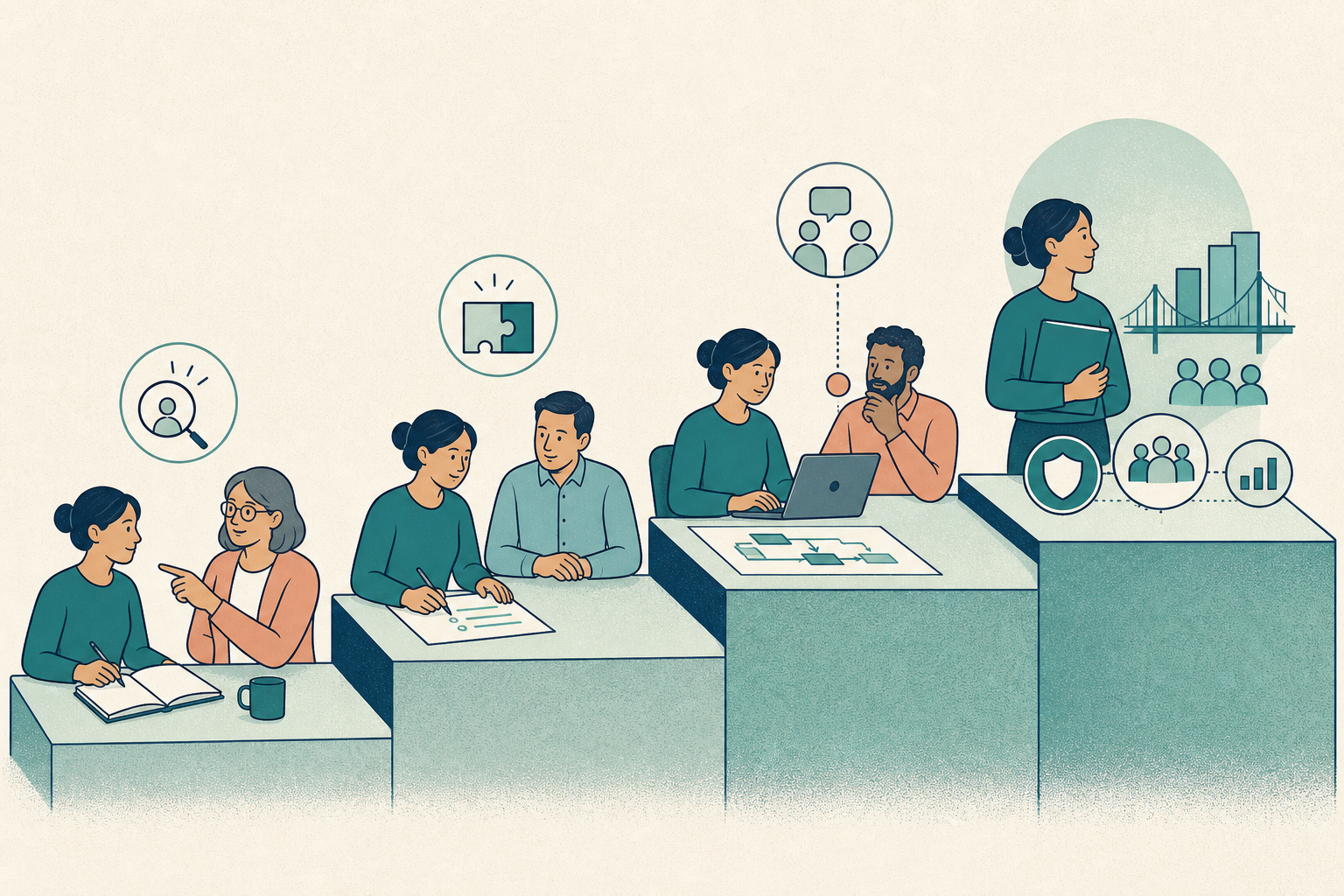 Cross-boundary work becomes stronger career evidence as review, repeatability, and trusted outcomes accumulate.
The CROSS test for credible role expansion
Before adding a cross-boundary accomplishment to your resume, run it through five questions. Together they form the CROSS test: Core outcome, Role boundary, Operating judgment, Safety and verification, Sustained evidence.
1. Core outcome: What improved in your actual role?
Start with the job you were responsible for, not the function you briefly borrowed.
Suppose a backend engineer uses AI to analyze a few hundred support tickets. "Performed customer-experience analysis" makes the adjacent task the headline. A better starting point is the engineering outcome: the analysis exposed recurring failure modes, changed prioritization, or reduced time spent reproducing incidents.
That anchor prevents breadth from looking random. It explains why the candidate crossed the boundary in the first place.
Compare these versions:
Used AI to analyze customer support data and generate product insights.
Clustered recurring support reports with an AI-assisted review workflow, verified themes against resolved tickets, and gave engineering a ranked set of failure modes for the next reliability cycle.
The second version does not claim the engineer became a customer researcher. It shows that customer evidence improved an engineering decision.
2. Role boundary: Which handoff actually moved?
"Worked cross-functionally" often hides the most interesting part. Name what changed.
Did you prepare the first draft that legal reviewed? Did you diagnose a technical issue before escalating it? Did you produce a prototype that changed a product conversation? Did you turn qualitative feedback into a testable engineering hypothesis? Did you automate the repetitive preparation step while a specialist retained final judgment?
This is where honest scope becomes a strength. "Prepared a first-pass accessibility audit for design review" is more credible than "owned accessibility." "Built a finance-reviewed cost model" is stronger than "led financial analysis" when finance retained authority over the assumptions.
The shifted handoff is the accomplishment. You do not need to claim the entire neighboring function.
3. Operating judgment: What did you decide?
Generation is rarely the scarce part. Judgment is.
What did you include or exclude? Which source did you trust? How did you break the task down? What counted as enough confidence to proceed? Where did you stop because the work required specialist knowledge? What tradeoff did you make after seeing the result?
Anthropic describes agents as systems that plan, act, observe, and adjust until a task is complete or human input is needed.[5] In a credible career story, the human's operating judgment should remain visible inside that loop. "The model produced a report" says almost nothing about your contribution. "I defined the decision categories, constrained the evidence set, and escalated ambiguous cases" does.
This is also why the best technical candidates explain tradeoffs, not just wins. Cross-boundary work is convincing when you can explain what you refused to automate and why.
4. Safety and verification: Why did the output deserve to be used?
AI makes adjacent work accessible, but unfamiliarity makes errors harder to notice. That combination raises the value of verification.
GitHub recently described a counterintuitive regression in Copilot code review. Replacing custom exploration tools with better-maintained shared tools initially raised review cost and reduced the number of issues found. The team had to examine how the agent gathered pull-request evidence and reshape the workflow before performance improved.[2] Better tools did not automatically produce a better system.
Microsoft has reported a similar lesson from agent evaluations: model, harness, environment, and scenario details can change results, so an apparent improvement may come from a hidden variable rather than the change being tested.[3] Its comparison of model versions also found that a newer model could use far more tokens while performing worse on the tested workflow.[4]
For a candidate, the standard does not need to be a research-grade benchmark. It does need to fit the consequence:
- Compare generated classifications with a reviewed sample.
- Recalculate financial outputs independently.
- Test code and inspect the changed behavior.
- Trace a factual claim back to the primary source.
- Ask the domain owner to review assumptions, not merely polish wording.
- Record failure cases and define when the workflow must stop.
The exact check matters more than the phrase "human in the loop." Name what the human checked and what happened when the check failed.
5. Sustained evidence: Did the capability survive contact with real work?
One impressive output can be luck. A sustained capability leaves traces.
Look for repeated use, an adopted template, a reviewed pull request, a decision log, a before-and-after workflow, a set of failure cases, a reusable script, or a measurable reduction in handoff time. If confidentiality prevents you from sharing the artifact, you can still describe its structure and the operating conditions around it.
Anthropic's real-world autonomy research found that longer Claude Code sessions had grown substantially over a three-month period, while also warning that much of the evidence comes from coding and may not generalize to every domain.[6] The useful career lesson is not that every task should run longer. It is that AI-assisted work increasingly unfolds over repeated actions, which makes process evidence more important than a polished final screenshot.
If your only proof is the generated artifact, you are showing output. If you can show the workflow, checks, revisions, and adoption, you are showing capability.
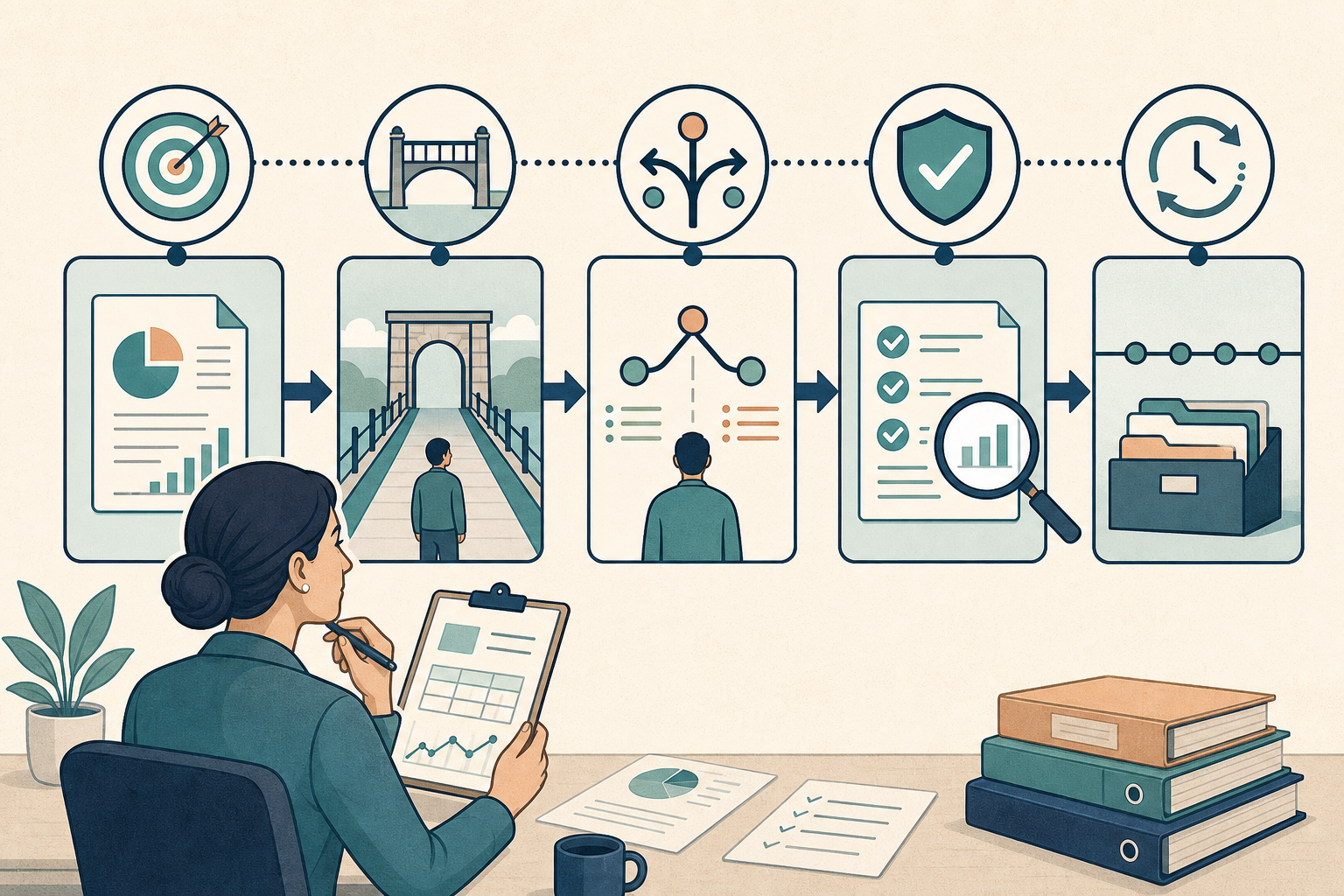 The CROSS test keeps an adjacent-task story anchored in the outcome, boundary, judgment, verification, and evidence that made it credible.
Three ways task crossover shows up in technical careers
The framework becomes easier to use when you see what it preserves and what it rejects.
The engineer who moved upstream into product evidence
An engineer notices that roadmap debates rely on scattered anecdotes. They use an AI-assisted workflow to group support tickets and interview notes, then inspect samples, remove misleading clusters, and connect the remaining patterns to observable product failures. Product still owns roadmap prioritization, but the engineer now brings better user evidence into technical decisions.
Weak framing:
Expanded into product management using AI to analyze customer needs.
Stronger framing:
Built a reviewed workflow to cluster support and interview evidence around recurring product failures, helping engineering and product prioritize reliability work from verified user patterns.
The stronger version preserves the engineer's identity, names the boundary crossed, and leaves product authority where it belongs.
Two more patterns in brief
- Support into technical diagnosis: Replace "Used AI to debug production issues" with "Created an AI-assisted triage guide that mapped sanitized log patterns to reviewed incident categories, improving reproduction notes and routing while escalating novel failures to engineering." The revised version contributes to diagnosis while leaving code-level ownership with engineering.
- Startup engineering across launch handoffs: Instead of listing release notes, cost modeling, analytics QA, and migration writing as four new disciplines, anchor them to one outcome: "Led the technical release path for a usage-based billing change, using AI-assisted first passes for cost scenarios, analytics QA, and migration guidance, with finance and customer teams reviewing domain-specific assumptions before launch."
Both examples make the moved handoff visible without inventing specialist authority.
This pattern pairs naturally with how to position internal tools and automations as career-making impact: start with who could make a better decision or complete work faster, then explain the system behind that change.
How to put cross-boundary AI work on a resume
Your resume has limited space, so use a simple sequence:
Core role outcome + moved handoff + your judgment + verification
You may add a metric when you actually have one, but the structure works without fabricated precision.
Here are four rewrites.
Before:
Used ChatGPT for SQL, copywriting, research, and project management.
After:
Used an AI-assisted analysis workflow to investigate onboarding drop-off, validated queries and event definitions with analytics, and translated the findings into two engineering experiments.
Before:
Leveraged AI to perform UX research.
After:
Synthesized interview notes into candidate themes, manually checked each theme against source excerpts, and helped design narrow the onboarding prototype before the next research round.
Before:
Built an AI agent for customer support.
After:
Built a bounded support-triage agent that drafted case summaries and suggested known runbooks, required source links for each recommendation, and escalated unmatched issues to on-call engineers.
Before:
Used the latest AI models to improve code review.
After:
Evaluated two AI review configurations against a fixed set of historical defects, selected the lower-cost workflow that preserved recall, and documented cases that still required manual security review.
Notice what these bullets avoid: a new professional identity, a model name presented as the accomplishment, or hidden decision authority. Each keeps the reviewer or specialist visible.
If one base resume needs to serve several adjacent roles, CoreCV's role-targeted resume workflow can generate a role-focused version and fine-tune it against a job description or job URL. Review the result against your actual experience, then keep the evidence that best matches the role's handoffs.
What belongs in a portfolio case study
A portfolio gives you room to prove that the crossover was more than a lucky prompt. Use six short sections:
- The bottleneck: What slow, unclear, or expensive handoff triggered the work?
- The old boundary: Which function did the task usually belong to, and why?
- The new workflow: What first pass or bounded action did AI make possible?
- Your decisions: What categories, sources, constraints, and escalation rules did you define?
- The checks: How did you detect bad output or unsupported conclusions?
- The outcome: What decision, delivery step, or user result improved?
Include one failure. GitHub's code-review story is compelling precisely because the initial migration made the system worse and the team investigated why.[2] A portfolio that only reports the winning configuration hides the judgment that produced it.
For AI projects, this is the difference between proof of existence and proof that you did more than press a button. The artifact may attract attention. The evaluation and recovery story earns trust.
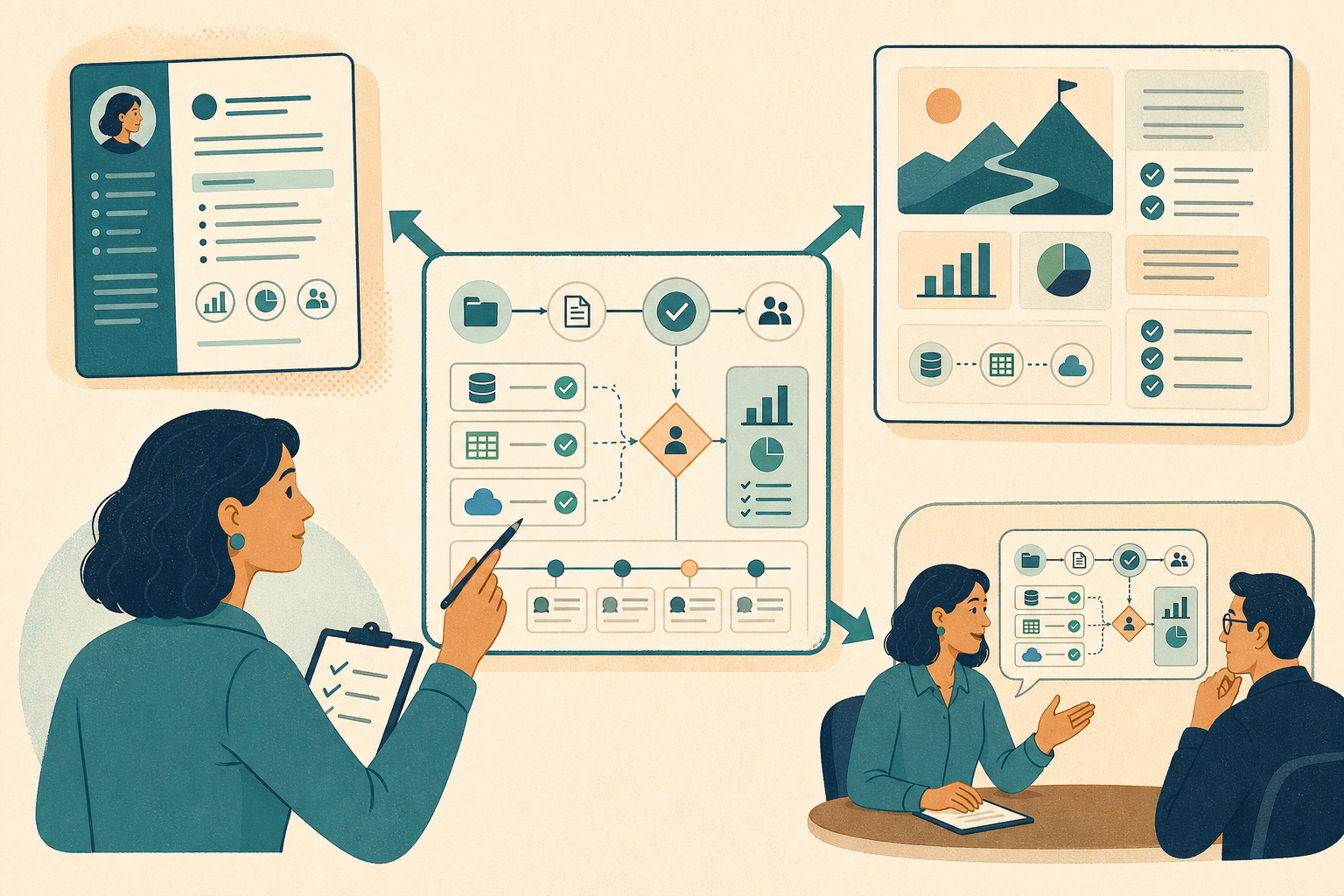 The same underlying facts can support three career formats when the source trail, checks, revisions, and human decisions remain visible.
How to explain it in an interview
Interviewers may hear cross-boundary work as either initiative or inflation. Make the boundary explicit before they have to challenge it.
A useful answer sounds like this:
I did not become the team's researcher. The problem was that engineering decisions were waiting on a first pass through a large set of support evidence. I built a workflow that grouped recurring reports and linked each theme back to source tickets. I reviewed samples, removed weak clusters, and brought the remaining patterns to product and support for validation. They retained prioritization and customer-context judgment. My contribution was making the evidence easier to inspect and act on.
That answer works because it states the limit without diminishing the achievement. It also makes collaboration visible. The candidate moved a handoff; they did not erase the people on either side.
Prepare for follow-up questions:
- What did the model get wrong?
- How did you know your categories were useful?
- What would you never let the workflow decide?
- Which part required the neighboring specialist's judgment?
- Did the workflow keep being used?
- What did you learn that changed your core work?
If you cannot answer those, the task may still be exposure rather than durable capability. That is fine. Describe it at the right level and keep building evidence.
Choose adjacent skills by following bottlenecks
Task crossover does not mean you should chase every function AI makes accessible. Breadth without a center becomes noise.
Choose the next adjacent capability by asking where your core work repeatedly stalls. An engineer who loses days to unclear product evidence may benefit from research synthesis. A platform engineer whose proposals die in budget conversations may need cost modeling. A support specialist who repeatedly sees diagnosable patterns may benefit from logs and basic querying. A designer whose prototypes fail at implementation may need enough frontend knowledge to test feasibility earlier.
Then narrow the learning target. "Learn data science" is too broad. "Validate an event funnel, inspect query assumptions, and communicate uncertainty" is usable. "Learn marketing" is vague. "Draft release positioning, test it with the product owner, and connect claims to shipped behavior" is bounded.
Finally, define the review relationship. Who can tell you that your first passes are wrong? What source or test settles the dispute? What decisions stay with the specialist? Task crossover becomes professional growth when it improves collaboration and raises the quality of the handoff. It becomes risky theater when AI lets you avoid the people who understand the domain.
A one-week task-crossover audit
This week, inspect your recent work rather than adding another AI course to your list.
First, write down three moments when you used AI to move beyond the normal edge of your role. Include small examples. Perhaps you interpreted user feedback, diagnosed a vendor issue, drafted a policy comparison, or modeled a cost tradeoff.
Second, run each example through the CROSS test:
- What core outcome improved?
- Which role boundary moved?
- What operating judgment was yours?
- How was the work verified?
- What sustained evidence remains?
Third, label the level honestly: assisted exposure, bounded contribution, repeatable ownership, or integrated capability.
Fourth, choose one example with a real outcome and rewrite it using the resume sequence. If it has enough depth, outline the six-section portfolio case study. If it is still thin, decide what repeated use, review, or artifact would make it stronger.
Fifth, review three target job descriptions. Look for handoffs, not only tools. Does the role connect engineering with customers, security, finance, operations, or product? Select the crossover evidence that makes that particular boundary easier to trust. Do not add every adjacent task to every version.
The durable career signal is responsible range
OpenAI's task-crossover research is an early view into changing work, not a verdict on which occupations survive or which workers are qualified for new ones.[1] Its most useful lesson for job seekers is simpler: jobs can reorganize before job titles announce the change.
That creates an opportunity for candidates who can make responsible range visible. Show the bottleneck you crossed, the outcome tied to your core role, the judgment you supplied, the limits you respected, and the checks that made the work usable. AI can lower the cost of crossing a handoff, but the durable career signal is judgment on the other side.
Explore the AI Career Signals archive for more research translated into practical resume, portfolio, interview, and job-search decisions.
Disclosure: This article is authored by the CoreCV team. While we mention CoreCV.ai, the strategies and advice presented here are intended to be useful whether or not you use our product.
Sources
- OpenAI, How AI is expanding what people do at work: https://openai.com/index/how-ai-is-expanding-what-people-do-at-work/
- GitHub, Better tools made Copilot code review worse. Here's how we actually improved it: https://github.blog/ai-and-ml/github-copilot/better-tools-made-copilot-code-review-worse-heres-how-we-actually-improved-it/
- Microsoft Developer Blog, The hidden variables in your agent eval: https://developer.microsoft.com/blog/the-hidden-variables-in-your-agent-eval
- Microsoft Developer Blog, Not all model upgrades are upgrades: https://developer.microsoft.com/blog/not-all-model-upgrades-are-upgrades
- Anthropic, Trustworthy agents in practice: https://www.anthropic.com/research/trustworthy-agents
- Anthropic, Measuring AI agent autonomy in practice: https://www.anthropic.com/research/measuring-agent-autonomy