How to Write Resume Bullets for Engineers Who Worked on Teams Too Large for Clear Ownership

Large-team engineering creates a resume problem that generic bullet advice usually handles badly. The work is real, the scope is valuable, and the outcomes matter, but clean solo ownership is often fiction. In an AI-shifting hiring market where both software and humans compress experience into fast signals, a vague "collaborated on X" bullet wastes evidence, while an inflated "owned X" bullet can make the story less believable. The stronger move is to show the slice of the system you changed, the constraint you worked inside, and the consequence your work helped create.[1][2][3]
Start with the smallest true unit of ownership
When a project is too large for clear ownership, start with the smallest true unit you can defend in an interview.
That unit might be a rollout path, a service migration, a test strategy, a dependency cleanup, or the coordination between two teams whose systems had to change at the same time. Resume guidance tends to reward bullets that combine action, context, and result because the reader needs evidence they can scan quickly, not a responsibility label.[1][2]
Collaborated with cross-functional teams on a major migration project.
Teamwork is a real career-readiness competency, and technical hiring often depends on whether someone can operate across people, systems, and constraints.[4] This bullet still fails because it names a setting, then hides the work.
Partnered with platform and payments service owners to migrate checkout services onto shared deployment tooling, owning rollback-path testing and dependency cleanup for the cutover.
That bullet makes the individual contribution easier to audit without pretending one engineer built the entire migration.
If your resume has team-project stories that need different emphasis by role, CoreCV can help you keep one structured base resume and tune which systems, bullets, and collaboration signals show up for the job in front of you.
Make the lane visible inside the system
Large-team bullets work best when they carry five pieces of information in a compact sentence: the system, your lane, the constraint, the collaborators, and the consequence. Missing all of them is how good engineering work turns into resume fog.
Worked with engineers across teams to improve deployment processes.
Worked with platform and service teams to move three high-change services onto shared deployment tooling, validating rollback paths and reducing manual release coordination during cutover.
The second bullet gives the reader a system, a scope boundary, a risk area, and a plausible outcome while keeping shared-ownership language attached to evidence.
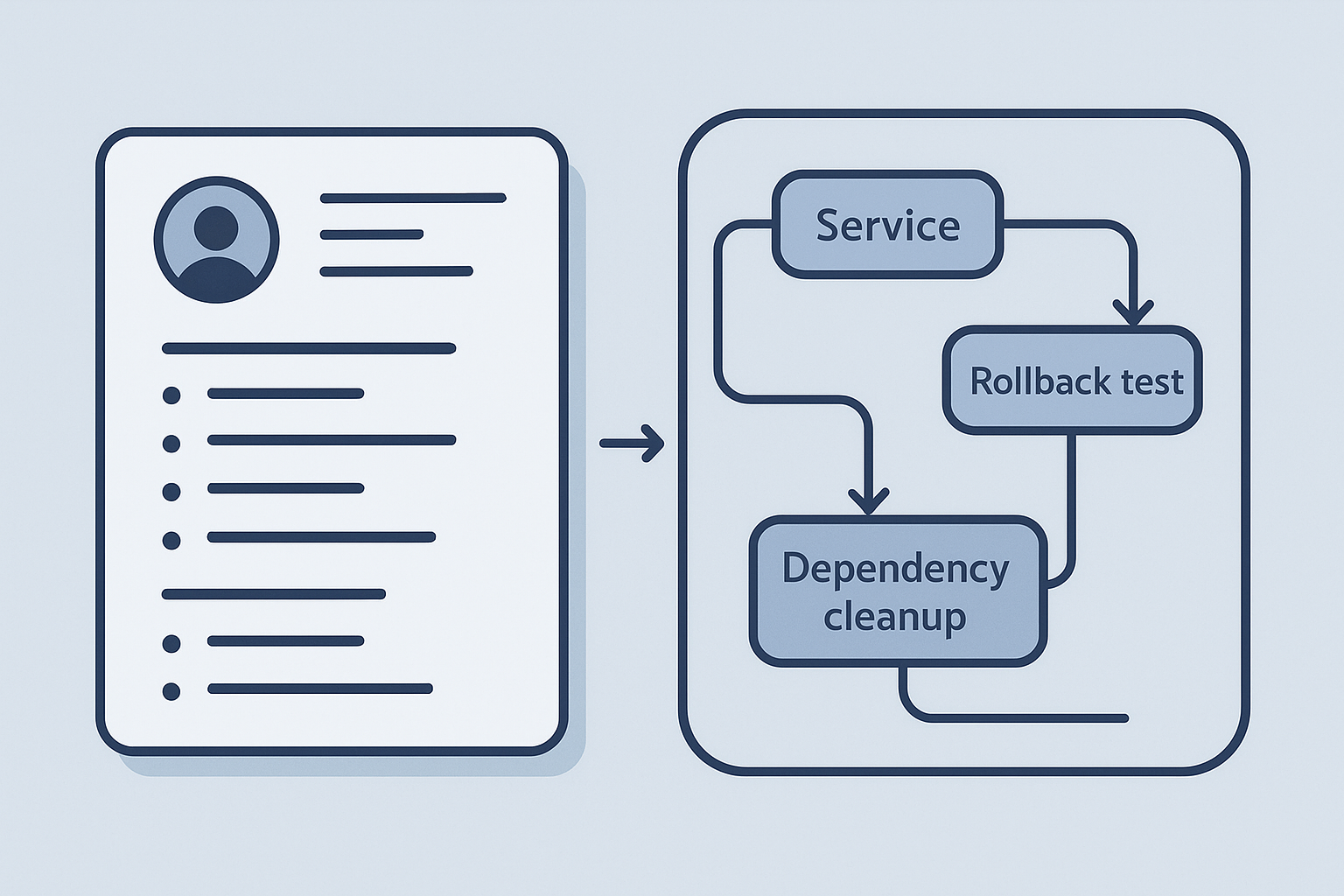
The bullet gets stronger when the reader can see your lane inside the bigger system instead of just reading that you collaborated.
Use honest shared-ownership verbs, then attach proof
Candidates often avoid verbs like partnered, supported, coordinated, or contributed because they fear sounding passive. Those verbs only become weak when left alone. "Supported migration work" is thin. "Supported the migration by building parity checks for customer data and resolving schema mismatches before launch" is much stronger.
The useful test is whether the verb is attached to proof. If you write "partnered," name the teams and workstream. If you write "coordinated," show the dependency. If you write "supported," explain the artifact. If you write "led," name the lane you led.

Shared ownership reads well when the contribution stays specific and the surrounding system stays visible.
Show the constraint that made the work hard
The middle of a strong team-project bullet should often name the constraint. Large-team engineering work is valuable because it happens around dependency risk, release timing, legacy behavior, compliance review, backwards compatibility, and unclear ownership boundaries. Those details show why the work required judgment rather than activity.
Instead of writing:
Helped improve authentication flows with multiple teams.
Write something closer to:
Worked with identity and frontend teams on an authentication redesign, defining backwards-compatibility checks and rollout monitoring for the highest-risk login paths.
This version works without a dramatic metric because it shows the system, collaborators, constraint, and work product. Use a trustworthy metric when you have one, but do not fake one. A consequence can be a safer rollout, fewer manual steps, clearer incident ownership, faster onboarding, or cleaner dependencies.
For adjacent problems, read Stop Faking Resume Metrics: What to Do When You Can't Prove the Number, How to Show Systems Thinking on a Resume Without Writing a Wall of Text, and How to Position Internal Tools, Automations, and Dev Productivity Work as Career-Making Impact.
Run the five-question filter
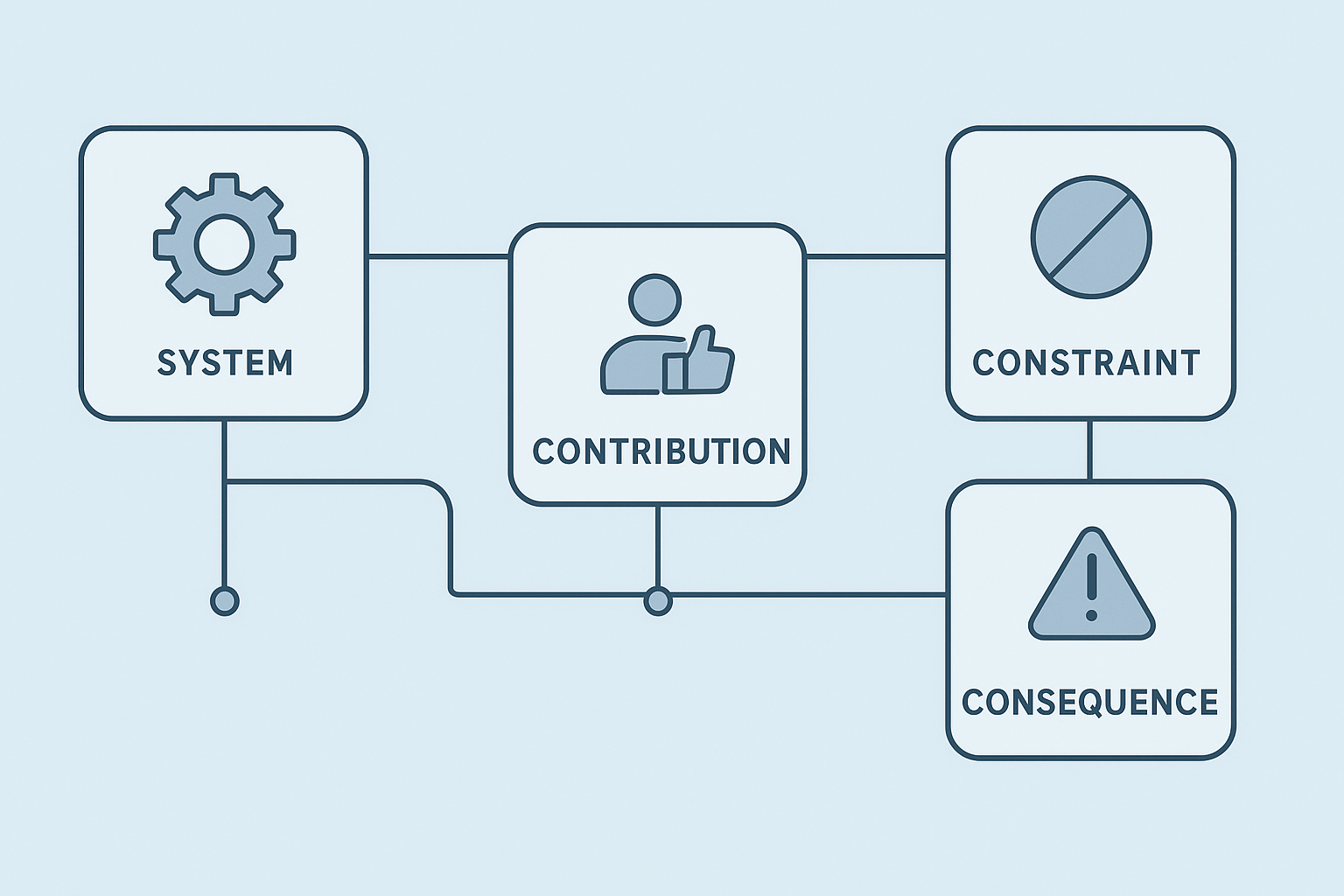
A team-project bullet usually needs a visible system, contribution, constraint, collaboration pattern, and consequence.
Before a team-project bullet stays on the resume, ask five questions: Can the reader tell what system this involved? Is your contribution visible? Did you name the constraint or risk? Did the collaboration language make the work clearer? Can the reader see what changed afterward?
If most answers are no, the project is probably fine and the wording is doing the damage. Large-team work needs a legible slice of the truth, not a disguise as solo authorship.
That matters more as hiring gets noisier. Technical candidates are competing against vague AI-polished resumes, keyword-stuffed rewrites, and compressed recruiter screens, so inspectable evidence matters more than louder language: the system, the lane, the constraint, and the consequence.
If you want help turning one history of shared projects into role-specific resume versions, CoreCV can help preserve the full story while adjusting emphasis for each application.
For a repeat-touch next step, follow the resume advice archive, then continue with The Best Resume Strategy for Engineers Re-Entering the Market After a Long Stable Job.
Sources
1. Columbia Center for Career Education, Resumes with Impact: Creating Strong Bullet Points: https://www.careereducation.columbia.edu/resources/resumes-impact-creating-strong-bullet-points
2. MIT Career Advising & Professional Development, Resumes: https://capd.mit.edu/resources/resumes/
3. Harvard FAS Mignone Center for Career Success, Create a Strong Resume: https://careerservices.fas.harvard.edu/resources/create-a-strong-resume/
4. NACE, What is Career Readiness?: https://www.naceweb.org/career-readiness/competencies/career-readiness-defined