The Best Technical Candidates Explain Tradeoffs, Not Just Wins

A polished success story tells an interviewer that something went well. A tradeoff tells them whether you can be trusted when every plausible option has a cost. The best technical candidates make that judgment visible: which constraint mattered, what alternatives were credible, why one fit the situation, and what consequence they accepted.
Technical interview tradeoffs reveal what wins hide
“Reduced API latency by 40%” sounds impressive, but it leaves the difficult questions unanswered. Did you add a cache, change a query, relax consistency, or remove work from the request path? What new failure mode appeared? Was the improvement worth the operational cost?
Those questions reveal the engineering inside the win. Amazon's current software development interview guidance says candidates are evaluated on applying what they know to solve problems efficiently and effectively, rather than memorizing every technical detail.[1] A result alone offers little evidence of that application.
This matters outside system design rounds. Resume bullets, portfolio case studies, behavioral answers, and code discussions all become more credible when they expose a decision under constraints. If you want to prepare for the distinct signals collected by coding and design rounds, start with this guide to technical interview formats.
Use the Constraint, Options, Choice, Consequence framework

Constraint, Options, Choice, Consequence turns one engineering decision into a clear, inspectable reasoning trail.
You do not need to narrate an architecture review. For one consequential decision, cover four parts:
- Constraint: Name what made the obvious solution insufficient. It might be a latency target, migration window, privacy rule, small team, vendor dependency, or tolerance for stale data.
- Options: Give two credible choices. A weak alternative makes the preferred option look preselected.
- Choice: Identify the deciding factor. Explain why the choice fit this system, users, and moment, not why it is universally superior.
- Consequence: State both sides. What improved, what became harder, and how did you check whether the bargain held?
This framework mirrors real architecture practice without its ceremony. AWS recommends evaluating performance choices against workload requirements and customer impact, then testing the effect.[2] Microsoft similarly recommends decision records that capture context, options, outcomes, tradeoffs, and implications.[3]
Put the same decision on three surfaces

Keep the decision consistent while increasing the level of detail from resume to portfolio to interview.
Your resume, portfolio, and interview should reveal the same decision at different resolutions.
On a resume, compress the context and choice into one line:
Cut p95 read latency from 480 ms to 170 ms by caching catalog responses with a five-minute freshness limit, accepting delayed inventory updates while keeping checkout reads authoritative.
That bullet offers an interviewer handles to grab: freshness, consistency, boundaries, and measurement. Showing systems thinking on a resume requires this kind of selective detail, not a miniature design document.
In a portfolio, add the alternative and evidence. Explain that full-page caching was rejected because price and inventory changed independently, then link a benchmark or architecture note. The previous guide on turning a portfolio artifact into proof of work covers that deeper decision trail.
In an interview, make the reasoning conversational:
We considered caching the whole response and caching only the catalog fields. Whole-response caching was simpler, but stale inventory could affect checkout. We cached the slower catalog data for five minutes and kept inventory authoritative. That cut p95 latency, but it added invalidation work, so we tracked stale reads and documented a rollback threshold.
The answer is specific without sounding academic because every detail helps explain the choice.
Admit the cost without sabotaging the story
Candidates often hide downsides because they think every answer must end in triumph. That instinct produces suspiciously frictionless stories.
Name the accepted cost plainly, then show how you bounded it. “This increased deployment complexity, so we limited the first rollout to one service and added a rollback trigger” signals better judgment than pretending complexity disappeared. If stakeholders shaped the constraint, describe how you aligned the decision without vague teamwork language.
Avoid two traps. First, do not invent an alternative after the fact just to complete a framework. Say when the choice was inherited or when time allowed only one viable path. Second, do not turn uncertainty into false precision. Qualitative evidence such as fewer escalation reports, a successful staged rollout, or a documented failure can be honest when no clean metric exists.
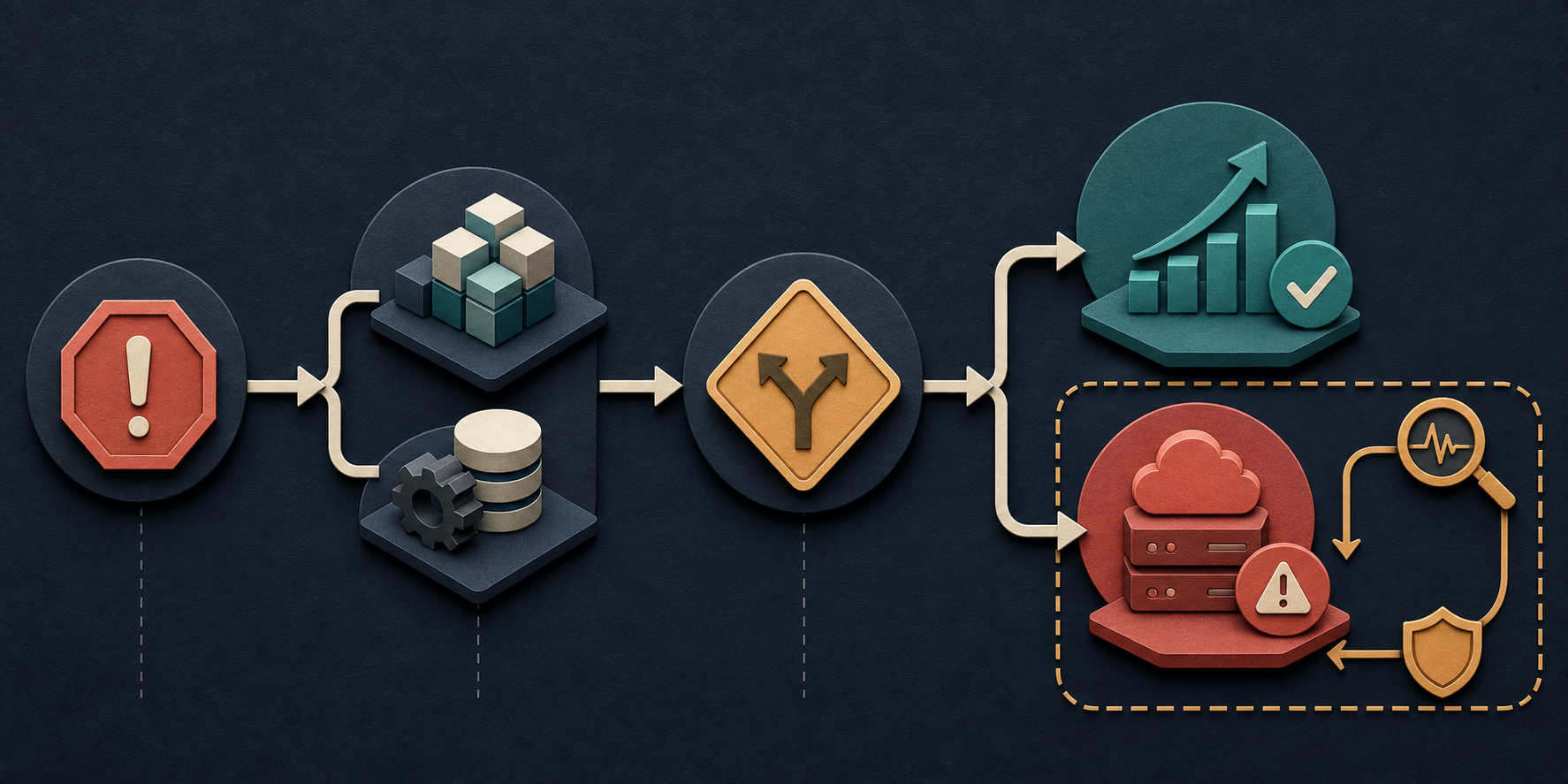
A credible answer shows the benefit and the accepted cost, then explains how the cost was monitored and bounded.
Make decision quality easy to find
Choose three relevant experiences and mark the constraint, alternatives, decision, downside, and evidence for each. If one element is missing, inspect an old design note, ask a former teammate, or state the limit honestly.
Then use CoreCV to structure the strongest evidence in your resume and fine-tune it against a relevant job description or job URL. Keep the full tradeoff explanation for your portfolio and interview preparation; the resume only needs enough detail to make the decision worth asking about.
Google's guidance for change descriptions makes the same distinction useful in everyday engineering: code may show what changed, while future readers still need the problem and why the approach was appropriate.[4] Hiring materials have the same burden. Make the “why” retrievable.
A win tells the interviewer what happened. A well-explained tradeoff shows how you reasoned when there was no free option. That is the signal to carry consistently from the first resume scan through the final technical conversation.
For future practical guidance on technical interviews, evidence, and career positioning, subscribe to the CoreCV Blog RSS feed in your feed reader. You can also browse the interview preparation archive now.
Sources
1. Amazon Jobs, Software development interview topics: https://amazon.jobs/content/en/how-we-hire/interview-prep/software-development-topics
2. AWS Well-Architected Framework, Evaluate how trade-offs impact customers and architecture efficiency: https://docs.aws.amazon.com/wellarchitected/latest/framework/perf_architecture_evaluate_trade_offs.html
3. Microsoft Azure Well-Architected Framework, Maintain an architecture decision record (ADR): https://learn.microsoft.com/en-us/azure/well-architected/architect-role/architecture-decision-record
4. Google Engineering Practices, Writing good CL descriptions: https://google.github.io/eng-practices/review/developer/cl-descriptions.html