The AI Hiring Boom Is Real. Build a Bridge Into It, Not a New Identity

AI hiring is growing fast enough to make reinvention feel urgent. A backend engineer changes a headline to "AI engineer." A product manager adds a stack of model names. An analyst starts a new portfolio full of generic chatbots. The apparent logic is simple: if the titles are changing, your identity should change with them. That is usually the weakest way to enter the market. The stronger transition preserves the judgment you already earned and builds a visible bridge from it into one AI responsibility.
LinkedIn's February 2026 analysis found that AI engineers represented a share of software-engineering-adjacent hires 14 times larger than in 2019. But transitions into generative AI engineer roles still accounted for less than 1% of software engineer job switches in 2025.[1] Both facts matter. Demand is moving, but a fast-growing title is not a mass doorway.
The work is also spreading beyond teams with AI in their names. OpenAI's August enterprise analysis describes organizations moving from question-answering toward bounded, multi-step execution, with weekly active enterprise Codex users growing across legal, recruiting, sales, marketing, and engineering.[2] That makes the opportunity broader than "become a machine-learning specialist." Companies need people who can connect models to real workflows, supply the right context, evaluate results, define permissions, and own the consequence.
The practical career question is therefore not, "How do I become an AI person?" It is, "Which AI responsibility can I make credible because of the work I already understand?"
Title growth does not tell you how to transition
Labor-market numbers are useful for direction, but they compress important differences. "AI engineer" can describe model infrastructure, retrieval systems, application development, evaluation, workflow integration, or customer-facing deployment. A company hiring its first applied AI engineer has a different problem from a research lab, a bank modernizing operations, or a software vendor adding a copilot.
The LinkedIn report offers a particularly useful tension. AI-related roles are expanding quickly, while core programming, Python, cloud platforms, SQL, JavaScript, and React remain prominent in postings or recent hires.[1] The market is not replacing every prior capability with one new AI skill. It is recombining established engineering and domain skills around new systems.
A 2026 preprint reporting a hiring experiment with 1,725 recruiters in the United States, United Kingdom, and Germany adds another piece of evidence. Across hypothetical software engineer, office assistant, and graphic designer resumes, named AI skills increased interview-invitation probabilities, though effects varied by occupation and recruiter background.[3] This shows that AI skills can act as a positive signal. It does not show that a generic AI label, a certificate, or one demo proves readiness for any AI role.
Treat these findings as a map of changing demand, not a permission slip to overstate your experience. A credible transition still needs continuity between what you know, what you built, and what the employer needs.
Start with the work lane, not the fashionable title
Before choosing a course or rewriting your resume, classify the work you want to move toward. Four lanes cover many current roles, even when employers use inconsistent titles.
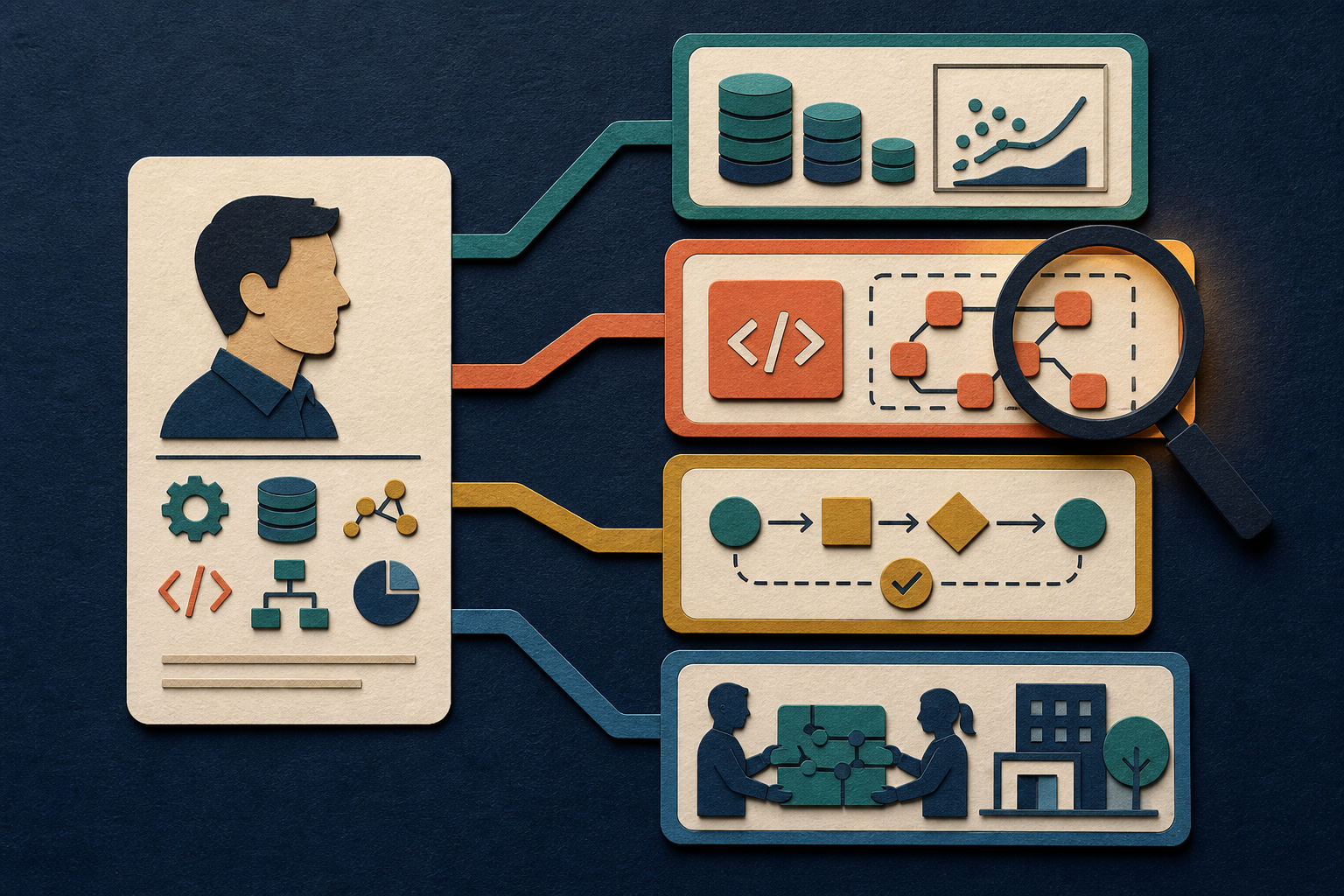
Model and data systems
This lane includes training or fine-tuning, data pipelines, inference, experimentation, model performance, and infrastructure. The bridge is strongest for machine-learning engineers, data engineers, platform engineers, quantitative specialists, and researchers who already understand the relevant technical substrate.
Evidence here should expose technical depth: data quality decisions, evaluation design, latency or cost tradeoffs, deployment constraints, and failure analysis. A thin API wrapper will rarely bridge a large gap into model systems work.
AI application engineering
This lane connects models to user-facing products. It includes retrieval, tool use, structured outputs, orchestration, observability, testing, and application behavior. Software engineers often have a natural base because reliable AI applications still need ordinary engineering: authentication, state, interfaces, logging, fallbacks, and deployment.
The bridge becomes credible when the artifact shows more than a model call. It should reveal how you handled uncertainty and integrated the system into a usable product.
Workflow and operations ownership
This lane applies AI inside support, recruiting, finance, legal, marketing, security, or another operating function. The core skill is not necessarily model development. It is understanding the workflow well enough to identify a useful boundary, define what the system may do, keep sensitive context controlled, and measure whether the change helps.
OpenAI's enterprise data is directionally relevant here because agent use is spreading across knowledge-work functions, not only engineering.[2] Still, vendor usage data should not be read as a hiring forecast. Use it to notice where responsibilities may be forming, then verify them in actual postings.
Forward-deployed and solutions work
This lane sits between product, engineering, and the customer's environment. The work may include discovering a use case, adapting a system to messy data, integrating tools, evaluating the result with users, and carrying lessons back into the product. Solutions engineers, implementation consultants, technical account managers, product-minded engineers, and domain specialists may already own parts of this loop.
The strongest evidence combines technical execution with field judgment. Show how you translated an ambiguous operating problem into a bounded system and how user feedback changed the implementation.
Do not pick the lane with the most impressive title. Pick the one where your current experience reduces the number of unproven assumptions a hiring manager must make.
Use the BRIDGE framework to design the transition
A useful career bridge has six parts: Base, Responsibility, Inspectable artifact, Decision, Guardrail, and Evidence of use. Each part answers a question a skeptical reviewer is likely to ask.

Base: what do you understand before AI enters the story?
Your base may be a technical system, industry, user group, or operating process. Examples include incident response, revenue analytics, healthcare scheduling, support operations, developer tooling, fraud review, or contract intake.
Domain knowledge is not decorative background. It helps you recognize bad assumptions, select representative cases, and define correctness. A support lead knows which ticket categories are ambiguous. A data engineer knows when a source is stale. A security analyst knows why an apparently useful action needs approval.
Write the base in one sentence: "I understand how this work enters the system, who uses the result, and which failures matter." If you cannot yet name those things, your first step is workflow discovery rather than tool selection.
Responsibility: what new AI decision can you own?
Choose one responsibility adjacent to the base. It might be retrieval quality, evaluation, classification, tool permissions, human review, prompt and context design, monitoring, or adoption.
"Learn AI" is not a responsibility. "Design and evaluate source-grounded answers for support specialists" is. The narrower wording tells you what to build and what evidence counts.
This is also where candidates avoid a common pivot mistake: trying to prove architecture, data science, product strategy, and production operations in the same first project. One deeply defended responsibility creates a stronger signal than five shallow claims.
Inspectable artifact: what can another person examine?
An artifact turns interest into evidence. Depending on the lane, it could be:
- a small working system with a clear README;
- an evaluation set and failure analysis;
- a workflow map with an approval boundary;
- a source and data-quality audit;
- an implementation PR with tests and design notes;
- or a case study documenting discovery, decisions, limitations, and user feedback.
The artifact should let a reviewer inspect your contribution without trusting the demo at face value. A screen recording can show that the system ran. The repository, evaluation notes, and decision log show why the result deserved trust.
Decision: where did you supply judgment?
AI projects become career evidence when they make human decisions visible. Explain why you selected a retrieval approach, rejected a fully autonomous action, split an evaluation category, changed a schema, or narrowed the use case.
A strong case study includes at least one alternative you considered and one result that changed your plan. Otherwise the project can read like a tutorial you followed rather than a problem you owned.
Guardrail: what kept the claim and system honest?
Name the boundary. The system may draft but not send. It may search approved sources but not the open web. It may classify ordinary cases but route ambiguous ones to a person. It may propose code but require tests and review before merge.
Guardrails show that you understand consequence. They also prevent portfolio theater, where the demo appears autonomous only because the hard cases and real risks were removed from view.
Evidence of use: what happened when someone interacted with it?
Use evidence can be modest. A domain practitioner tested ten scenarios. Two colleagues completed the workflow without you driving. A reviewer found three failure categories. A small team adopted the draft step while keeping final approval manual.
Do not inflate a pilot into production experience. State the scale, participants, and limits. A small honest test produces better interview material than an unsupported claim that a prototype "transformed" a workflow.
Three transitions built as bridges
The framework becomes clearer when applied to candidates who are not starting from the same place.
Backend engineer to AI application engineer
The weak pivot begins with a generic retrieval chatbot and a new headline. The stronger bridge begins with an operating problem the engineer understands: incident responders lose time locating the right runbook during an alert.
The candidate builds a source-grounded incident assistant over a small set of versioned runbooks. The inspectable artifact includes retrieval tests, refusal behavior when sources conflict, latency notes, and logs that preserve citations. The candidate decides that the system may propose a runbook but may not execute remediation. An experienced engineer reviews the failure set and finds that similarly named services cause false matches, leading to a metadata filter.
The resulting claim is specific: backend engineering plus retrieval, evaluation, and safe integration for incident response. The candidate has not proven production ML infrastructure depth. They have made one application-engineering bridge defensible.
Recruiter to AI workflow owner
The weak pivot lists prompt engineering and several chat products. The stronger bridge focuses on a known bottleneck: intake notes arrive in inconsistent formats, making it harder to compare role requirements.
The candidate creates a workflow that extracts a draft set of responsibilities, knockout constraints, and open questions from approved intake documents. It never ranks candidates. The artifact includes a schema, examples, a review checklist, and an analysis of where the extraction misses implied seniority. Three recruiters test it and revise the schema so uncertain requirements remain explicitly unresolved.
This is credible AI operations evidence because the candidate owns the workflow, the sensitive boundary, and the quality definition. They do not need to claim to be a model engineer.
Financial analyst to AI solutions or data role
The weak pivot is a market-news summarizer. The stronger bridge starts with variance analysis, where analysts already know which comparisons, periods, and accounting definitions matter.
The candidate builds a source-bounded assistant that drafts explanations from approved reporting tables and links every numerical statement to a cell or query result. The artifact includes adversarial cases for mismatched periods and missing values. The candidate rejects automatic narrative publication and requires analyst approval. A finance colleague tests the workflow and exposes a materiality threshold that was missing from the first design.
The career story connects finance judgment, structured data, grounding, evaluation, and stakeholder use. That combination can support an AI-enabled analytics, solutions, or workflow role without erasing the candidate's domain advantage.
Build a portfolio that a hiring team can audit
One bridge project needs enough context to be understood quickly and enough depth to survive scrutiny. Organize the case study around six questions:
- What real workflow did you study?
- Which user and decision did you serve?
- What was the system allowed to do?
- How did you define and test acceptable behavior?
- What failed, and what changed because of it?
- What did another person actually use or review?

Include the minimum artifacts that answer those questions. A concise repository might contain a workflow description, architecture note, representative cases, evaluation summary, known limitations, and operator instructions. If the underlying work is confidential, create sanitized examples and describe the decision process without exposing private data.
Avoid five nearly identical demos. A project collection becomes stronger when each item proves a different responsibility or deepens the same lane. For example, one application project may prove source-grounding and evaluation, while a second shows permissions, monitoring, and user adoption. Random tool breadth creates noise.
This principle builds on the need to make an AI workflow survive a handoff and to show AI projects without sounding like you pressed a button. The transition-specific addition is continuity: a reviewer should be able to see why your prior experience made this particular project more credible.
Translate the same evidence into your resume
Your portfolio can show the full bridge. Your resume needs the compressed version: base, responsibility, decision, and outcome or use.
Weak:
Aspiring AI engineer skilled in Python, RAG, agents, and prompt engineering.
Stronger:
Backend engineer who built and evaluated source-grounded incident triage, adding conflict detection and approval boundaries for runbook recommendations.
Weak:
Leveraged AI to automate recruiting workflows.
Stronger:
Designed a recruiter-reviewed intake workflow that extracted role constraints into a structured schema, preserved unresolved requirements, and excluded candidate ranking.
Weak:
Developed an AI financial analysis tool that increased efficiency.
Stronger:
Built a source-linked variance narrative prototype over approved reporting tables, tested period and missing-data failures, and required analyst review before use.
Notice what the stronger bullets refuse to do. They neither borrow a target title as proof nor lead with a vendor, and they avoid invented productivity metrics. Instead, they expose the work, boundary, and judgment.
Your summary can make the bridge explicit without announcing a total reinvention:
Backend engineer with six years in reliability and incident tooling, now applying that operating depth to retrieval, evaluation, and approval-aware AI applications.
Tailor the emphasis by role while keeping the facts fixed. A platform role may prioritize observability and access controls. An applied AI role may prioritize evaluation and retrieval. A forward-deployed role may prioritize discovery, integration, and user feedback. CoreCV's role-targeted resume workflow can fine-tune a structured base resume against a pasted job description or job URL. The tool can help select and reshape evidence, but you remain responsible for the truth and scope of every claim.
Use the AI job-description classification guide to identify which lane a posting actually describes, then run a skills-gap analysis before adding another course to your plan.
Make the bridge defensible in an interview
A title-first pivot tends to collapse under follow-up because the candidate must defend a broad identity. A responsibility-first bridge gives the interviewer something concrete to examine.
Use a five-part answer:
- Continuity: "I already understood incident response and runbook ownership."
- New responsibility: "I wanted to own retrieval quality and escalation behavior."
- Artifact: "I built a source-grounded assistant and a reviewed scenario set."
- Learning: "Similar service names caused incorrect matches, so I added metadata filtering and conflict refusal."
- Boundary: "I have application and evaluation evidence, not production model-training experience."
That final boundary increases credibility. It tells the interviewer where you can contribute now and what you still need to learn.
Prepare for questions about the evidence rather than rehearsing a speech about enthusiasm:
- Why was this workflow worth changing?
- Who defined correctness?
- Which cases were missing from the first evaluation?
- What could the system read or change?
- When did a human have to intervene?
- What did user feedback invalidate?
- Which part could you operate independently tomorrow?
- Which part would still need specialist review?
The goal is not to sound flawless. It is to demonstrate that you can learn in contact with reality, revise a system, and state the limits of your experience.
A two-week bridge sprint
You do not need to complete a career transformation in fourteen days. You can, however, replace a vague intention with one reviewable bridge.
Days 1 and 2: collect role evidence. Read ten to fifteen relevant postings. Ignore title variation and extract recurring responsibilities, inputs, outputs, constraints, and collaborators. Group them into the four lanes.
Day 3: choose the narrow responsibility. Select one responsibility that appears in target postings and connects to a workflow you understand. Write down what you can already defend and what remains new.
Days 4 and 5: design the artifact and evaluation. Define the user, task boundary, representative cases, acceptance criteria, and prohibited actions before building. Keep the scope small enough to inspect.
Days 6 through 9: build and keep a decision log. Record alternatives, failures, and changed assumptions. Do not hide tool assistance. Preserve the decisions that show your judgment.
Days 10 and 11: invite domain review. Ask one or two relevant practitioners to use the artifact or review the cases. Give them a specific question, such as "Which failure would prevent you from trusting this draft?"
Day 12: revise the system and claim. Fix the most consequential issue. State what remains unresolved. Remove any claim the evidence cannot support.
Day 13: package the portfolio case. Create a short reading path through the problem, boundary, artifact, evaluation, failure, revision, and evidence of use.
Day 14: update one resume version and interview story. Select the proof that matches the target role. Keep the base resume truthful and make the bridge legible.
At the end, you may not have a new title. You will have something more useful: a specific responsibility you can discuss with evidence.
A bridge strategy cannot solve unequal access
Career advice can become dishonest when it turns structural barriers into individual homework. Access to compute, mentors, production systems, respected employers, and time for unpaid projects is uneven. Hiring networks and credential filters can restrict who gets to accumulate visible AI experience. A portfolio framework cannot repair those conditions.
The recruiter experiment found that AI skills sometimes offset conventional screening disadvantages, but the effects varied by occupation and evaluator.[3] That is encouraging evidence about signaling in a controlled setting, not a guarantee in a live market. LinkedIn's platform data likewise reflects the behavior and profiles visible on LinkedIn, not the entire labor market.[1]
Work with the access you have without pretending the playing field is level. An internal workflow improvement may be stronger evidence than an unpaid public demo. A sanitized case study may be the right artifact when code cannot be shared. A volunteer project should have a real user and boundary, not merely exchange free labor for a logo. A small peer review can still prove that somebody other than you examined the work.
Employers also have responsibility. If they want AI-ready candidates, they should define the work behind the title, assess adjacent capability, create supervised pathways, and stop treating prior possession of an identical title as the only proof of potential.
Keep your identity. Add a credible responsibility.
The AI hiring boom creates opportunity, but it also creates pressure to perform a premature identity change. Resist it. Your previous work is not baggage to hide under a list of models. It is often the source of the judgment that makes an AI system useful.
Start from work you understand, then take ownership of one nearby AI problem. Make the result inspectable, show where your judgment changed the approach, and let another person test it. Carry those facts consistently into your portfolio, resume, and interview.
The strongest AI career pivot does not erase your previous work. It makes one new responsibility credible because of what you already know.
For a practical research breakdown like this each week, follow the AI Career Signals archive for guidance on AI-shifting resumes, portfolios, interviews, and job searches.
Disclosure: This article is authored by the CoreCV team. While we mention CoreCV.ai, the strategies and advice presented here are intended to be useful whether or not you use our product.
Sources
- LinkedIn Economic Graph, U.S. Software Engineer Talent Landscape: https://economicgraph.linkedin.com/content/dam/me/economicgraph/en-us/PDF/us-software-engineer-talent-landscape-2026.pdf
- OpenAI, From assistance to execution: How enterprises put AI to work: https://openai.com/index/how-enterprises-put-ai-to-work/
- Fabian Stephany, Ole Teutloff, and Angelo Leone, AI Skills Improve Job Prospects: Causal Evidence from a Hiring Experiment: https://arxiv.org/abs/2601.13286