The Best AI Candidates Know What Context to Add - and What to Leave Out
A lot of candidates still describe AI work as if the achievement were sheer prompt volume: more docs, more context, more system instructions, more connected tools. As agents move into longer, cross-functional work, the stronger signal is almost the opposite. Good candidates can tell what the model already knows, add only the missing or current context, block the wrong default path early, and keep the workflow trustworthy once it starts moving.[1][2][3]
That shift matters because the work changed. OpenAI says agents are becoming the primary AI tool across departments and are increasingly used for work that stretches well beyond a quick chat turn.[1] Anthropic's latest Economic Index report points in the same direction: usage is moving toward longer-running agentic tasks, not only one-shot assistant help.[7] Once a workflow runs longer, touches more systems, and starts carrying real business or user consequences, "we added more context" stops sounding impressive. It starts sounding like someone never learned to separate relevant context from noise.
Context volume is not the same thing as context quality
Microsoft's recent guidance says the quiet part plainly: if your skill or prompt keeps returning documentation the model already knows, you are not helping. You are burning context budget and crowding out the material the workflow actually needs: live workspace state, recent tool output, current version details, private rules, and environment-specific constraints.[2]
That is a much better hiring test than "Do you use AI?" Plenty of people use AI now. Fewer can explain why the right move was less context, not more. The weak version of the story is still volume: we added all our docs, built one giant skill, and gave the model everything so it could figure it out. The stronger version is diagnosis: we measured the baseline, found the exact place the model failed, added only the missing current context, and removed repetitive material that crowded out more important signals. That difference matters because it reveals judgment. The first story is about loading material. The second is about choosing what belongs in context and refusing to waste space on what the model already handles well.
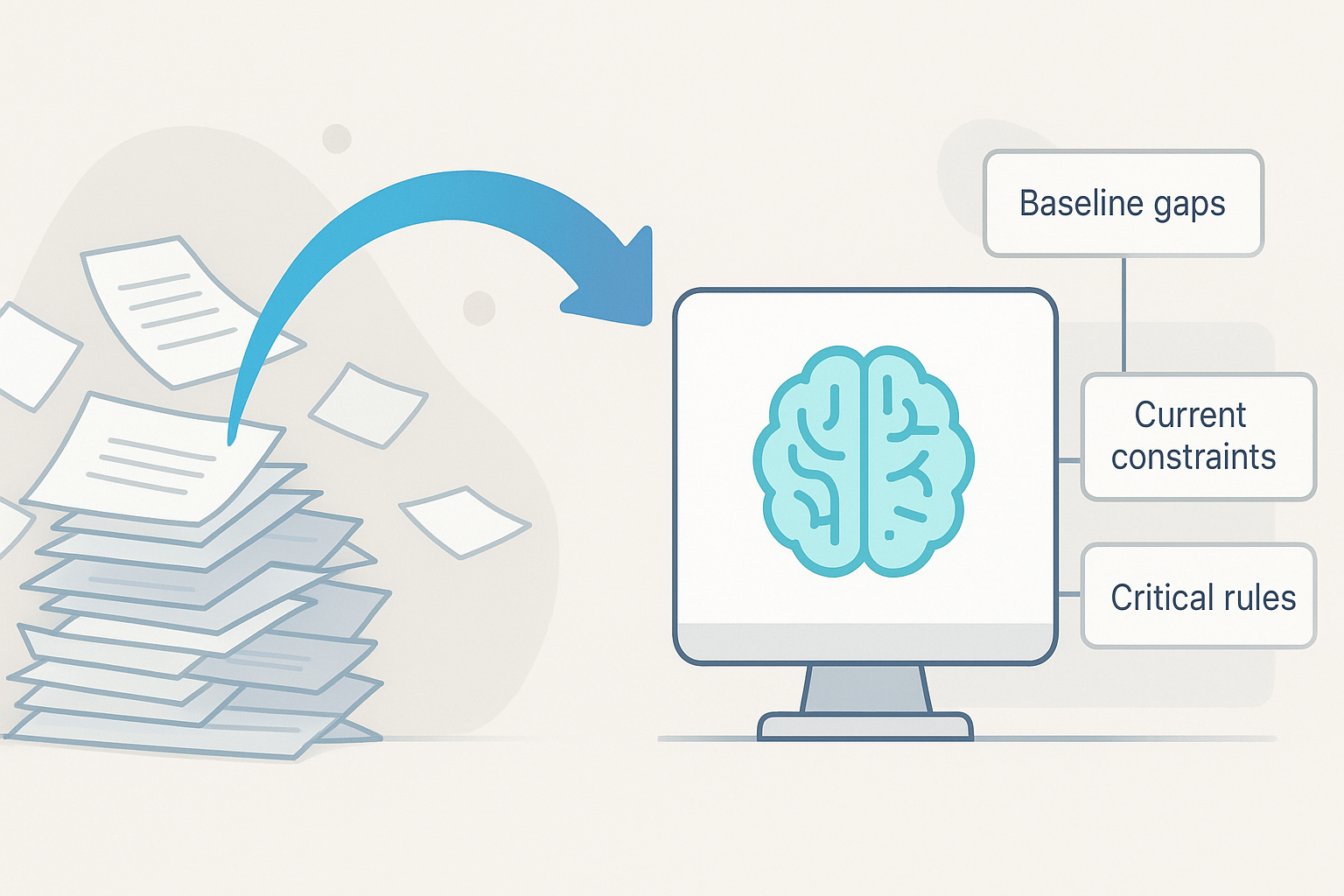 Stronger AI work is usually more selective, not more expansive.
The model already has a plan before your docs arrive
This is the second part many candidates still miss. Microsoft argues that an agent often forms its plan before it reads your documentation at all.[3] That means a helpful tip can lose to a confident wrong default.
So the job is not always to describe the right approach more clearly. Sometimes the job is to invalidate the likely wrong one before the workflow runs too far on stale assumptions.
That is a subtle difference, but it is a career-relevant one. Strong candidates can usually explain what the model handled correctly without intervention, what wrong default it kept choosing, which current rule or local fact changed the answer, and how they stopped the workflow from repeating the same mistake. If you can explain that move, you sound much more credible than someone who says they "improved the prompt." Hiring teams hear a lot of vague AI language. They hear much less from candidates who can talk about planning failure, context gaps, and correction logic in plain English.
Selective context design is the scarce skill
The practical loop is not complicated, but it is disciplined.
1. Measure what the model already knows
Microsoft's first point is the most important one: you do not know what context is needed until you have a baseline.[2]
If the model already handles the common API flow, the default auth path, or ordinary CRUD work correctly, do not spend precious context budget restating it. Save that space for the breaking change from last month, the internal exception rule, the environment-specific constraint, or the policy language the model could not have learned reliably from public training data.
This is where stronger resume language begins. Instead of "used AI to help with internal ops," the more credible line sounds like this:
Measured baseline agent performance on internal ops scenarios, then added only the current policy and environment-specific context needed to close recurring failure cases.
That sounds different because it signals experimentation, scope control, and judgment instead of generic tool enthusiasm.
2. Add only the missing or current context
The best context is usually not broad. It is specific.
Maybe the workflow needs the current vendor API version. Maybe it needs the internal runbook that changed last week. Maybe it needs the escalation threshold for a compliance exception. Maybe it needs a short list of policy edge cases the public docs never covered.
The key is that the added context changes the outcome because it is missing, not because it happens to be available somewhere.
This idea travels well beyond engineering. OpenAI says agents are becoming a primary work tool for legal, finance, recruiting, and other departments too.[1] In those workflows, the gap is often not "how do I write code." It is "what does our team actually consider correct right now?"
3. Block the likely wrong plan
If the model tends to choose the wrong first move, the fix may need to be explicit.
Microsoft's planning piece makes the point sharply: if the agent has already settled on a bad approach, documentation that merely suggests an alternative may not change anything.[3] But instructions that make the default move explicitly invalid can force a re-plan.
That is a powerful interview detail because it shows you were not only feeding context into the system. You were reasoning about how the system would misuse it.
A candidate who says, "We noticed the agent kept choosing the old upgrade path, so we explicitly invalidated that approach and pointed it to the current tool chain," sounds much stronger than one who says, "We clarified the docs." The first person sounds like they were steering the workflow. The second sounds like they were watching it.
Private context is becoming part of the signal too
Some of the highest-value context is not public at all.
OpenAI's Secure MCP Tunnel post is useful here because it makes a broader point visible: the MCP servers teams care about most often live inside private networks, local machines, service meshes, or enterprise environments that are supposed to reject public access.[4] OpenAI's Codex Remote guidance points to the same operating reality from the engineering side: high-value agentic work often depends on controlled access to real repositories, tools, and environment state rather than a generic prompt sitting in isolation.[6] Better AI work increasingly depends on secure context plumbing, not just clever wording.
This matters for job seekers because a lot of real AI-assisted work happens in exactly those settings: internal tools, private ticketing systems, regulated data flows, policy databases, current runbooks, and local repos with live environment state. The stronger signal is not "I connected the agent to everything." It is "I connected the right private systems narrowly, kept the private boundary intact, and exposed only what the workflow actually needed."[4]
That is the kind of detail that makes an internal tooling or compliance-support project sound real instead of demo-like. It also makes the candidate sound safer. Bounded access is increasingly part of the accomplishment, not a side note.
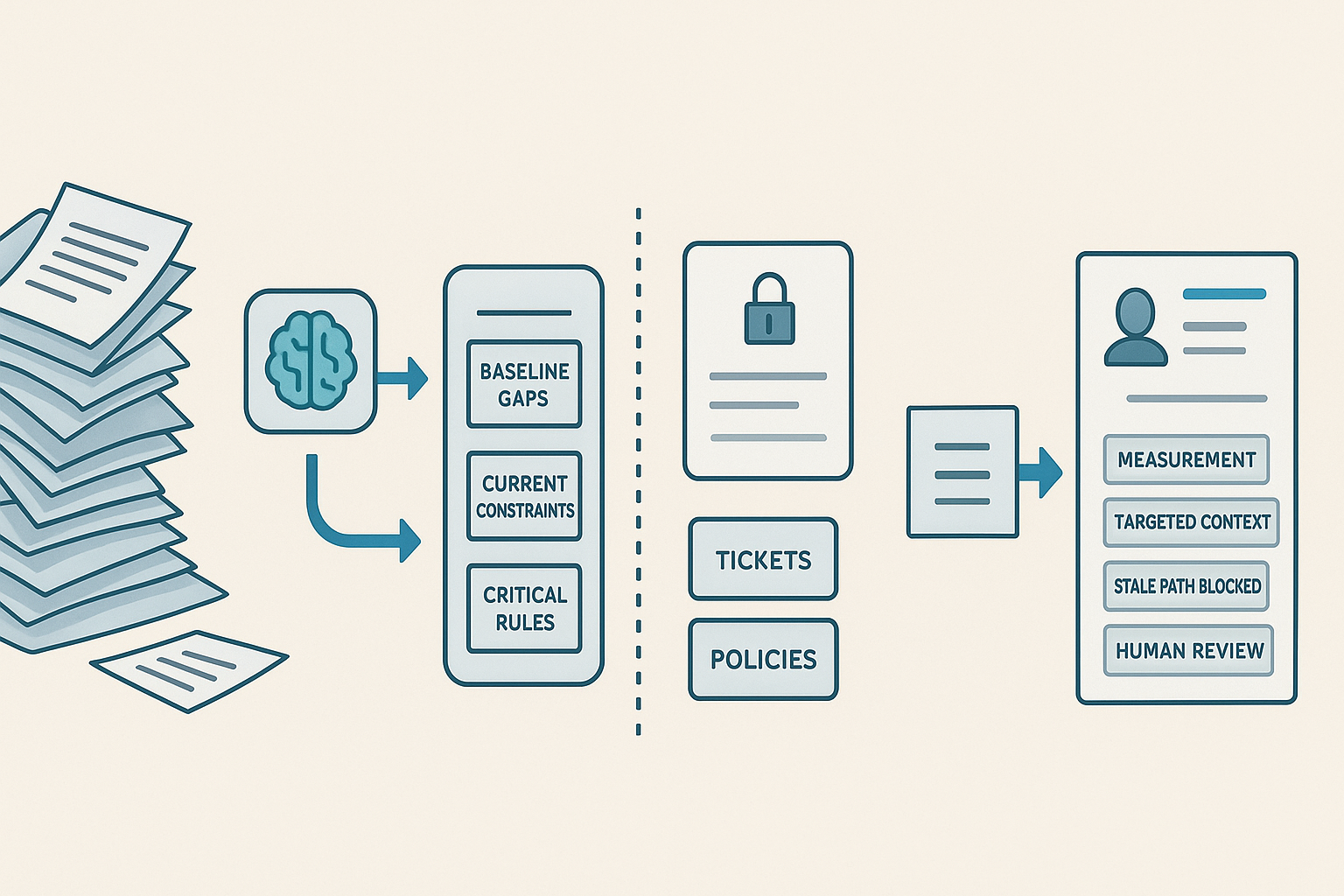 Private context becomes a stronger signal when the boundary is explicit and intentionally narrow.
If your work already lives in that internal-tools world, this pairs well with How to Position Internal Tools, Automations, and Dev Productivity Work as Career-Making Impact and Agentic Coding Is Raising the Value of Domain Expertise.
Better context still does not remove the need for checks
This is where the Hugging Face release pipeline is such a useful example. Their process uses AI to draft release notes and announcements, but the durable pattern is not "the model wrote it, so ship it." The durable pattern is: model draft, deterministic validation against a manifest, iterative repair if anything is missing or extra, then human review before final release.[5]
That should sound familiar because it is the same professional move in a different setting. Good context improves the draft. It does not remove the need for verification.
So the strongest AI story is rarely:
We gave the model enough context and it handled the workflow.
It is more often:
We gave the model the minimum context needed to improve the draft, then wrapped that draft in deterministic checks and human review before anything consequential shipped.
That language makes you sound trustworthy because it shows you understand the limits of even well-grounded outputs. A workflow that still needs checks does not sound weaker. It sounds like it was built by an adult.
The rewrite candidates should make this week
Take a technical operations or compliance-support workflow. The weak version sounds like this:
Built an agent to help review compliance tickets and added our documentation.
The stronger version sounds like this:
Measured baseline failure cases on compliance ticket triage, added only current policy exceptions and internal system context the model lacked, explicitly blocked an outdated remediation path it kept proposing, and required rule-based checks plus human review before recommendations reached operators.
The stronger version makes the judgment visible: there was baseline measurement, selective context instead of bulk context, a wrong default that had to be blocked, private internal context handled deliberately, and deterministic review before trust. That is the real accomplishment. The agent is part of the story, but the judgment is the point.
If you already have one real workflow like that and need help tailoring how much of the detail to surface for different roles, CoreCV's resume builder is useful for keeping a stable base resume while shifting emphasis for engineering, platform, operations, product, or compliance-adjacent roles against a job description or job URL.
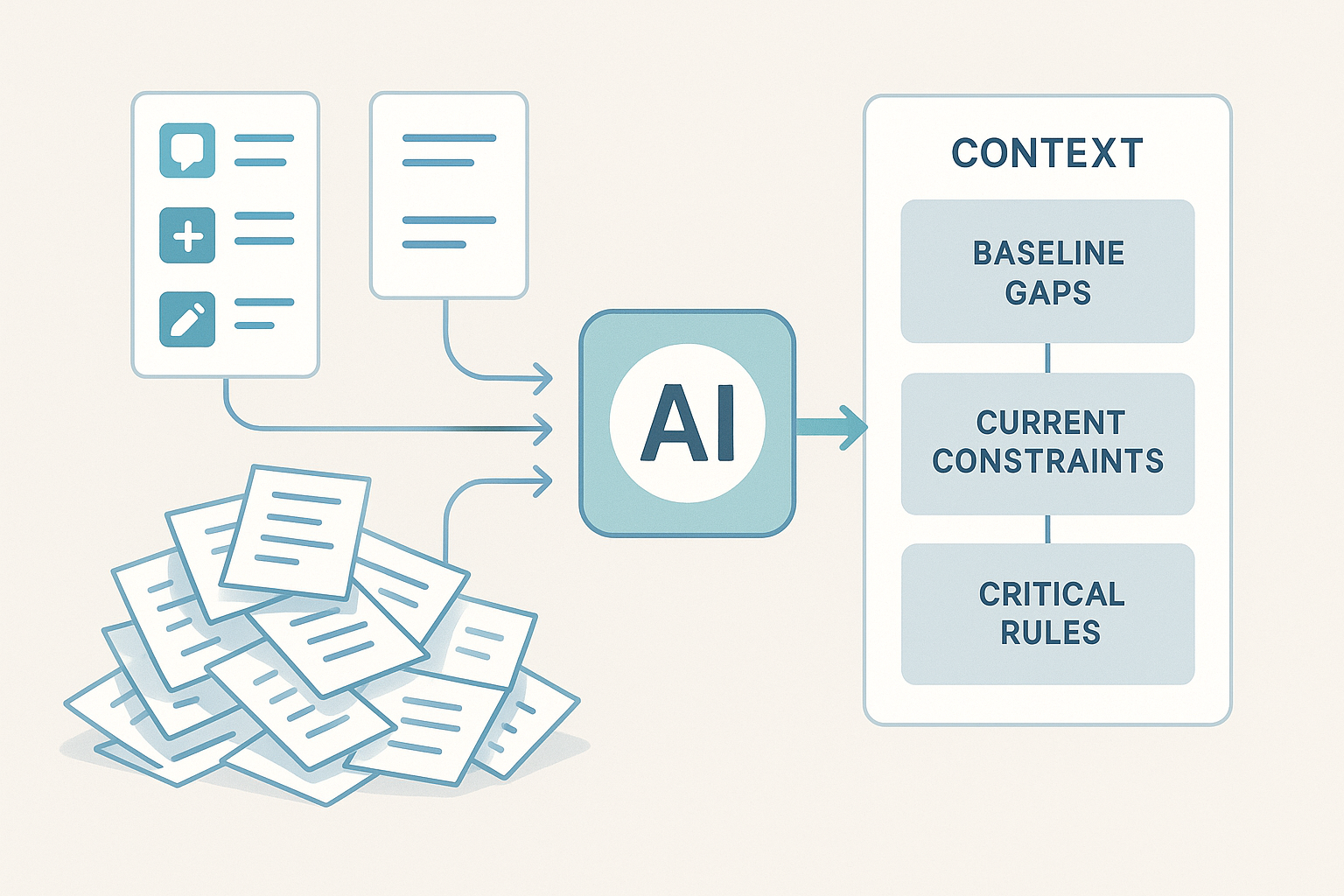 The stronger bullet is not longer because it uses more buzzwords. It is stronger because it shows judgment.
How to show it on a resume, in a portfolio, and in interviews
Your resume does not need to explain the whole architecture. It needs to make your context judgment legible. A portfolio case study has room to show the control logic more explicitly: what the model could already do, what it got wrong, what current or private context you added, what wrong default you had to block, and what checks stayed in place. Interview answers should sound plain rather than theatrical. "The useful part was not adding more docs. We first measured what the model already handled, then added only the current and private context it was missing. We also had to block a default path from older assumptions, and we kept deterministic checks plus human review around anything sensitive." That answer works because it sounds like someone who understands workflow design, not someone who is impressed by bigger prompts.
For broader framing on AI project language, The Right Way to List AI-Assisted Projects Without Sounding Like You Pressed a Button is the right companion. It also helps distinguish this piece from the earlier entries in the same series. Grounded and Measurable AI Work Is Becoming a Hiring Signal covers the wider measurement pattern. The Best AI Candidates Know When to Stop and Ask covers pause points and escalation. This piece is about the context choices upstream of both.
Take one AI bullet, one project summary, or one interview story and pressure-test it with five questions:
- What did the model already do correctly before you added anything?
- What missing context was actually current, local, or private?
- What likely wrong plan did you have to block?
- What internal tool or data source needed bounded access?
- What deterministic check or human review still sat around the output?
If your current wording cannot answer those clearly, the signal is still too generic.
The bigger point
As agents spread into broader and longer work, generic prompting gets cheaper. Dumping more documentation into context gets easier. Neither stands out for long.
What stands out is selective context design: knowing what the model already knows, what it does not, which wrong path it is likely to choose, what private systems should stay private, and what still has to be verified by code or by people.
That is a much stronger hiring signal because it is much easier to trust.
If you want more weekly breakdowns like this, follow the AI Career Signals archive for practical guidance on resumes, portfolios, interviews, and AI-assisted work.
Disclosure: This article is authored by the CoreCV team. While we mention CoreCV.ai, the strategies and advice presented here are intended to be useful whether or not you use our product.
Sources
- OpenAI, How agents are transforming work: https://openai.com/index/how-agents-are-transforming-work/
- Microsoft Developer Blog, Stop overloading your skills: https://developer.microsoft.com/blog/stop-overloading-your-skills
- Microsoft Developer Blog, Your agent already has a plan: https://developer.microsoft.com/blog/your-agent-already-has-a-plan
- OpenAI Developer Blog, Making private MCP servers reachable without making them public: https://developers.openai.com/blog/connect-private-mcp-servers-to-openai-products
- Hugging Face Blog, Shipping huggingface_hub every week with AI, open tools, and a human in the loop: https://huggingface.co/blog/huggingface-hub-release-ci
- OpenAI Developer Blog, Mastering Codex Remote for engineering: https://developers.openai.com/blog/mastering-codex-remote-for-engineering
- Anthropic, Anthropic Economic Index report: Cadences: https://www.anthropic.com/research/economic-index-june-2026-report